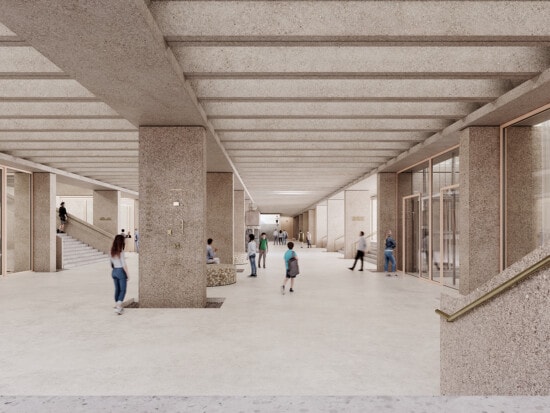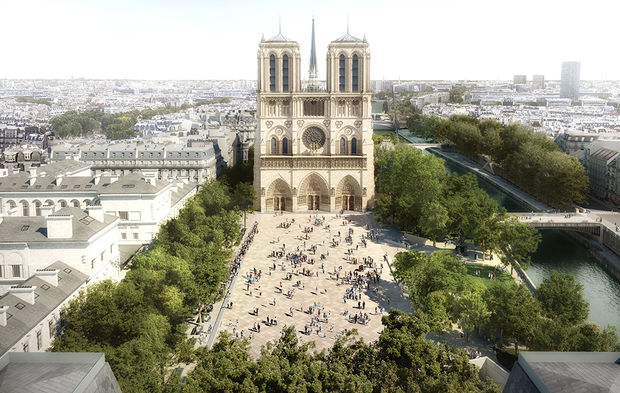
The landscape surrounding the iconic Place de Notre-Dame will be designed by the Belgian firm Bas Smets, in collaboration with the Parisian architects Grau and Neufville-Gayet. Their proposal transforms the forecourt into a clearing bordered by new planting. The project is not limited to the “visible world”; another invisible interior landscape continues underground. Linked to the Crypt and the Seine, it offers new routes to explore.
The tragedy of the 2019 fire has nevertheless had a silver lining. It has breathed new life into the redevelopment project for the area surrounding Notre-Dame, which had been initiated a few years earlier but had not come to fruition. The challenge today is not only to restore the building to its original state but also to create a dialogue between it and its wider context.
Both understated and monumental, the square naturally serves to showcase the main structure. Like an extension, the pattern of the stone paving the ground is identical to that inside the cathedral. Without limiting itself to this role of showcasing the building, the square also employs an ingenious system to address the challenges posed by global warming. In the event of intense heat, stored rainwater is released. It flows down the slight slope of the square, creating a cooling effect through evaporation. Water, a symbolic element in the face of fire, offers here a necessary and recreational climatic experience for its many visitors seeking a special sensation.
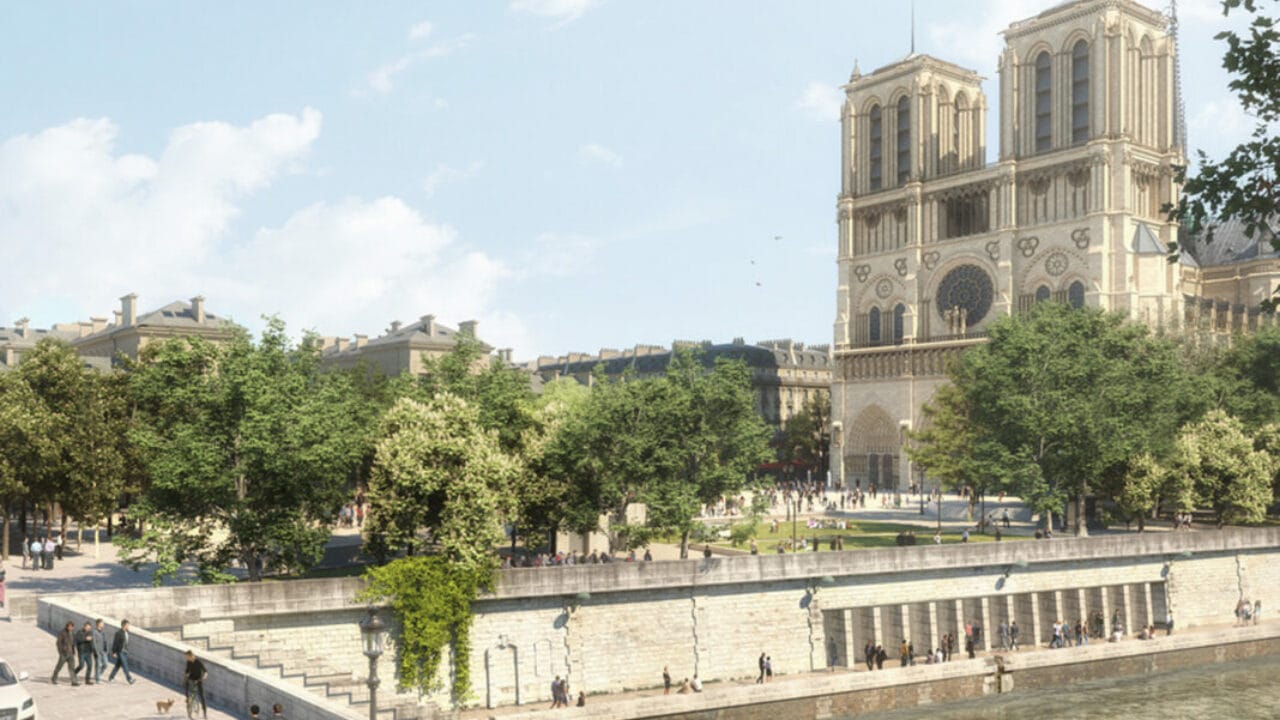
Like the three other projects presented, Bas Smets’ proposal offers a new entrance to the underground crypt, which also connects to the Quai Maurice Carême. One can reach it either via the grand staircases or the lifts. As a result, the quay becomes accessible to all. More delicate than those in the other proposals, the staircases are set amongst the vegetation, close by, yet set apart from the unchanging surface of the square.
The existing grid of the underground car park gives rhythm to what becomes a new internal pedestrian passageway. Its structure of pillars frames the view, opening out towards the Seine on one side and towards the Crypt on the other. This combination of concrete, stone and earth offers new possibilities for use. Among them, a café in the shade of the passageway brings a sense of proximity to the water. The quay’s retaining wall is pierced across the four central bays. This allows for a certain porosity whilst retaining its monolithic appearance with its large piers.
In the manner of a “landscape builder”, Bas Smets’s approach to design highlights the intertwining of the two disciplines. Landscape and architecture emerge from a shared reflection on the city and its resilience. Going far beyond a simplistic view of the role of vegetation in the city, the Bas Smets practice thinks in terms of ecosystems and sequences. It pays particular attention to each of the elements that make up the landscape. Ultimately, the decisions are very straightforward, hardly surprising, as they reflect a sensitivity to what is already there. The strength of the project lies in its ability to create a new vision in keeping with our times whilst respecting this iconic landscape.