
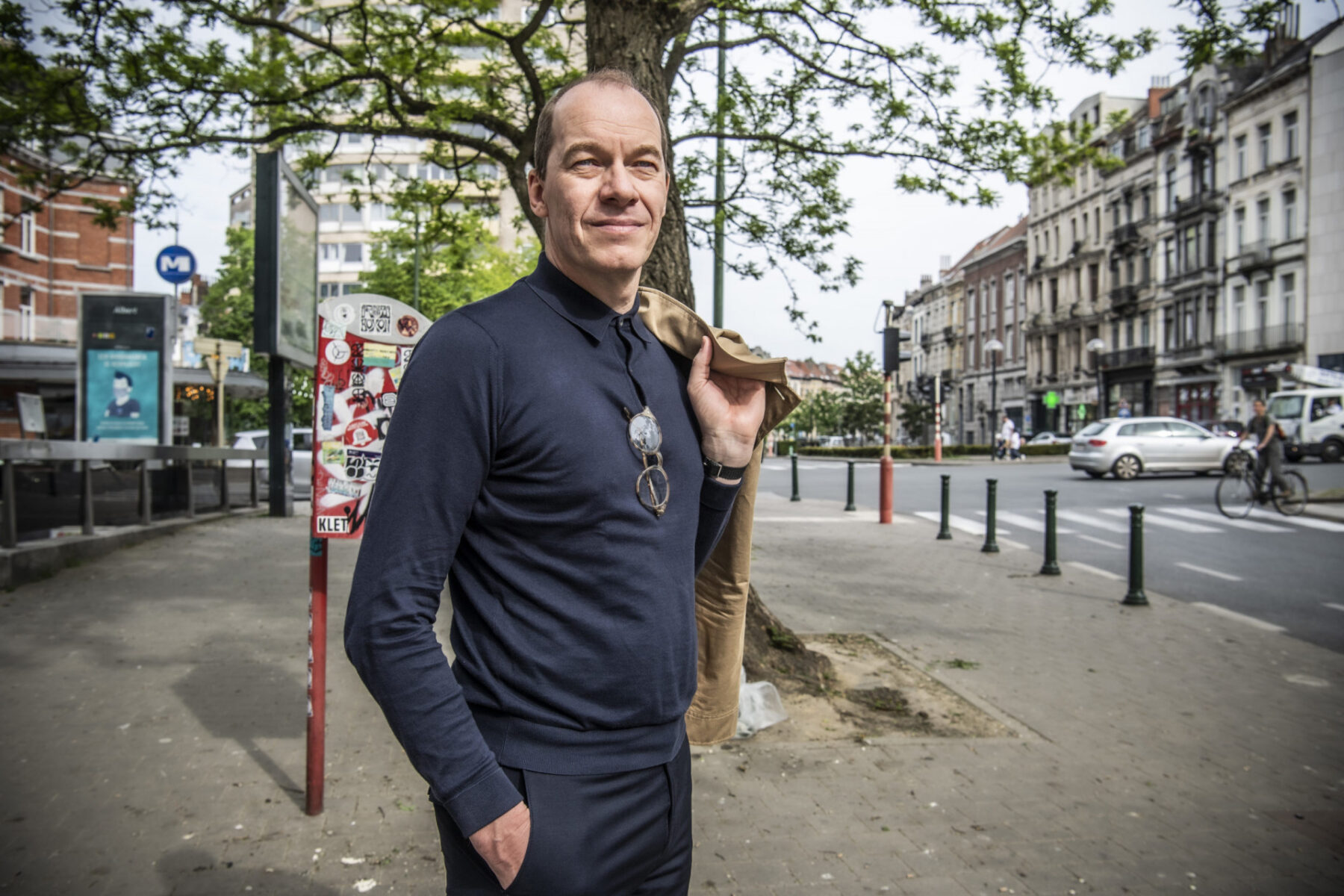
We had to wait a little while, but at the end of April the decision was made: Kristiaan Borret can begin a second term as Brussels Bouwmeester – Maître architecte. A fresh start, in the midst of the coronavirus crisis, a time when not only the city is being called into question, but also our way of life and our relationship with public space and the climate. We asked the new Bouwmeester how he plans to respond to this and probed his ambitions for the next five years.
“The honeymoon period is over straight away,” says Kristiaan Borret, “that’s the downside of a second term (laughs). The advantage, on the other hand, is that you can get started straight away with a team and partners you know, and continue to implement and realise the ambitions and outlines that were mapped out over the past five years. It makes sense that this second term should build on the first, and continue to build on the foundations laid previously.”
Lisa De Visscher – That continuity is only logical, but you’ve also set out a number of ambitions that clearly introduce new priorities. What are they?
Kristiaan Borret – When I speak of continuity, I do not mean the status quo. I am, of course, aiming for more! More good projects, new procedures, you name it. And that also includes expanding our ambitions. These are, of course, also in line with the new Brussels coalition agreement. For instance, I want to embrace the complexity of Brussels even more than before. I call this Multiplicity. This is also the narrative we need to develop abroad: the complex city as a mirror of society. Brussels is the most diverse city in Europe. The fascination that our capital holds for the rest of the world is partly based on this. It is not about the harmonious beauty of Brussels, about Art Nouveau or a picturesque historic centre. What constitutes the strength of Brussels is its exciting disharmony. And we must dare to promote this.
Another ambition concerns the paradigm shift within urban planning that I too wish to bring to fruition. I have referred to this as ‘from 10,000 to 2’. From 10,000 additional homes per year to a maximum of 2°C global warming. Such a slogan also immediately highlights the tension between, on the one hand, the continuing need for good housing due to past demographic growth in Brussels, and on the other hand, the need to take drastic action to make our city more climate-resilient. We will need to bring the densification frenzy in Brussels into better balance. In concrete terms, this means that I want to focus more on combating heat stress through greening, on people-friendly design of streets and squares, and on circular construction. And in this way, I am also responding indirectly to the current crisis. What has proved good for the climate has also proved good for the coronavirus crisis.
LDV On the other hand, this crisis is also being used as an argument against city living and in defence of housing developments. We have also noticed in recent weeks that public space in the city has come under pressure.
KB Indeed. And that brings us to the fourth ambition: developing a greater focus on public space. We already did this in 2019 with the booklet ‘Espace Publiek, 10 design tips for the ordinary street’, and now we are taking that further. We always want to focus on ordinary public space: the small neighbourhood park within walking distance, the green inner courtyard, the street redesigned in a different way, etc…
Today you also see many initiatives related to tactical urbanism: spaces that are set up on a temporary basis. I see it as my role as Bouwmeester to help ensure these projects are consolidated in the long term. That they are not merely part of a sort of ‘contingency plan’ but take on a permanent form.
A Bouwmeester in Brussels never initiates projects. The initiative always comes from a client or the government, and together with the team we can guide them in a certain direction. In the next term of office, thanks to the coalition agreement, we will be able to highlight the climate aspect with greater legitimacy. We do this across all our activities: advice, competitions, design research, planning applications and guidance.
The challenge for me now is how we can reconcile the ambition for more open space with demographic growth. We will, of course, still need to continue building homes and public facilities. At the moment, it is mainly middle-class homes that are being built for the private market, and the lowest income groups are missing out. There is a significant shortfall in the social housing market, and today there are 40,000 families on the waiting list. Those homes must be built, and they must be more robust than ever in terms of quality of life.
I believe my strength as Bouwmeester lies in my ability to translate a set level of ambition into tangible projects. I have already demonstrated this with the Canal Plan and the Productive City. I can ensure that a vision is realised. That is what I now want to do with climate-resilient urban development.
LDV You just mentioned the Canal Plan, which you tackled during your previous term of office. What projects are on the agenda for the new term?
KB Indeed, the Canal Plan is in place and is being implemented. Naturally, there is still a lot of work to be done, but the methodology exists and there are no more boundaries to push. That is why I want to address a new issue and put it on the agenda: the twentieth-century belt. In collaboration with Perspective, an exploratory study is currently underway on this, led in particular by Géry Leloutre (ULB), Michiel Dehaene (Ugent) and Paola Vigano, but also involving the Flemish Government Architect, as this area lies partly in Flanders. Once we have gained a better understanding of this 20th-century belt, we can identify key issues, conduct design research and set the agenda. We will then be able to identify where urban regeneration is needed, where opportunities for densification exist, which open spaces we must preserve, and how we can adapt accessibility. Not just from the centre, but also from one edge to the other. For example, you could also construct tangential cycle paths from, say, Jette to Anderlecht.
Food also plays a role. If you manage to get the fruit and vegetable growers working around Brussels to set up new market stalls in that area, then the 20th-century belt could become a place of new centrality on a metropolitan scale.
LDV A Bouwmeester uses a whole range of tools. Are new ones being added?
KB We’ve noticed that the competitions are becoming victims of their own success. Since 2015, far more entries have been submitted. That’s obviously a success, but clients are daunted by the sheer volume of submissions, and architects are put off by the low chance of being selected. We will therefore try to make both the application dossier lighter and the content of the tender itself less burdensome, more of a vision statement than detailed designs.
Furthermore, I would like to propose pools to assist with the design of public space. This will allow us to shorten procedures and speed up the process by having a group of designers on standby to be deployed for municipal projects.
This is, of course, part of my aim to both speed up the redevelopment of public space and ensure it is climate-focused. A research study on inner-city areas is due to start shortly, which will lead to a guiding framework, and I am also in favour of a roadmap for the public domain, following the example of the visual quality plan for the canal.
As well as fine-tuning existing tools, I also want to undertake a number of new initiatives in the area of governance.
LDV What exactly does this involve? What actions do you intend to link to this?
KB The city is not shaped solely by public institutions. There are many third parties who help shape the city; think of traditional residents’ associations or more recent action groups such as Picknick The Streets or Filtercaféfiltré. I regard them as professionals too and want to involve them more in the workings of BMA. During my first term, I was mainly focused on structuring everything internally – the team, the relationship with the administration and the public sector. Now that this is up and running, it’s time to seek advice externally, from civil society. I am already in regular contact with them behind the scenes anyway, so I think it is better to formalise this transparently
In this way, I want to open up, expose and allow the Bouwmeester’s operations to be guided in collaboration with various social actors, in the spirit of what John Keane calls ‘monitored democracy’: the idea that those in policy-making positions are willing to be monitored by civil society. This can be done in various ways. For example, there is a monitoring committee for the BMA as part of my contract. It would be good if external members were also included on that committee. The project meetings and quality committees, which currently consist solely of public sector representatives, could also evolve to include external members, just as is the case in, say, Ghent or Zurich.
We want to make competitions even more transparent than they already are. This can be achieved, for example, by making juries public. This has already happened in the past – all shareholders of the Brussels Beer Project were able to attend the judging of the competition – and is proving successful. I also believe it is important that the submitted designs and the jury’s decision are always published online. There will also be a charter for cooperation with the private sector, and an update to the current competition guidelines.
To ensure all this is properly coordinated, I now wish to organise a 360° consultation and ‘peer’ review as soon as possible. This means that an external consultancy will hold various discussions with the sub-groups of the professional sector with which the BMA collaborates, with the aim of gathering constructive feedback and formulating recommendations for future operations. My second term therefore begins with an open consultation, and this sets the tone for the approach through which I, as Bouwmeester, hope to realise my ambitions for urban quality even more effectively.
