
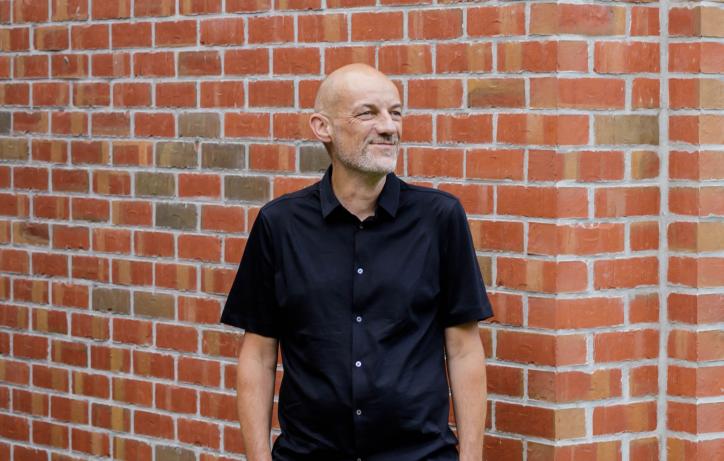
Last Friday, the Flemish Government announced the name of the new Bouwmeester. Erik Wieërs will take up the post on 17 August for the next five years. Erik Wieërs is an architect, philosopher, senior lecturer at the University of Antwerp and co-founder of the Antwerp-based firm Collectief Noord architecten. A+ spoke to him.
Lisa De Visscher – Congratulations on your appointment as Bouwmeester. What are your priorities for the next five years?
Erik Wieërs – First and foremost, I want to make the Flemish people more convinced of and familiar with collective housing models. In Flanders, many people live in housing estates, outside the city. Why? Because they are looking for greenery, space, but also a sense of community, a village-like quality. I am convinced that collective housing can also fulfil those needs. Many people are wary when they hear the word ‘collective’; they do not want to feel obliged to cooperate or share more than they are prepared to do. If you start from the principle of community spirit, you find that many people are more open to collectivity than they themselves realised. As long as the private sphere remains protected. The collective exists by virtue of the private.
Secondly, I want to open up the debate on what architectural quality actually entails to a wider public. Today, architectural quality is all too often confused with personal taste. Yet there are certainly a number of objective criteria that can be discussed. I want to engage in that discussion, even beyond the circle of architects.
LDV Over the past twenty years, various Bouwmeester have introduced new policy instruments to realise their ambitions. How do you intend to proceed?
EW A Bouwmeester and his team have two types of tools at their disposal: those that enable new projects, such as the Open Call, and those that are more focused on research and the development of new typologies, such as the pilot projects. At the moment, I don’t think there is a need for any additional tools. There is a team that has been functioning very well for twenty years, and I want first and foremost to discuss my vision with them and work with the building blocks that already exist.
LDV Last November, you wrote an opinion piece for A 280 Collective Housing on the value of collective living. You also want to make this one of your key priorities. How do you intend to approach this?
EW There are many good projects on collective living. That publication is proof of that. First and foremost, I want to showcase those good examples to a wider audience. Furthermore, there are certain Bouwmeester tools that lend themselves well to research into new housing models, such as pilot projects. I look forward to developing this further with the team.
