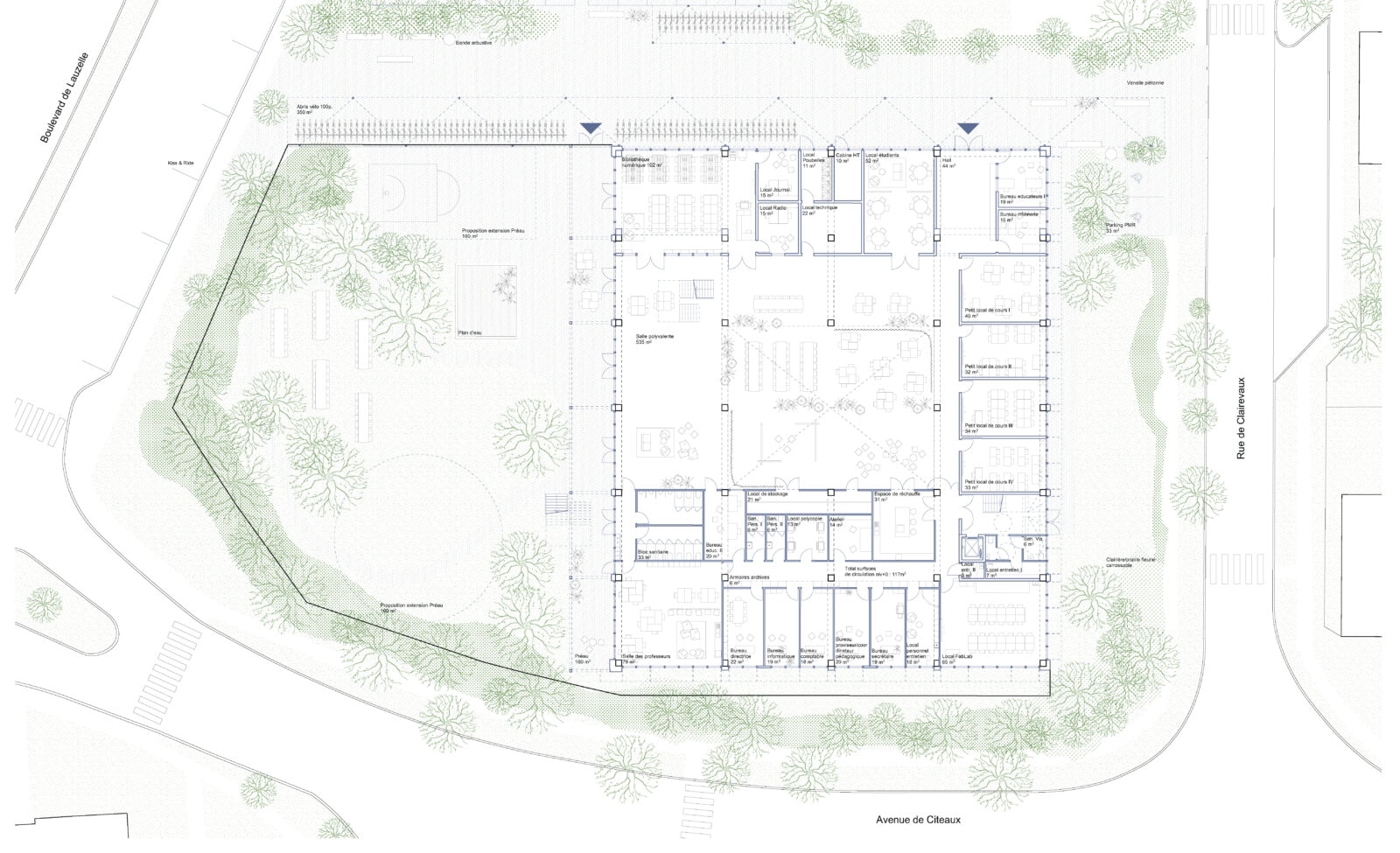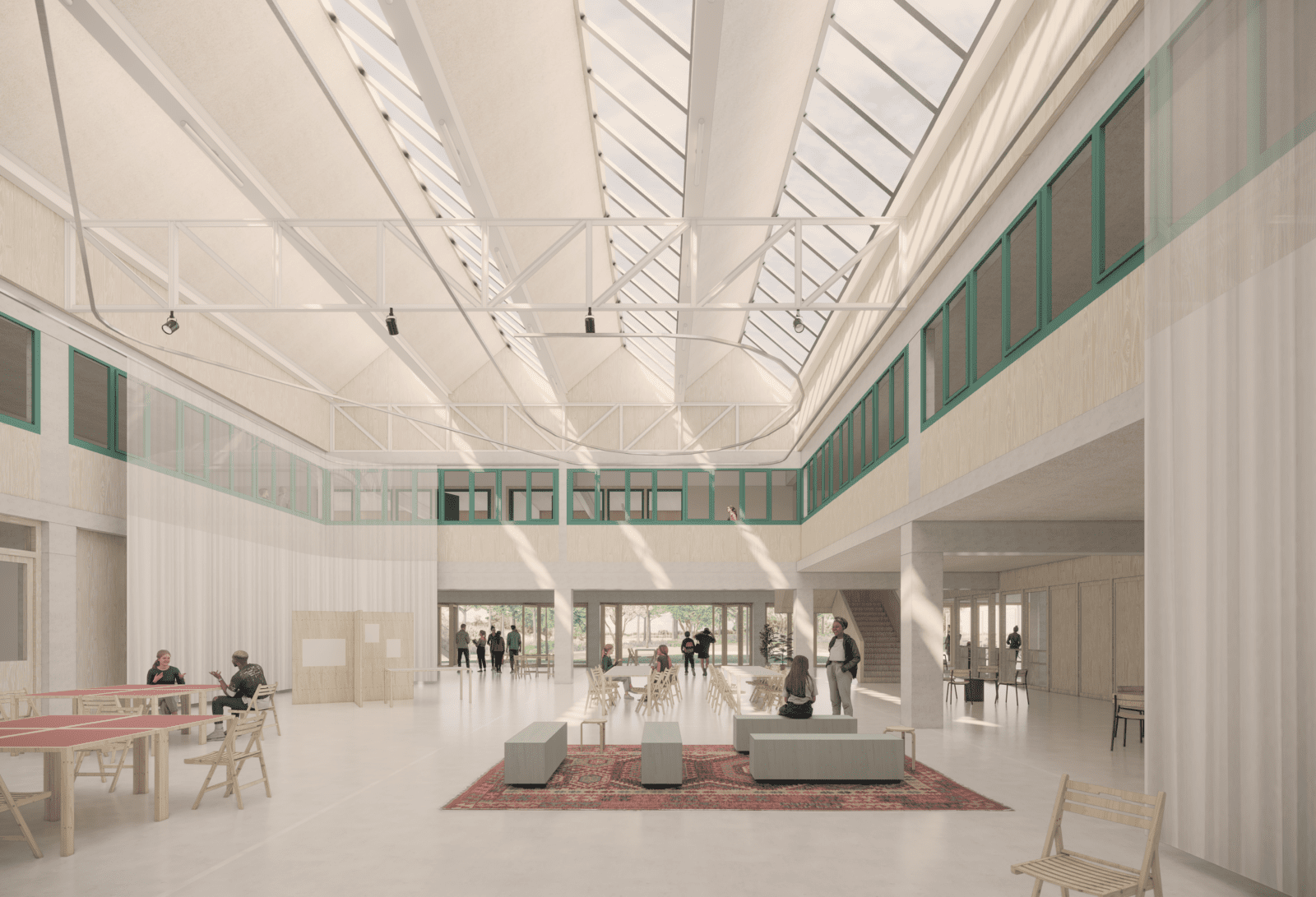
Within the orthogonal structure of a vacant office building, the team comprising Goffart Polomé Architectes and Czvek Rigby is designing a flexible secondary school with a variety of teaching spaces. Through the design, the team links the school’s interior to the green square surrounding it and successfully connects it to pedestrian routes and green spaces. The school complex will become a crucial link in the neighbourhood, which aims to transform itself into a liveable, ecological and safe environment.
The project was selected as the winner from four entries in a competition for the extension of the Athénée Royal Paul Delvaux, organised by the Cellule architecture. The current campus in Louvain-la-Neuve consists of several terraced houses and a detached building in a residential neighbourhood along Boulevard de Lauzelle, a major access road. There are also a few office buildings there, one of which became vacant. This provided the ideal opportunity to expand the campus. Situated on a spacious plot along the road, the site is visible and accessible to traffic. The creation of a kiss-and-ride zone reduces the amount of traffic entering the neighbourhood, making it safer.
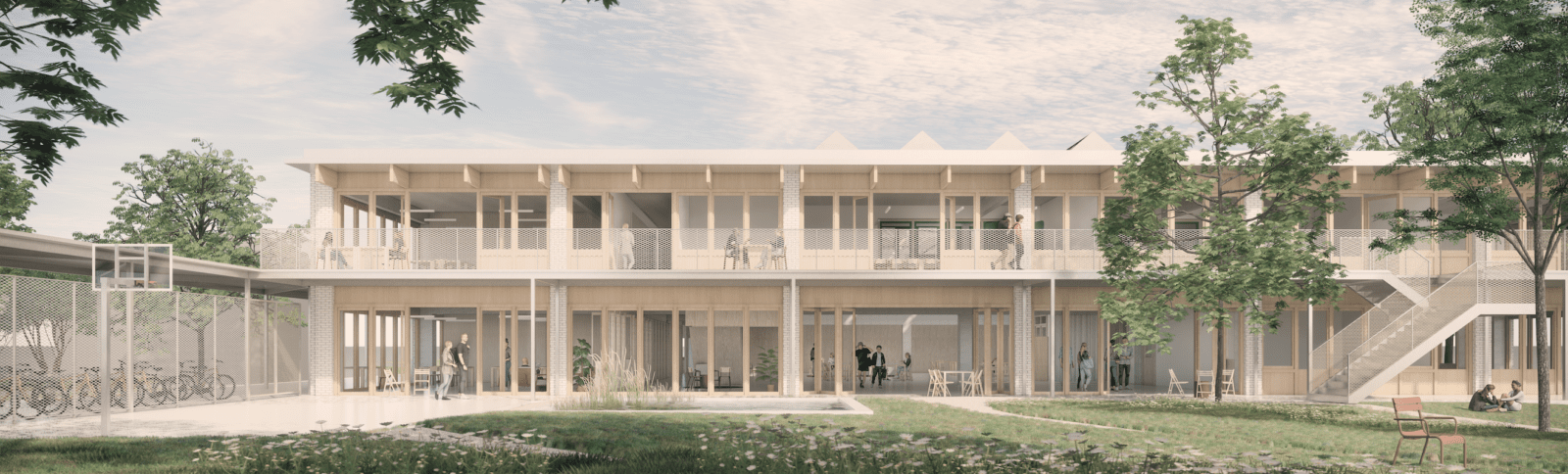
The new school acts as a gateway to the campus. From the car park, a footpath and cycle path leads to the other school buildings. It is flanked by a light canopy structure, which provides shelter for bicycle parking and protects two entrances, to the building and the playground. Another canopy has been installed between the building and the garden, featuring an external staircase. It serves both as a covered outdoor space adjacent to the playground and as a direct link to the classrooms above. On both floors, the structure functions as an outdoor classroom.
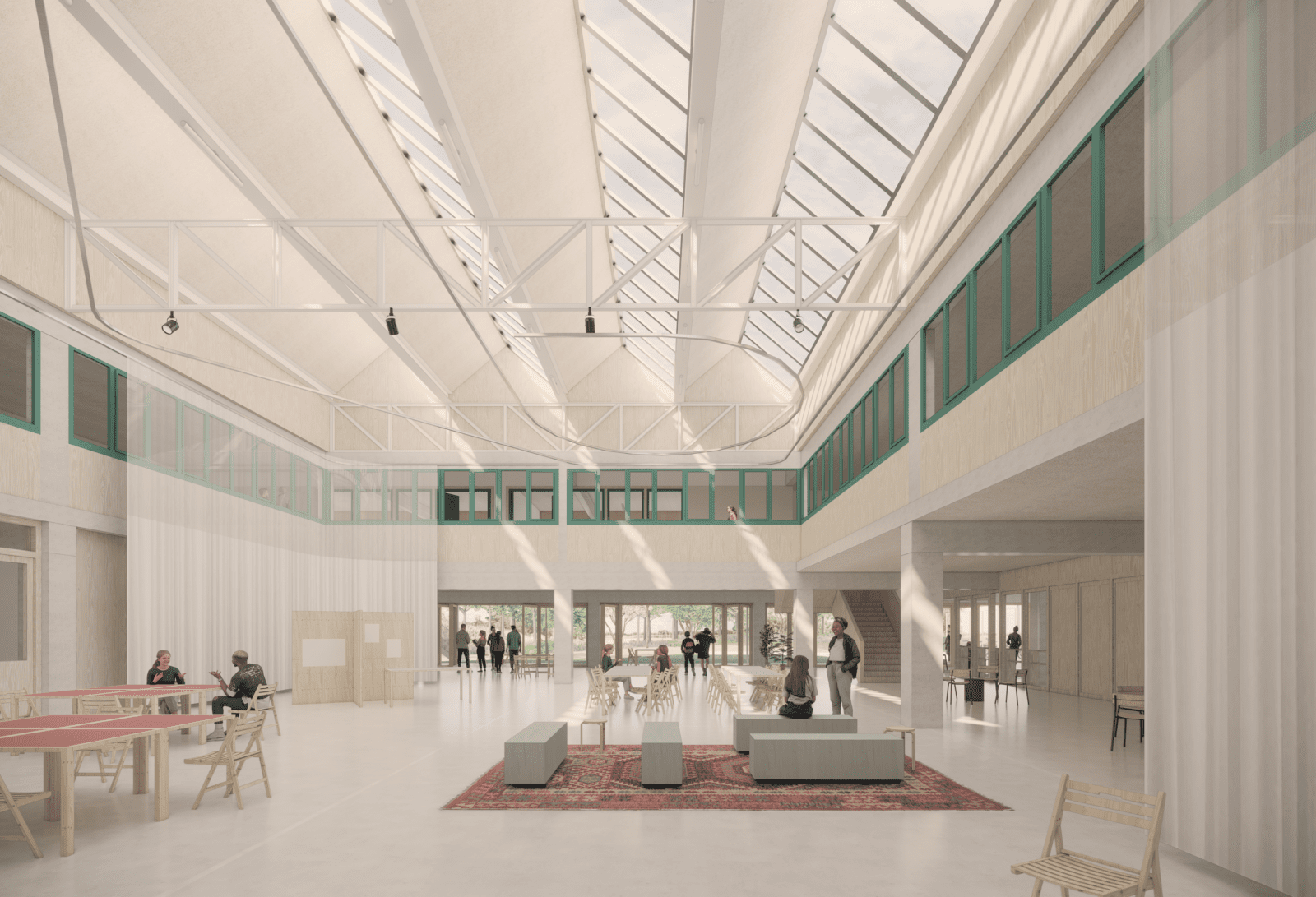
Centrally located on the ground floor, a large multi-purpose hall adjoins the garden. Both function as extensions of one another. As part of the original floor on the first floor was removed, the central space extends throughout the entire building. The garden is thus a tangible presence on every floor. The atrium is covered by a new sawtooth roof, making it larger than the rest of the building and bathed in light. Rings of classrooms circle around the centre of the building: on the ground floor, these are mainly larger communal rooms, but there are also spaces for teachers and the management, set apart from the hustle and bustle. Upstairs are the majority of the classrooms, arranged around the wide central space that accommodates lessons and collaborative work. The design team thus offers the school many opportunities to break out of the confines of traditional classrooms. This fits perfectly with the participatory pedagogy championed by the school.
Apart from the structure, the school bears little resemblance to the original office building. The façade has been radically altered and emphasises the horizontal lines of the storeys: the building is now enveloped by a rhythm of uniform windows, accentuated by pronounced sun awnings. As a reminder of the demolished brick façade, a brick piers is being built at the level of the columns. The façade therefore reads as a slotting of joinery into a solid skeleton. The original external joinery is reused internally as partition walls between rooms. The consistent use of wooden infill walls also makes the logic of the insertion very clear internally.
This project is clear and respectful of the logical structure. Through targeted additions and omissions, the once rather uninspiring building is brought back to life. In this way, the design team realises the site’s full potential.