
‘How will we live together’ was the central question of the 21st Venice Architecture Biennale. Farshid Moussavi answered it by giving a voice to the residents of her Ilôt 19 project in Nanterre, near Paris. They emphasise in every possible way that the building has brought the residents closer together. A minor miracle, as the building defies the first rule of property development: never mix different social groups. In Ilôt 19, however, social housing, student rooms and (expensive) duplexes stand side by side. Yet the eleven-storey building, situated near the prestigious Arche de la Défense, looks – thanks to its lavish use of glass walls and screens – like a haven for the happy few. The building is thus the perfect demonstration of Moussavi’s architectural theory. He applies the ideas of philosophers such as Félix Guattari & Gilles Deleuze and Jacques Rancière to the field of architecture. You quickly realise that Moussavi is not merely paying lip service to these names, but has truly made their ideas his own. Rancière himself also wrote an essay for this book, as did leading colleagues and critics such as Iñaki Ábalos and Irénée Scalbert.
Macropolitics, she argues, is about rigid binary distinctions and rules: man-woman, white-black, etc. Micropolitics, on the other hand, constantly undermines those boundaries by following the chaotic flow of desire. Both influence each other: a bureaucracy can only maintain itself if people bend the rigid rules at the micro-level to their will. The creative power of micropolitics lies in recognising, within the macropolitical framework, those moments when the system, contrary to its objective logic, allows or even demands change.
What does this have to do with architecture? Today, more than ever, every building is subject to strict regulations, yet it often still embodies wild dreams and desires. Architects operate within this field of forces, and can make choices within it. Do they opt for the familiar, ‘safe’ formulas, for the representation of accepted ideas and symbols, or do they pursue the unexpected and the unthought-of? The latter is not self-evident: thinkers such as Henri Lefebvre or Guy Debord, who chose that path in the 20th century, rejected the architect. Taking refuge in the role of the architect as a great visionary or functional planner is equally not an option, as it is hopelessly authoritarian and outdated.
According to Moussavi, architects today are indeed no longer the ‘author’ of a project, but the ‘mediator’ in a complex process involving many parties, not least the user. They can be placed on an equal footing, in an egalitarian relationship, if the architect ensures that a series of spatial propositions are offered, without dictating how users appropriate them. She describes this as a framework of three ‘actants’: architect-building-user.
Of course, the architect remains the one who assembles the building. They choose certain materials and forms, and determine the position of doors and windows. Unlike even 30 years ago, that design process has today become completely unpredictable due to the impact of many political, economic and technical forces. An architect is no longer someone who develops a single ‘original’ idea, but rather rides the wave of opportunities as they arise, or, to put it another way, moves through a rhizome of possibilities. Yet for Moussavi, the aim remains to challenge the status quo. Each project in this book therefore begins with a diagram of such a rhizome.
The designs that emerge from such a process do not, therefore, appear to be understandable or usable in just one way. Because they allow for alternative forms of use, they challenge the social order, according to Moussavi. They do not start from a grand gesture, but from an attention to every detail of the context, the brief and the structure. However, this attention to detail and process does not prevent Moussavi’s buildings from exhibiting a strong intuitive coherence. They form a powerful, often enigmatic figure.
This book thus offers at once a stimulating theory, a magnificent project documentation and a wealth of methodically and clearly presented technical and aesthetic research. That makes it an important book.
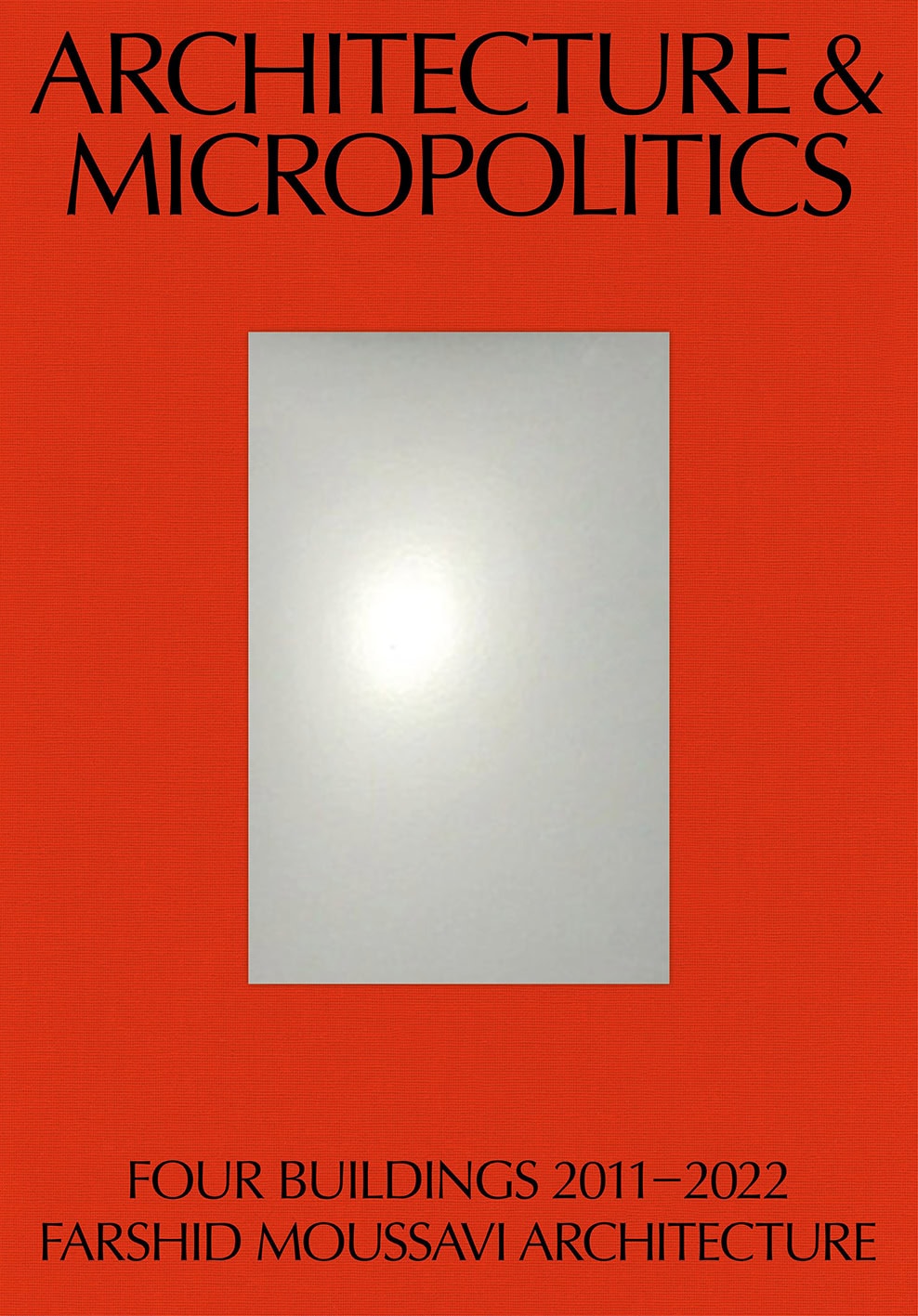
Architecture & Micropolitics. Four Buildings 2011–2022. Farshid Moussavi Architecture (ed.), Park Books Zurich 2022. Paperback, 588 pages. ISBN 978-3-03860-194-4. RRP €68 (CHF 75)
