
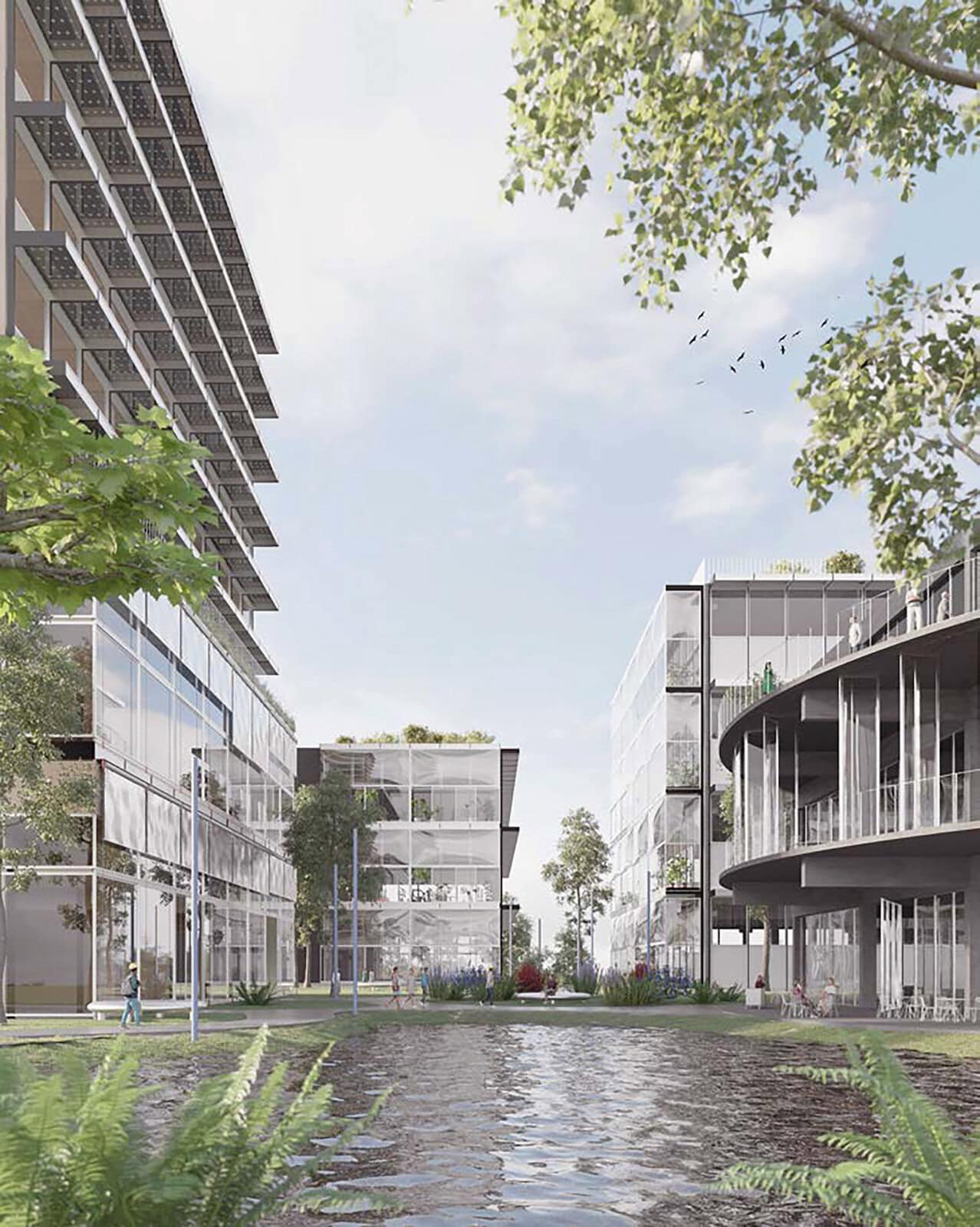
Mixed-use developments, stacking strategies, and hybridisation in business districts, business parks and industrial estates – what exactly are we talking about? What are the key issues behind this question of mixed-use and density? What visions and strategies are currently being developed? Guillaume Vanneste spoke to three key figures for A+: Brussels Bouwmeester Kristiaan Borret (BMA), architect and urban planner Xaveer De Geyter, as well as Filip Vanhaverbeke, Steven Vanassche and Griet Lannoo from the Leiedal intermunicipal association in Kortrijk.
Kristiaan Borret – The question needs to be clarified depending on the context in which we find ourselves. In Brussels, the BMA team has championed a vision that has been applied in several ‘productive city’ projects. This involves bringing production back into residential areas, alongside housing, particularly in zones where this is permitted, the ZEMUs (urban business zones). In Flanders or Wallonia, within business and industrial parks, the situation is somewhat different. The issue of mixed-use development in these areas requires clarification of the programme through which these business zones are being integrated. Recreational programmes are particularly complementary to the spaces and timescales of production. On the other hand, whilst the issue of housing is well addressed in Brussels within high-density projects, it is less realistic or less straightforward to develop outside the ‘high-density city’.
Leiedal – When we look at current trends in mixed-use development, we can already see a number of businesses adapting and transforming. They are welcoming other businesses onto their sites; transformations and experiments are already underway, whether we are guiding them or not. Within the inter-municipal association, we strive to facilitate or encourage this type of diversity on the business sites we manage. This diversity is not limited to businesses; partnerships with research, education or leisure sectors are often fruitful. For example, a laboratory forming part of a business park linked to a secondary school or a university. It may also involve facilities that contribute to the well-being of employees. Through the ‘De Stapel’ study, carried out on behalf of Leiedal, we were able to identify the challenges, the visions, and above all the tools needed to build this diversity.
Xaveer De Geyter – There isn’t really an overarching vision of what needs to be done. As architects, we have repeatedly encountered specific cases that allow us to experiment. To answer this, I could cite the example of projects we are currently developing at the office. At Thor Park in Genk, the project combines workshops, labs and offices. It is quite large and the whole complex is organised around a central corridor. Interactions occur between the different levels: views through double-height spaces, patios and circulation routes. These are spaces available to businesses seeking development and collaboration. For the Mobilis project in Brussels, a retail space for mobility vehicles, the approach is different. We envisage the project becoming hybrid, changing its functions over time.
A+ What are the reasons and rationales driving the urbanisation of business zones in this way today? Is it the scarcity of space that drives the need to mix uses to achieve greater density? Or the search for fruitful encounters between complementary programmes?
LD Space is becoming scarce throughout Flanders. For the sake of water, biodiversity and soil, we must preserve as much open space as possible. In our projects, we implement a ‘space neutrality strategy’ to safeguard these open spaces. In practical terms, in business parks, we have to be very clever with space. That means we have to share it. In every area.
KB In Brussels, the issue of scarcity presents itself differently. I like to say that institutional constraints lead to a kind of desire to maintain functions within the Region: this is what drives us to seek complexity, to find solutions involving stacking and mixed-use development. More than a choice in the face of scarce space, it is a political will. The ZEMU, for example, at an urban planning level, is the result of a compromise between the needs for housing and productive activity in the city.
A+ What synergies does the stacking of mixed functions generate? What are the spatial or technical benefits? And how can we ensure that everything works despite the stacking of functions as specific as productive activities?
KB There are, of course, sustainability benefits. Mixing uses is sustainability. Firstly, in terms of mobility; by bringing diverse activities closer together, we reduce the distances between customers, workplaces and homes. Secondly, technically, it is more complex. The difficulty stems from the fact that projects are built for businesses in a neutral, generic way: we don’t know what kind of business they’re intended for, and indeed we want to leave that open to make them more marketable. As we do not know the type of activity, it is difficult to predict heat production or future reuse requirements. To be honest, at the start, the focus was not on mutual benefits, but rather on reducing mutual nuisances. We managed to convince people on this point: that productive activities would not be scaled back in favour of housing or leisure, in this instance – or vice versa.
XDG With City Dox, in a more urban context, we have a concrete example of managing the respective functions and nuisances. The car park, situated between the productive spaces and the housing, serves as a sound barrier.
LD In the projects developed by the inter-municipal association, we advocate specifically for dedicated spaces rather than generic ones. When it comes to urban planning and architectural concepts for generic spaces, the campus model is more readily developed, combining spaces of different types and thus offering a broader range of facilities. Strategies for generic spaces do exist, however: basic ‘plug-and-play’ infrastructure, or even sometimes oversized service ducts, which allow for the installation of larger-scale systems in the future should the company’s activities require it, despite the stacking of functions.
A+ As an architect, client or public sector stakeholder, what is the framework within which you operate when developing a project? What makes it possible or impossible to implement ambitious and innovative projects involving mixed-use developments?
LD The situation differs for us depending on whether we are dealing with renovations or new developments. On a new site, we act as a public developer and can implement very ambitious strategies. For renovations, we often have to work with the existing situation. Sometimes we even act as a coach for consortia of companies that we do not manage. Sound planning principles sometimes struggle to align with economic realities. Our region around Kortrijk is dense and metropolitan. If space is scarce, we build upwards and increase density, but this is more expensive for a developer, whereas there are other locations where land is cheaper for businesses. The culture of mixed-use development is not so straightforward when it comes up against economic logic.
XDG As an architect, given that this is essentially a programmatic issue, I believe much of it lies in the hands of the client or the project owner. As designers, we therefore strive to create spaces that will stand the test of time. This is the case in the neighbourhood where my office is located in Brussels. Very mixed-use and dense spaces, linked to the neighbourhood’s historic port and railway functions, but which still serve a wide variety of purposes today. It offers a possibility for reinterpretation.
KB The first challenge is to construct a vision of the city that can be politically viable. It is an urban landscape we are not used to seeing; we must therefore invent new images of the city that fit with this diversity. And so, we must accept that this intense and new urban landscape might consist, on one side of the street, of rows of sectional doors, and above them housing, with buildings that are sometimes taller, and so on. My concern regarding this model of superimposition is the large number of underused ground floors. We must therefore seek a morphological diversity that does not impose too much repetition of these situations. Furthermore, in operational terms, behind the soft power initiatives, an ambitious project such as that of mixed-use zones also requires robust tools, sound urban planning and development strategies that provide guidelines and ensure the project’s development.
