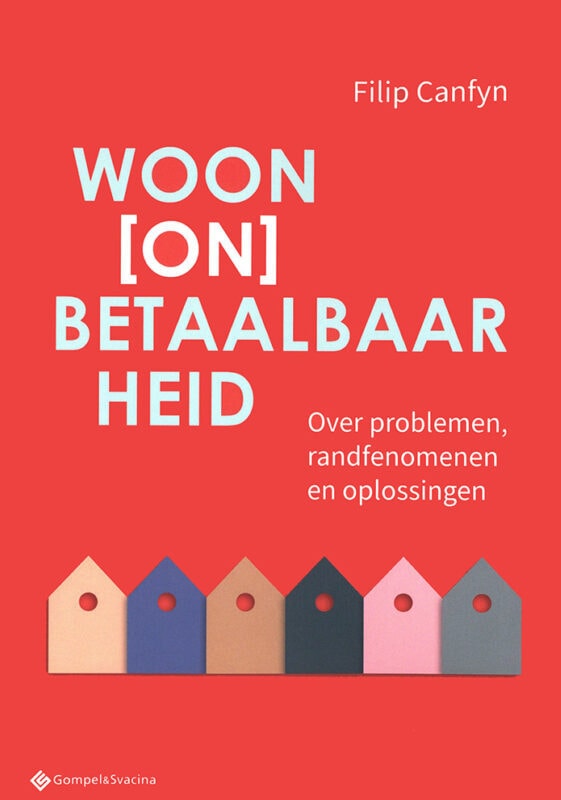
Housing (in)affordability: is it what it seems? by Filip Canfyn uses an extensive review of the literature, a great deal of calculation and some sociological reflections on the Flemish sociological ‘mainstream’ to explain why there is a housing crisis in Flanders, or rather an affordability crisis. This began when housing policy in the 1990s ceased to think in terms of decent housing for all and instead focused on ‘property’ and investment. The housing crisis now appears to be the canary in the coalmine of a polarisation of society into haves and have-nots. The book proposes viable solutions, though unfortunately with the caveat that the likelihood of their implementation is virtually nil.
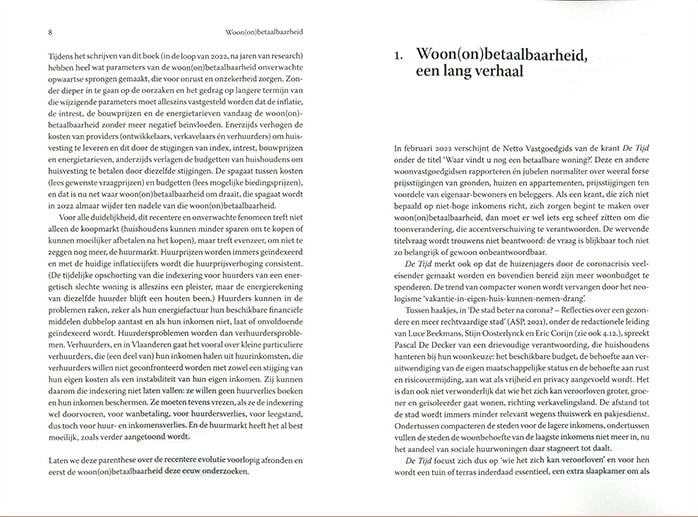
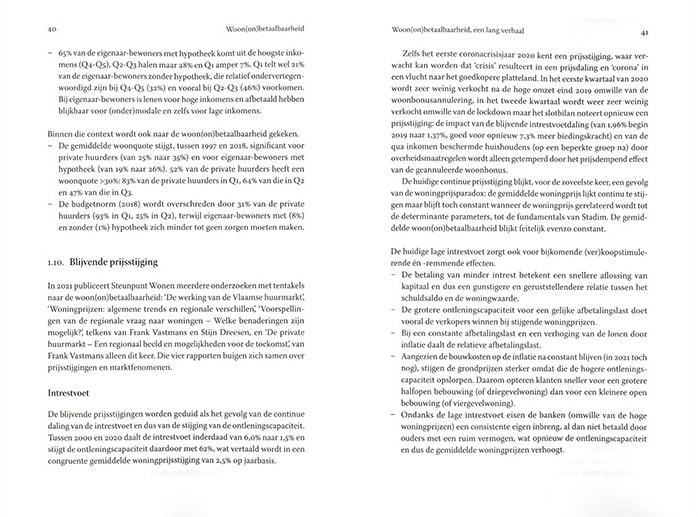
The first chapter of the book, which serves as both a problem statement and a literature review, accounts for a quarter of the text. It sets out the facts. Property prices rose enormously from around 2000 onwards due to the increasing bargaining power of buyers. These were no longer exclusively those keen to build, but also investors. Their purchasing power determines the market price, not the other way round. That price rose sharply as purchasing power increased, partly due to low interest rates. However, that purchasing power did not rise to the same extent for all sections of the population: the lower income quintiles (Q1 and Q2) were left behind and can generally forget about owning their own home. They are often reliant on a deficient private rental market and a social housing market that is too small. The middle-income group Q3 is also struggling. Only the highest quintiles (Q4 and Q5) are catered to by developers, who are increasingly dictating the rules of the game.
Of particular interest is the simple calculation carried out by Canfyn in Chapter 4. This shows, among other things, that a small flat (90 m² net) has construction and land costs of approximately €200,000. On top of this come many other costs. Canfyn estimates 10% in fees, 2% in interim interest, 3% in sales costs and 15% in profit and the developer’s overheads. (In the Netherlands, these figures are quite different: fees 18% or almost double, interim interest and sales costs 8%, and general costs and profit 12%. Designers are clearly better off there than in Belgium!). Building your own home is certainly cheaper, but in practice this rarely proves feasible due to the pressure on land prices, which is itself a consequence of the logic of development. On top of all that, there is 21% VAT, registration fees and notary costs. €200,000 thus swells to €311,500, a fifth of which is tax. The author calculates that average buyers (Q3) and certainly those on modest incomes (Q1 and Q2) cannot afford this.
Canfyn then demonstrates that, despite this, the government is focusing almost exclusively on home ownership to solve the Flemish housing problem, and in such a way that three-quarters of all support measures end up with the highest income quintiles. Canfyn explains this through a sociological analysis: the ‘middle class’, which shapes the Flemish self-image, has a blind spot (or even a panic-stricken fear) regarding the problems at the bottom of society. This is one of the less convincing and substantiated parts of the book. What is convincing, however, is the picture Canfyn paints of the consequences of this policy. Among other things, it threatens the energy-efficiency upgrade of the housing stock; it also threatens the functioning of cities, as key workers, for example, can no longer live in the very places where they provide essential services. The conditions in which many people are housed today also appear to be socially unacceptable.
So what are the solutions? Canfyn first calculates the costs of alternative financing methods, such as housing cooperatives. He comes to the sobering conclusion that simply buying with a mortgage is still the cheapest option. Here, however, he has been rather sloppy in his research. For example, he does explain why housing cooperatives struggle to get off the ground – the model is difficult to finance, partly because it is unfamiliar and therefore unpopular – but fails to mention that an owner is sometimes faced with high maintenance costs during a reference period. A cooperative member is spared these costs. Nor does he mention that cooperatives have a strong dampening effect on land speculation once they reach a sufficient scale.
The point Canfyn wishes to make, however, is that such initiatives are a drop in the ocean as long as the government does not change tack by doubling the number of social housing units, immediately scrapping the housing bonus scheme and investing those funds in a stronger rental market and more opportunities for affordable owner-occupied homes. The government should also put pressure on private parties to curb land speculation and build more for those on modest incomes, such as key workers. It should also invest more in energy-efficient renovation of homes for socially vulnerable groups, for example by carrying out the work itself in exchange for the land on which the property stands. In the long term, this would also result in a more robust land position, and thus greater clout for the government. But as long as it continues to view housing in terms of property, rather than a fundamental basic need and a right, Canfyn believes there is little chance that any of these measures will actually be implemented.
The merit of this book is not that it tells us anything new. Anyone who wants to can, with some effort, find all the data themselves. Rather, it clearly sets out the causes of the housing crisis – the mental shift from housing to property and the resulting retreat of the government – and the consequences – an increasingly visible polarisation of society. The fact that the book is sometimes rather rambling, occasionally repeats itself, becomes a bit heavy-handed or indulges in a form of amateur sociology is something you just have to put up with. The debate is open, and that is what counts.