
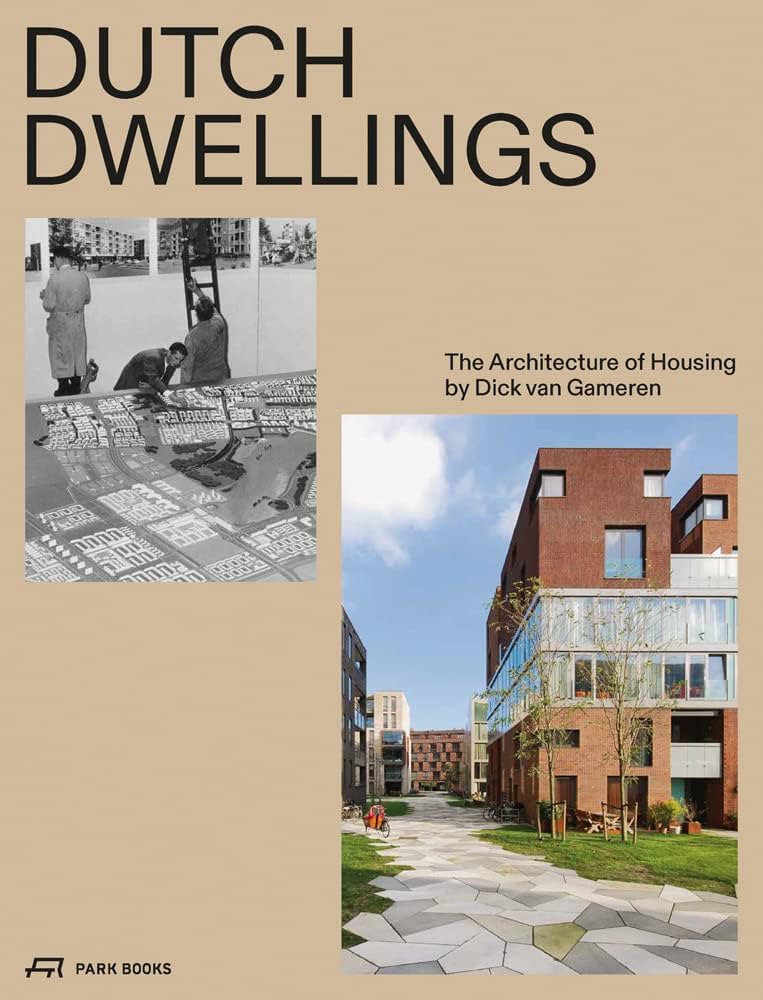
In *Dutch Dwellings / the architecture of housing*, Dick van Gameren sheds light on the history of housing construction in the Netherlands. He combines this with an analysis of the essential building blocks of every home. Finally, he presents his own housing projects. That is quite a lot to cram into a single book, but it is certainly interesting. The historical section even explains, concisely but very clearly, why Dutch housing is (only) what it is.
Building in the Netherlands has always required substantial collective investment due to the marshy ground. To save costs, people almost always opted for deep, narrow plots with load-bearing party walls, wooden floors and large façade openings. This also allowed plenty of light and air to enter. That housing stock had fallen into disrepair due to the economic downturn following the ‘Golden Age’. The Housing Act (1901) turned the tide. But the underlying model – narrow and deep – persisted, albeit more in the form of flats.
Initially, on Berlage’s advice, the Housing Act mainly resulted in closed building blocks. From the interwar period onwards, detached blocks gradually became the norm. This culminated in the construction of the Bijlmermeer in Amsterdam. This housing development proved to be of such poor quality and so monotonous that, from the 1980s onwards, many alternatives began to emerge, just as van Gameren was starting his career. As an architect (including at Mecanoo) and as a professor at Delft University of Technology, he was therefore a privileged witness and participant at a crucial moment in the history of Dutch housing construction.
In the first chapter, he guides the reader through this history in an accessible, richly documented manner. In the following three chapters, he explores sub-themes in greater depth. For instance, he discusses ‘palaces for the people’ and large housing estates, as well as the added value of inventive layouts. He also demonstrates that unconventional clients were often at the forefront of innovation.
The fifth chapter, ‘Seven elements of housing design’, however, takes a completely different tack. Here, using photographs, Van Gameren categorises and analyses the basic elements of a dwelling, from its relationship to the street and the garden, or the courtyard or the park, to the basic elements of the dwelling itself, such as the hearth, the wall and the roof. In this chapter, Van Gameren draws almost exclusively on his own work for illustration, whereas previously he mainly showcased the work of others. This is a somewhat strange break. It feels as though you are reading two books at once.
In a separate section at the end of the book, those same projects are presented once more, this time not through photographs but with plans, sections and elevations. Fascinating material for anyone with an interest in housing. After all, Van Gameren has tested – and sometimes improved – a wide range of typologies, from the individual dwelling to large complexes. So, in effect, you have three books in one volume. Just as economical as Dutch building methods, if you look at it that way.
Dutch Dwellings / the architecture of housing, Dick van Gameren, Park Books, Zurich, 2022. Hardback, 336 pages, 358 colour and 459 b/w illustrations. ISBN 978-3-03860-304-7
