“Oh yes, those ‘tiny houses’…” I often get this pejorative, simplistic response when I talk to fellow architects about light forms of housing1. They do not correspond to the aesthetic canon that applies within our discipline, which means that their many complex challenges are often overlooked. 1 Light forms of housing is one of the ’45 actions’ selected in Inventaires #3 architectures Wallonie-Bruxelles 2016–2020, a book compiled under the direction of Gilles Debrun and Pauline de La Boulaye and published in November 2020.
According to the ‘Réseau brabançon pour le droit au logement’ (RBDL, or Brabant network for the right to housing), around 25,000 Walloons chose a different way of living, either of their own free will or sometimes because they had no other choice. They are divided into three groups: 12,000 people living on recreational land (mobile homes, chalets), 10,000 travellers and nomads, and 3,000 residents of so-called ‘alternative’ dwellings (yurts, tiny houses, caravans, etc.)2. 2 Teret, Céline, ‘Habitat léger : premier jalon d’une reconnaissance juridique’, Alter Échos, no. 474, June 2019. According to housing law experts Vincent Wattiez of the RBDL and Anaïs Angéras, a doctoral student at UCLouvain, these lightweight forms of housing are “considered by some to be temporary, by others to be the result of a change in lifestyle and, finally, by all to be an adequate response to their needs. The economic aspect, linked to the housing crisis, certainly plays a role. However, the growing proportion of micro-homes is also linked to a search for a smaller ecological footprint. These types of housing also encourage more dynamic social contacts, if only because of the self-build principle, which often involves friends.”
In May 2019, after considerable effort on the part of residents, associations and lawyers, the Walloon Parliament passed a decree that officially recognises micro-homes for the first time as dwellings “that meet at least three of the following characteristics: demountable, movable, limited volume, limited weight, limited land use, self-built, without floors, without foundations, not connected to utilities.” Legal recognition is now in place, but this does not mean that this type of housing is ‘culturally accepted’. Far from it, in fact. “Civil servants and the average resident of Wallonia have a rigid view of what a home is or should be. They tend to disapprove of such a light form of housing. For some, a yurt made of organic wool is more acceptable than a mobile home in a recreational area. But every light form of housing is, of course, legitimate,” says Vincent Wattiez[footnote]Alter Échos, ibidem.
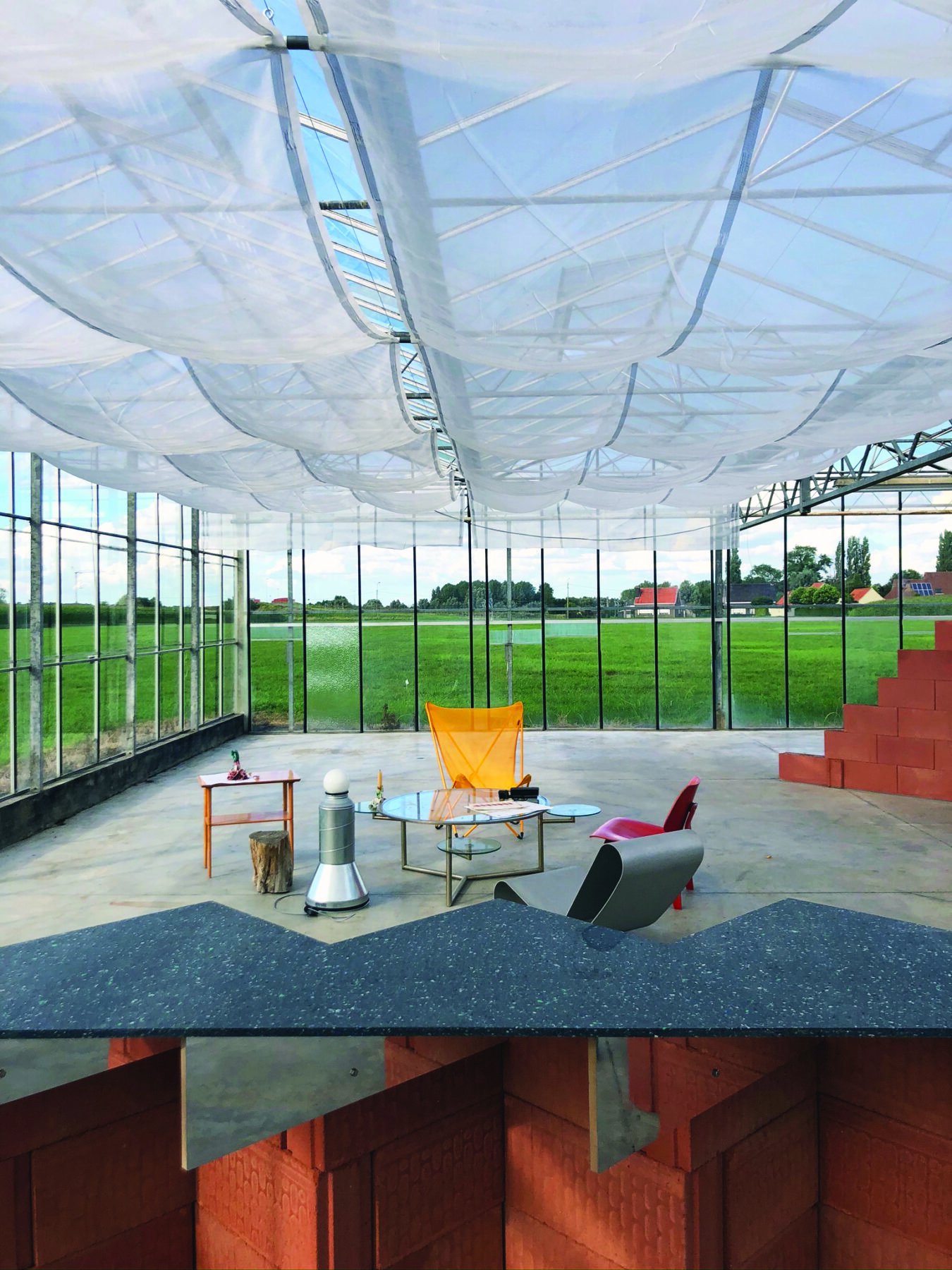
Whether it is a simple, austere dwelling for a person in a vulnerable situation, or rather for someone with a specific dream – such as that of the 19th-century American philosopher Henry David Thoreau 3 – the micro-home fits in particularly well with the concept of the ‘Urban Village’ developed by Italian urban planner Alberto Magnaghi. 4 Micro-homes contribute to protecting the earth. However, given that these are solitary, isolated homes, we must ensure that they do not contribute to urban sprawl. There must be a clear definition of where they can and cannot be built. Preferably, they should be located close to dense residential areas, with public transport nearby. Lightweight housing can also bring us closer to the Flemish (2040) and Walloon (2050) concrete stop, because they ensure faster densification of subdivisions, for example by applying the BIMBY [Build In My Back Yard] concept in a more flexible way. 3 In his masterpiece Walden, or Life in the Woods, published in 1854, he described how one can lead a simple life in the woods, isolated from ‘civilised’ society. 4 Magnaghi sketches a self-sufficient ‘ecopolis’, in which human motivations are not based on wealth and income, but on quality of life, social solidarity and non-commercial care relationships.
Light, reversible, flexible. Minimal use of materials, assembly. The qualities of light forms of housing strongly challenge the common Walloon and Flemish dream of home ownership – ‘our brick in the stomach’. A very heavy brick indeed.
In my opinion, simply legitimising light forms of housing does not go far enough. I believe we must abandon our sedentary reflex. In a country where our territory is completely fragmented by the unbridled spread of buildings – mainly large and unmaintainable detached villas – we should encourage en masse any form of housing with a lighter footprint.