‘The principle of excluding untested techniques […] risks having adverse effects. Indeed, if practitioners only take into account current standards, they will fail to introduce any new rules into their practice until these have been tried and tested in a real-world setting [as opposed to an experimental setting]. They will have adopted a most cautious approach, which on an individual level is certainly a satisfactory solution; but in doing so, they are not helping to change behaviours.’1 1 Anne Penneau, Règles de l’art et normes techniques, LGDJ, 1989, p. 130, cited in Michaël Ghyoot, 2014, PhD thesis, ULB. With thanks to Michaël Ghyoot, Thierry Decuypere, Raf Geysen, Fabian Lauener, Aurélie Hachez and Alice Babini.
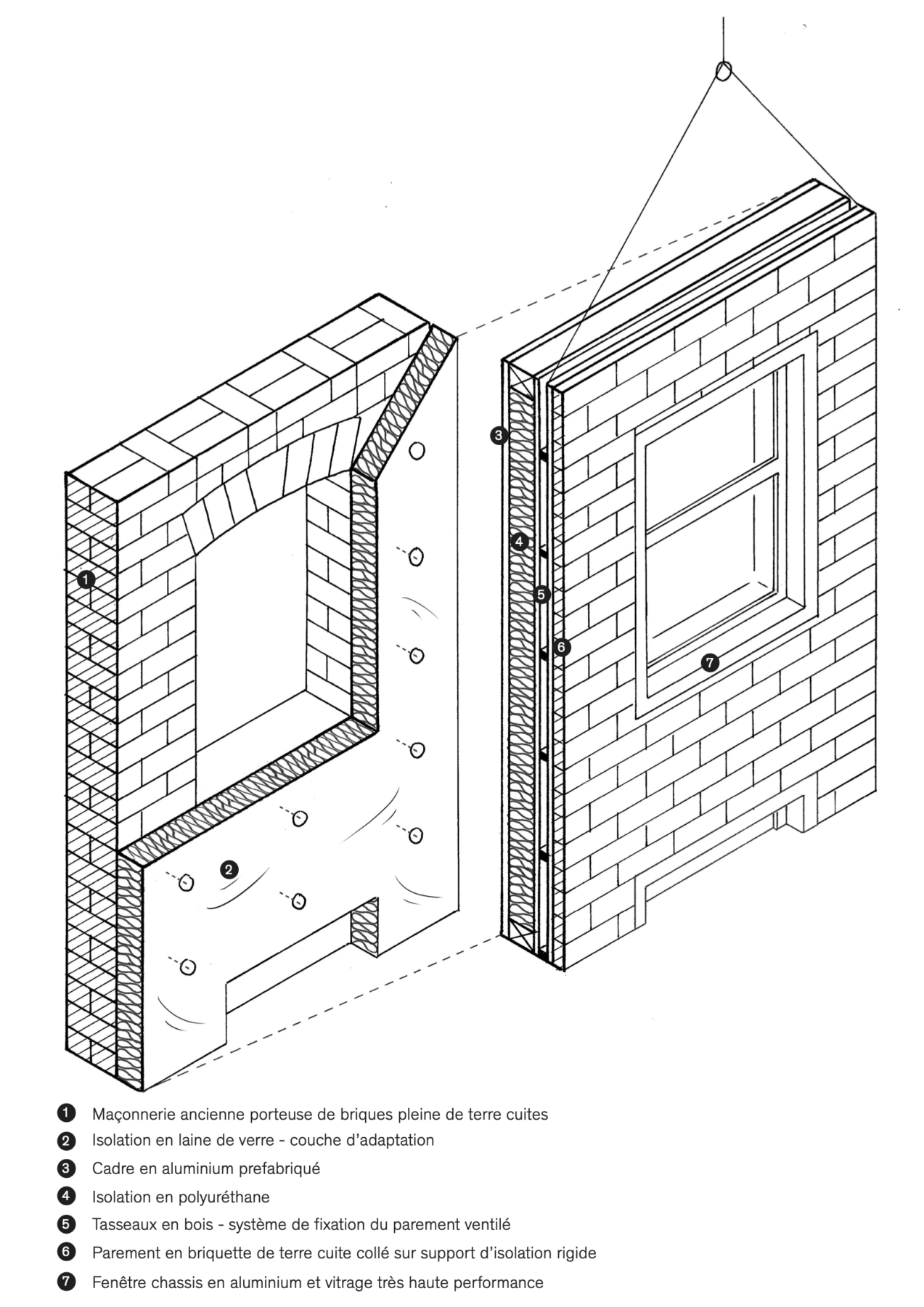
Understood as the activity of anticipating construction assemblies, the concept of the detail appeared late, as it only spread in architectural practice in the nineteenth century. Today, the detail, a tangle of requirements, products and responsibilities, is the subject of growing complexification. Between the late 1950s and 2013, simulations estimate that the number of elements involved in the design of a façade rose by 450 per cent.2 However, this growing complexity, made possible by industrialization and a heavy dependence on fossil fuels, has paradoxically hindered the broadening of technical possibilities towards processes and materials that have not yet been standardized and often remain difficult to grasp. Not only is the detail physically concealed behind a growing number of material layers, but it also falls outside the conceptual field of view, with neither the origin of this opacity nor its effects being truly debated. 2 See drawings by Kyle May comparing the original 1958 façade section of Marcel Breuer & Associates’ IBM Research Center with a hypothetical 2013 version: Kyle May, “Breuer Turns 55”, in CLOG: BRUTALISM, 2013, pp. 44–45.