
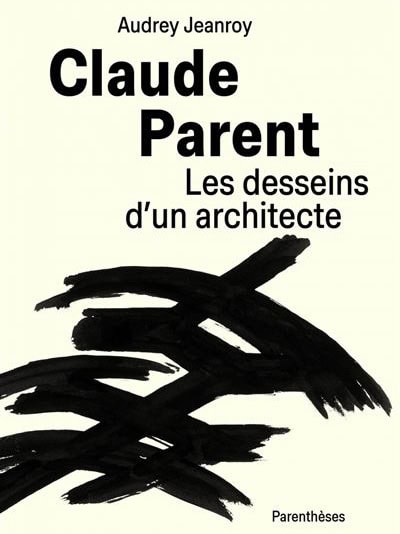
At the time of his death, the name of the French architect Claude Parent (1923–2016) was rarely recognised outside France. Yet between the 1960s and 1990s, he occupied a virtually unique position in the architectural debate due to his views on the relationship between people and the built environment. He had little interest in programme. He was all the more interested in architecture’s capacity to create, through its design, a new dynamic in the experience and interpretation of space. Les desseins d’ un architecte by Audrey Jeanroy sketches an extremely well-documented and committed portrait of the man, his work and his life.
First paragraph of the Dutch edition: Les desseins d’ un architecte is an untranslatable play on words, but it does strike at the heart of Parent’s oeuvre. Dessein is the French word for vision, insight and also vision, whilst dessin means drawing. But as Dominique Perreault points out in his foreword, for Claude Parent these two concepts were intertwined. Certainly from the 1960s onwards, his work involved imaginings of spaces that encourage users to engage with them actively, or even to perform within them like actors.
Parent was an outsider from an early age: a dandy, the son of sophisticated and enterprising parents, but without his father’s engineering talents. Drawing, on the other hand, he could do better than anyone. A training as an architect seemed the obvious choice. However, Parent hated the rigid formality of the Académie in Paris so much that he dropped out just before graduating. Yet even during his studies, he built up a parallel career as a publicist and developed a wide network in the world of fashion designers and artists.
He also managed to gain a foothold in both magazines such as Elle and prestigious journals such as L’Architecture d’Aujourd’hui (AA). The former secured him commissions for private homes, the latter a voice in the debates of the time. André Bloc, then editor-in-chief of AA, became his intellectual mentor for many years. This is how the first ideas about a dynamic architecture emerged, one that entices or compels the user to imagine a ‘different’ life.
However, his intellectual and artistic breakthrough only came after meeting Paul Virilio, a glass artist who would later develop into a leading left-wing and Catholic intellectual. Virilio was fascinated by the bunker architecture he knew from his youth in Nantes, but at the same time by modern phenomena such as permanent instability or war and speed as core metaphors of post-war society.
This struck a chord with Parent. Together with Virilio, he developed the concept of the ‘fonction oblique’. This is to be taken literally: by making all the floors in buildings slant, they wanted to make permanent instability tangible, to set people in motion both literally and figuratively. At the same time, they strove for strong, compact concrete volumes – bunkers, indeed. In many respects, this brought them close to the ideas of the English Team X, meaning one can rightly call those designs brutalist. It seems an almost bizarre idea, but it later found unmistakable resonance, for example in OMA’s Educatorium in Utrecht or MVRDV’s Villa VPRO.
In 1968, however, a rift emerged: Parent watched the street protests in Paris with dismay, whilst Virilio became actively involved in them. But Parent did not abandon the idea of the fonction oblique, and developed it further in drawings which he even distributed as posters in Paris.
From that moment on, a rift began to emerge in his oeuvre. In his drawings, Parent arrived at increasingly fantastical proposals for unprecedentedly fluid, undulating, unpredictable spaces. This aspect of his work is also evident in his contribution to the 1970 Venice Biennale. His built work, by contrast, grapples with the postmodern turn in architecture. Although Parent continued to build well into the 1990s, the historical significance of that work is less pronounced, with the exception of his designs for nuclear power stations and a few spectacular shopping centres.
Audrey Jeanroy places all of this precisely within its context. She does not always hold back her criticism, but always does so with sympathy for her ‘hero’ and the difficult position into which he often manoeuvred himself due to his independent spirit. She illustrates this abundantly with plans, drawings and historical photographs, as well as an overview of his oeuvre. That is no small achievement, for both views on society and architecture were changing at breakneck speed at the time. Parent thus gradually became the last man standing: the only one who still believed in architecture as an anchor point from which to engage creatively with that instability. That is worth reflecting on. It remains a relevant position.
Claude Parent / Les desseins d’un architecte, Audrey Jeanroy (Foreword by Dominique Perrault), Editions parenthèses, Marseille, 2022. 384 pp. ISBN 978-2-86364-390-7. RRP: €38
