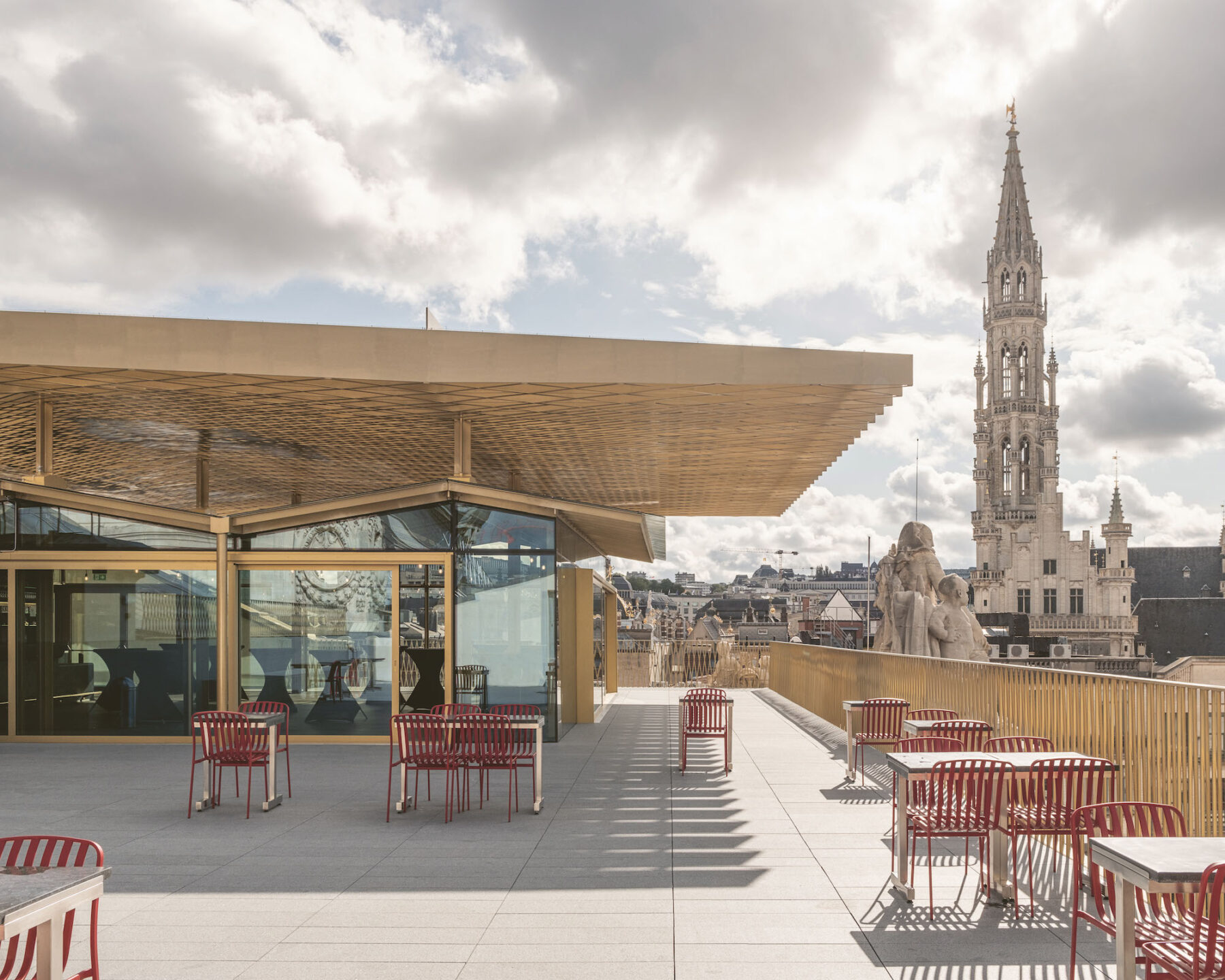
In 1996, the Brussels Stock Exchange closed its doors for good. Trading activities moved to the digital realm of Euronext. Only then did the building truly become a ‘monument’, a place of remembrance. Due to its grandeur, its location and, above all, the imposing staircase on the Beursplein – both a forum and a tribune – it became a landmark and an urban anchor point, for example during the mourning period after the attacks in 2016. However, the building’s precise function was forgotten. Almost no one even knew what it looked like inside. The renovation led by Robbrecht and Daem architects is changing that: for the first time, the building is becoming an urban interior with great allure. A beer museum was also added to the upper floors. The strange consequence is that the building is losing its symbolic aura: it is in danger of becoming a purely tourist attraction.
The designers had a keen eye for the disruptive role of the monument in Brussels in the second half of the 19th century. The enormous 40 by 80 metre complex was the final piece in the new development of the lower town, modelled on Paris. It tore apart the medieval fabric. The rear of the building is so close to St. Nicholas’ Church on Taborastraat that it overwhelms it. One of the most important interventions in the design, although at first glance it hardly affects the building, was to create large openings in the three-and-a-half-metre-high plinth of the building on the corner opposite the church. Behind it, a spacious stone staircase in the ‘Sint-Niklaaszaal’ leads to the central hall on the first floor. It is as if the medieval streets continue into the building. Unfortunately, the elegant brass grilles of this passageway were closed during my visit. The large stream of visitors therefore took the original narrow staircase in the axis of Léon Suys’ building, without even noticing this significant architectural gesture.