
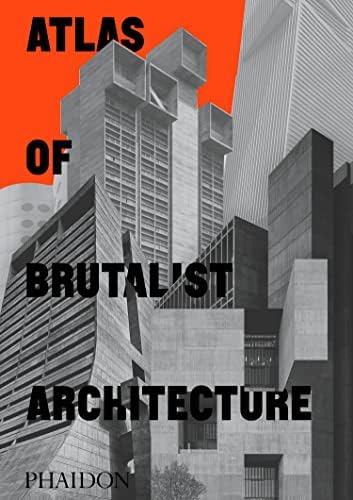
In December 1955, Reyner Banham published the controversial article ‘The New Brutalism’ in *The Architectural Review*. In it, he mocked art historians’ obsession with seeing ‘developments’, ‘styles’ and ‘connections’ where none existed. He thus demonstrated that Peter & Alison Smithson, who had claimed the term as a badge of honour, were not at all positioning themselves in opposition to some supposed ‘old brutalism’, but, in line with the ‘art brut’ of the time, were offering an original response to the questions of their era. The trap into which Atlas of Brutalist Architecture, a Phaidon publication, falls is to dust off precisely that art-historical perspective which sees formal and stylistic characteristics everywhere. The book thus strips the term ‘brutalism’ of all meaning and critical edge. It rides the wave of the resurgent interest in the architecture of the 1950s to 1970s in a rather banal way.
Banham summarised the Smithsons’ ‘new brutalism’ in three points. 1. Memorability as an image. 2. Clear exhibition of structure. 3. Valuation of materials ‘as found’. With a hefty dose of bloody-mindedness and the explicit aim to move (or, above all, to disturb). The authors of the Atlas (you’ll need a magnifying glass to find their names in the acknowledgements at the back of the book) do quote Banham – albeit very incompletely – but then cheerfully conclude that all buildings that make ostentatious and spectacular use of concrete and other raw materials immediately fall under the heading of Brutalism, whereas Banham’s argument was that even in the case of someone like Louis Kahn, it was doubtful whether one could really speak of Brutalism.
This immediately serves as a licence to track down Brutalism in the late twentieth and even the twenty-first centuries. The choices made by the Atlas are therefore sometimes truly astonishing. In the section on Italy, Luigi Moretti, Aldo Rossi and Ernesto Rogers appear side by side. They would turn in their graves if they were to learn that they are being lumped together in this way. But designers such as Pier Luigi Nervi or Gio Ponti are missing, even though they too did quite spectacular things with concrete, didn’t they? It gets even stranger when we look at the Belgian selection. What De Krook in Ghent or the Museum aan de Stroom in Antwerp have to do with Brutalism, God only knows. That the authors include Juliaan Lampens is understandable, but otherwise the selection is simply nonsense.
What makes the book particularly irritating is that it isn’t an atlas at all, as even the most basic location details – apart from the municipality – are missing. Try finding a chapel by Wotruba if all you know is that it’s in Vienna. The only thing nice about the book is that you get a global sample of buildings with a strong desire for an idiosyncratic, unprecedented form. Atlas of Reckless Architecture would have been a better title for this work, which simply parasitises on the reappraisal of post-war experimental architecture.
Atlas of Brutalist Architecture, edited by Phaidon Editors, Phaidon, London 2020 (reprint), ISBN: 9781838661908. RRP: €65
