
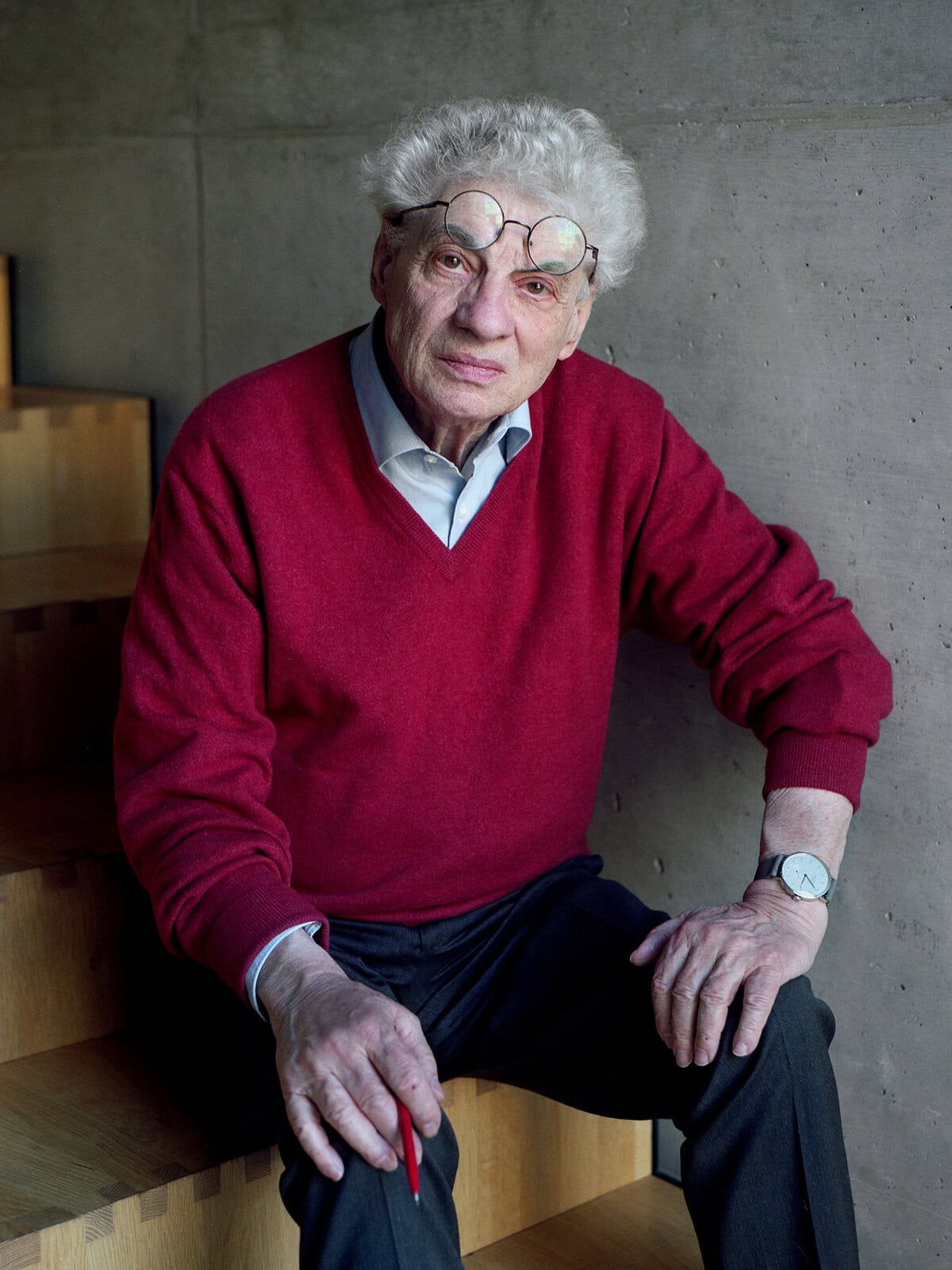
On 28 September, A+ Architecture in Belgium and Bozar are hosting a lecture by the Swiss architect and leading figure of postmodernism, Mario Botta, at the Centre for Fine Arts in Brussels. Lisa De Visscher, editor-in-chief of A, spoke with him about the architect’s moral commitment and the importance of collectivity. “The city is the barometer of civilisation.”
A+ Following in the footsteps of John Ruskin, you argue that architecture is an ethical question, not an aesthetic one. What exactly do you mean by that?
Mario Botta (MB) – Architecture touches upon the space occupied by human beings. Architecture can organise that space, or destroy it. In that respect, architecture is therefore an instrument with which ethical issues can be created or resolved. The space that surrounds us is not neutral. Today you see the most horrific images on television. Then you realise what it means to live in a democracy, or in a war situation.
Architecture has its own intrinsic values that determine spatial quality and thus people’s living conditions. The architect therefore has a moral commitment to fulfil. And this applies not only on the scale of architecture but also in terms of urban planning. As Walter Benjamin once said, the city is the place par excellence for engaging with society, its wealth and its marginalised neighbourhoods, its relationship between centre and periphery. The city is the barometer of civilisation. It is a kind of X-ray of all manner of different ways of life and the contrasts and contradictions that these entail. Only the city can provide a space for the collective, for collectivity. Public space, too, is never neutral; it always says something positive or negative about the living conditions of its inhabitants.
A+ Your body of work spans more than forty years. Alongside a series of famous residential buildings, you have designed churches, museums and banks; the spiritual, cultural and economic pillars of society. How did you manage to integrate the collective, the community, into these diverse projects?
MB There aren’t fifty programmes or themes that address the collective. In my body of work, there are two: the museum and the church, or any place for meditation, silence and prayer. People today have an enormous need for silence and tranquillity in this frantic world. I have had the privilege of being able to realise many such projects. That is not to my credit, but to that of the clients. As an architect, you can dream up as many beautiful spaces as you like, but if you don’t have a commission, you won’t build anything. And ultimately, our most important client is society itself.
For me, a museum is just as spiritual a place as a church. You go to church to talk to God or to yourself. You go to a museum to talk to the artist. In both cases, you are looking for a way to nourish and inspire yourself and your inner life. The artist speaks to us through his or her body of work, in its most diverse forms. From Picasso’s Blue Period to Guernica. I love the intimate dialogue that unfolds in this way and which we so desperately need today, in a world that moves so fast that we can no longer think and are constantly forgetting everything.
Artists create their own world in which they give themselves the opportunity to find an expression for their ‘Weltanschauung’, their way of seeing, their vision of the world. They do this within a self-created format, with self-imposed boundaries and using the means of expression that are their own. In this way, artists can position themselves somewhat outside society and create a kind of sanctuary, a kind of freedom for themselves and the development of their body of work. Understanding their vision requires a certain slowness, a willingness to delve deeper, to reflect. Designing a space in which this reflection, this intimate dialogue, can take place is, for me, a way of contributing to the collective.
A+ For the ‘Labiomista’ project in Genk, you collaborated with artist Koen Vanmechelen. What exactly is the project about, and how does it relate to the artist’s artistic vision?
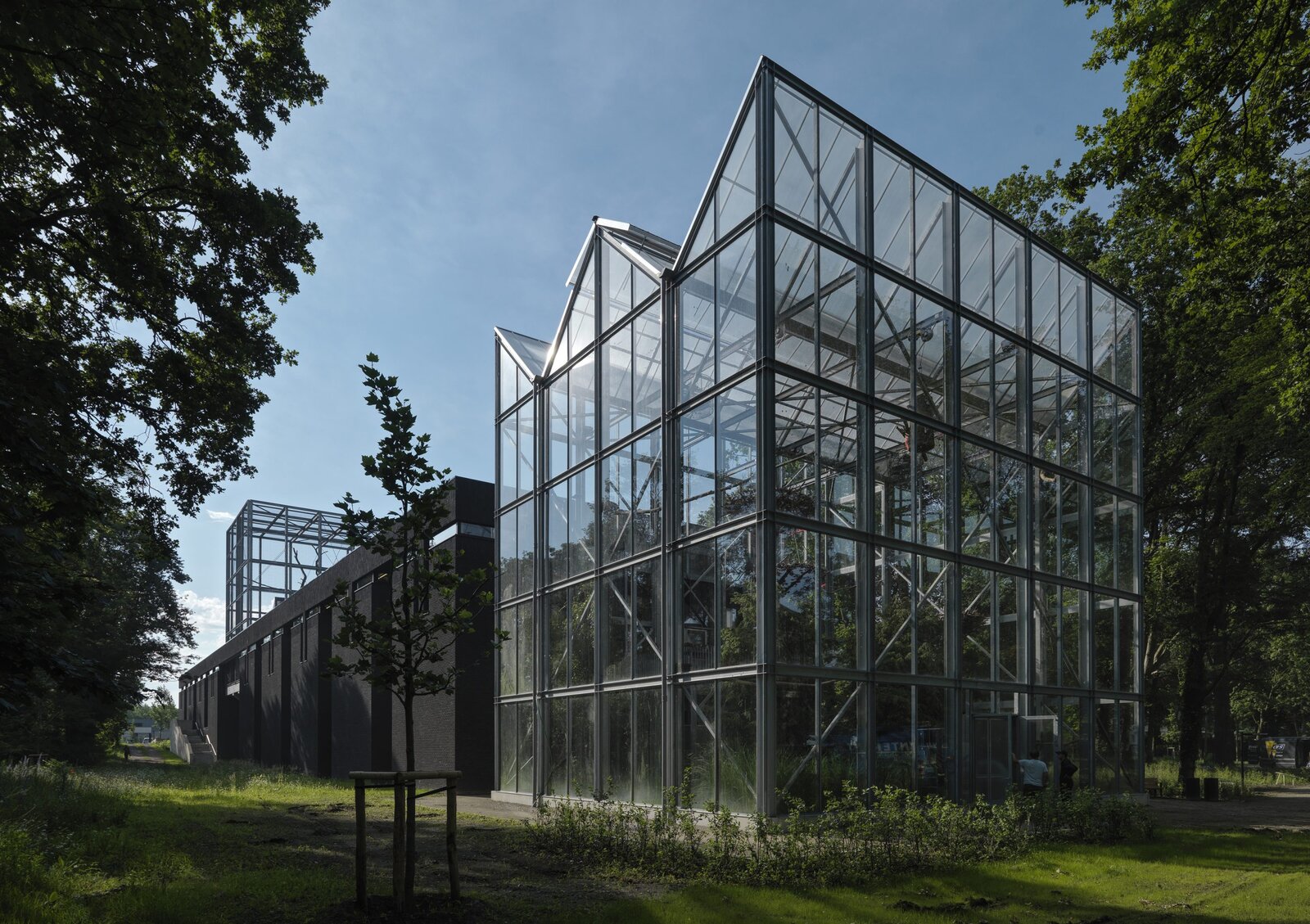
MB Koen Vanmechelen is a rare artist who has had the extraordinary courage to turn his studio, his workshop, into a factory in the middle of a public park, in the city. When the Zwartberg mine closed in 1966, the site became a zoo. It is in that former zoo that Vanmechelen has shaped his art project. His oeuvre operates on the intersection between art and science, where the focus is not on humans, but on animals and biodiversity. To me, the park is a mysterious place, like Hieronymus Bosch’s garden.
I had the privilege of working with Koen Vanmechelen on The Ark, the entrance pavilion, and on The Battery, his studio and the driving force behind the site. Both are constructed from polished concrete and black brick, referencing the site’s mining past. The studio consists of a series of brick volumes interspersed with glass aviaries. Vanmechelen lives there himself, amongst the exotic birds, in harmony with the animals. It is very rare to meet people who have found a balance with nature and the animal world. I have great respect for his approach, in which animals form a kind of model for life.
A+ You just referred to your concern about a world that is moving ever faster, where oblivion is gaining the upper hand, whilst you wish to make room for reflection and remembrance. In which projects is this concern expressed?
MB Indeed, the speed at which the world rushes by is directly proportional to the forgetfulness of people and society. To be able to reflect and remember, we need slowness, time for contemplation. Memory, of course, has various dimensions and everyone deals with it differently. For instance, in the early 1990s I was commissioned to build a chapel in Mogno, a small village in the Ticino mountains in Switzerland. It was not a building ‘ex novo’, but the reconstruction of a memory. In the early 17th century, a chapel had been built on the same site: the Chapel of St John the Baptist in Mogno. At the end of the 20th century, four centuries of history were wiped out in a single stroke by an avalanche. Paradoxically, only the ossuary remained; only the dead survived the disaster. My task was to build a chapel that could withstand any avalanche. We hung the old bell inside, which had been found 400 metres away in the snow after the disaster.
It was a complex task, and when I asked the villagers why they were willing to invest so much effort, time, money and energy into building this chapel, the answer was: “Because there used to be a chapel here before”. That is, of course, circular reasoning, but essentially it meant that the villagers wanted to leave future generations an area with the same richness and the same qualities as the one they themselves had known. So you see that architecture is always linked to lived history.
