
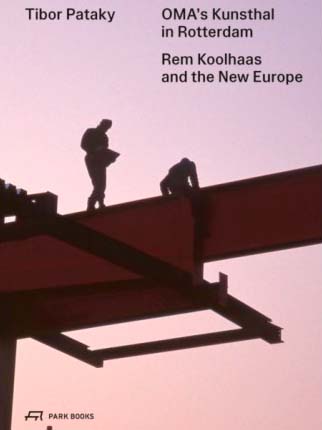
In November 1992, the Kunsthal Rotterdam, designed by Rem Koolhaas / OMA, was officially opened by Queen Beatrix. This was considerably later than planned, but it was one of the most talked-about buildings of its time, despite its modest dimensions of 60 by 60 metres, including the canopy of the ‘portico’ on Westerdijk. Tibor Pataky, an architect and architectural historian from Zurich, wrote an extensive study on it entitled OMA’s Kunsthal in Rotterdam / Rem Koolhaas and the New Europe. He argues that the building’s design, regardless of what Koolhaas himself claims, tells a specific story, one linked to the social and cultural upheavals around 1990.
If one were to summarise OMA’s early work, one would arrive at something like ‘program without form’, seasoned with a remarkable sense of subversiveness and aversion – ‘dégoût’ is the term Pataky borrows from Adorno – for the ‘mainstream’. Also at play was a quasi-nostalgic longing for an architecture which, like that of the modernists, had a clear ideological programme. On top of that was a burning desire to stand out.
At the time, Koolhaas did indeed use scathing texts to rail against the weak ideological basis of postmodern and deconstructivist architecture. They claimed to reflect the fragmentation of the world, but according to Koolhaas, they did so only in form, not in their function or programme. In doing so, they dragged the tradition of architecture along like a lead ball and a guilty conscience. In doing so, he criticised colleagues with whom, as an author and lecturer at, amongst others, the London AA School, he dealt with on a daily basis: the insular milieu of paper architecture during the crisis of the 1970s and 1980s.
But what was the alternative? That was where the shoe really pinched. On the one hand, OMA itself had until then relied heavily on fantastic collages of the modernist idiom, with a penchant for Ivan Leonidov’s constructivism. When that became the norm, certainly in the Netherlands, and deconstructionists too were delving into the legacy of the constructivists, he realised that something different, something truly new, was needed. Koolhaas also saw, sooner than anyone else, that the public domain—the city of Baudelaire, of the Surrealists or of Guy Debord—was on the verge of disappearing. Towards the end of the 1980s, Koolhaas saw only one refuge: the oversized building: programmatically heterogeneous, yet formally a unity.
That was a leap forward. A foreshadowing of what architecture might mean in an era in which every ideology and every certainty had been shattered by the triumph, but also the permanent instability, of capitalism following the fall of the Berlin Wall. After all, large buildings also require large capital and large companies – in short, everything that is just not subversive and very ‘mainstream’. Koolhaas realised this all too well.
His design for the NAi in Rotterdam, which for incomprehensible reasons was rejected in favour of Jo Coenen’s current ‘Nieuwe Instituut’, was a first attempt at a new architecture that would embody ‘the whole and the real’. At the same time, OMA was working on the Kunsthal. Also a compact volume, yet very different from the NAi. For those who have never seen it: the sleek, yet on closer inspection highly capriciously varied exterior façades enclose an interior that is almost bursting at the seams with an excess of ideas and references. It is like a compendium of every modern, postmodern and deconstructivist strategy. At the same time, through the sloping street that runs through it, it also internalises the idea of the building as a condensed city, open to unexpected events.
It is to Tibor Pataky’s immense credit that he unravels that excessive form in all its aspects. How it related to recent developments in architecture and to the neoliberal turn the EU took after 1990. How it fitted within the revision of Rotterdam’s urban development, with a fascinating account of the design of the Museumpark by Yves Brunier and Koolhaas. How the design itself evolved in its final phase, when Cecil Balmond of Ove Arup also became involved. How the architectural critics, taken aback, struggled to find the words to explain what this building was raising. The conclusion: in its excessive form, this building is both a farewell to architecture as a profession burdened by its own past, and a step towards the new. Without forgetting the old, mind you.
To this end, Tabaky brings together a wealth of historical material, ranging from plans and detailed drawings to texts, both by Koolhaas himself and by critics. Using this, he pinpoints the ambiguities and blind spots in Koolhaas’s rhetoric with razor-sharp precision, but also makes a convincing case for why this building was so important then (and now). Of particular fascination to architects is the account of the design process itself in Chapter 6. A must-read for anyone interested in the architectural theory of the 1990s and the work of OMA.
OMA’s Kunsthal in Rotterdam / Rem Koolhaas and the New Europe, Tibor Pataky, Park Books, Zurich, 2023. ISBN 978 3 03860 321 4. RRP: €48.
