
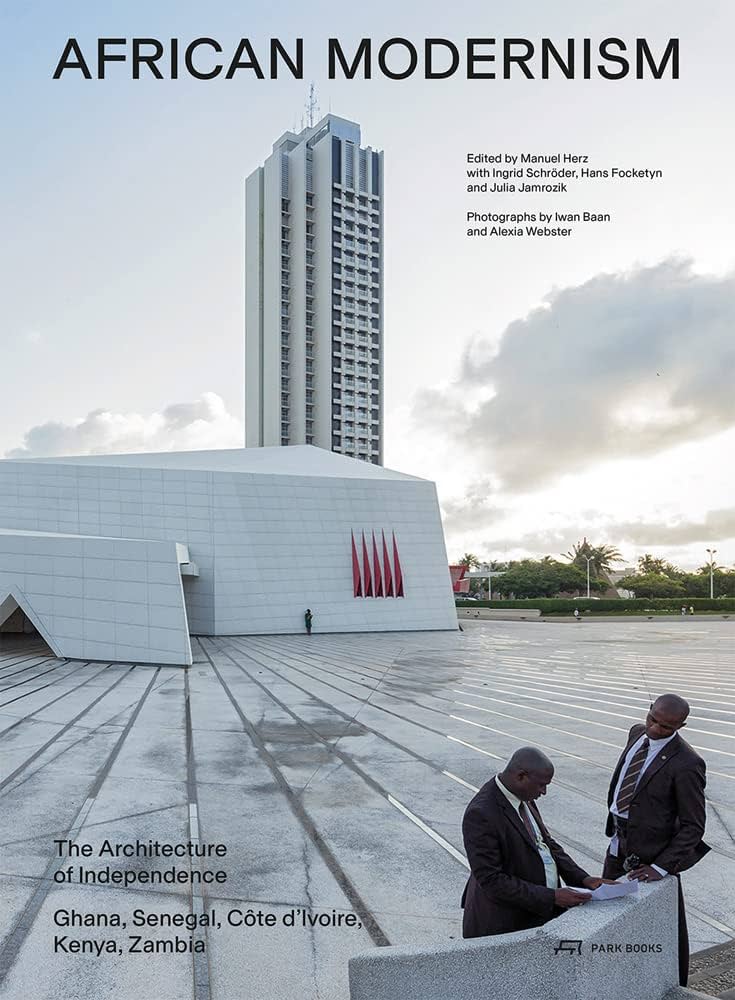
Between 1957 and 1966, 32 African states declared their independence. Ghana was the first to do so. When designing the buildings for their new institutions, these countries often drew on the formal language of the ‘International Style’. Manuel Herz and his team at ETH Zurich compiled a monumental book on this history. According to him, these buildings offer an insight into the way in which people at the time sought to give form to independence and modernisation. Iwan Baan and Alexia Webster documented them with a wealth of photographs showing their current state and context.
Manuel Herz and his co-editors (Ingrid Schröder, Hans Focketyn, Julia Jamrozik) are not blind to the ambiguities lurking behind words such as ‘independent’, ‘modern architecture’ and ‘modernisation’. Herz dissects them carefully in his nuanced opening essay. Herz outlines how the new states often remained under the thumb of their former rulers. In the 1980s, the IMF’s draconian measures would even nip this fledgling development in the bud. Countries such as Zambia also faced enormous adversity when the price of copper, the country’s most important mineral, collapsed.
Herz delves particularly deeply into the question of why ‘modernisation’ – proper education, healthcare and housing – was such a magic word. Most Africans were deprived of these under the colonial regime. The new heads of state assumed that modernisation was necessary if they were to be taken seriously. This included imposing modern architecture. With African accents, admittedly, if only for climatic reasons. It was often architects from ‘friendly’ foreign countries who designed them, for want of Africans with architectural training.
Sometimes, nothing was big enough. The buildings often ended up as foreign bodies in a society that was not prepared for them. Yet they often continue to serve us well to this day, and serve as a reminder of the leap forward that was made back then. The book examines how this played out in five countries. Congo is not included because ‘the years after independence were unfortunately overshadowed by civil wars and a general state of violence’. The book focuses on Ghana, Senegal, Côte d’Ivoire, Kenya and Zambia, countries that fell within the French or British spheres of influence and geographically reflect the various climate zones in Africa.
Each chapter opens with a brief outline of the history following independence. This is followed by a photo essay that paints a vivid picture of African metropolises today. This is followed by extensive documentation of the most important buildings of the newly independent state. These include schools, universities, government buildings, museums, embassies and, on the odd occasion, a hotel. Alexia Webster is responsible for the reportage in Ghana, Iwan Baan for all the others. Each chapter concludes with an essay by an author familiar with this history. A poignant final chapter, featuring an essay by Ingrid Schröder, examines the ‘Africa Place’ at the 1967 Montreal World Fair, the first on which African countries – albeit as a group – stood on an equal footing with other nations.
Despite all this information, the book is less a reference work than an eye-opener. But it is certainly a significant one. It documents the diverse developments of these five countries in a respectful and lively manner. It certainly gave me a different, sharper picture of this far too little-known continent and its history. And what is unknown is unloved…
African Modernism / The Architecture of Independence. Ghana, Senegal, Côte d’Ivoire, Kenya, Zambia, edited by Manuel Herz, Ingrid Schröder, Hans Focketyn, Julia Jamrozik, with photographs by Iwan Baan and Alexia Webster, Zurich 2022. ISBN 978-3-03860-294-1, 640 pp. 909 (colour) and 303 (b&w;) illustrations. Price approx. €94.50.
