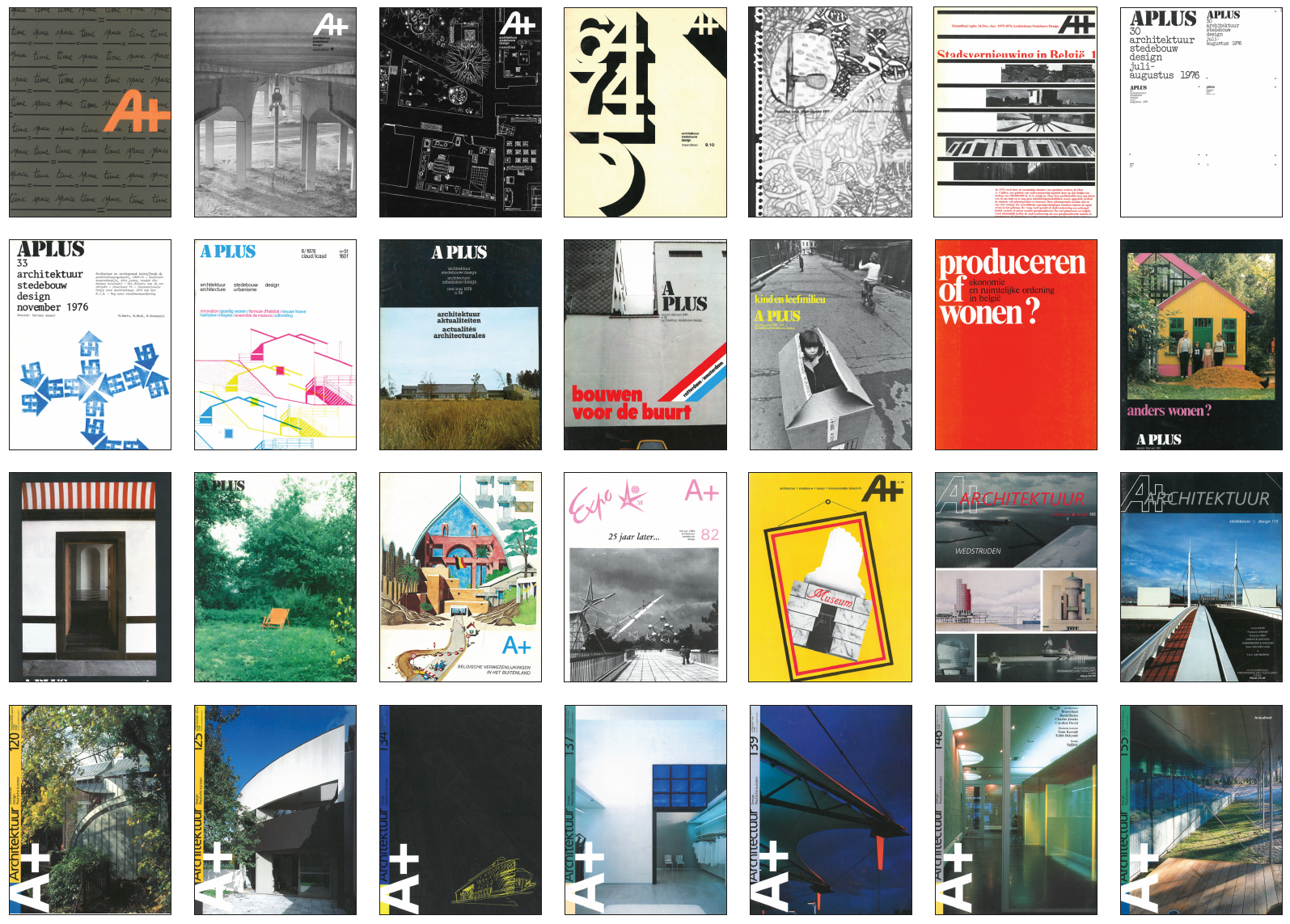
In issue A+ 300, the editorial team announced the magazine’s 50th anniversary! But the real anniversary issue is actually the one you are reading right now: issue A+ 302, published in June. Exactly fifty years ago, in June 1973, the very first issue of the magazine was published, with architect and teacher Jan Bruggemans (1946–2022) as editor-in-chief. The editorial team asked Maarten Delbeke, professor of architectural history at ETH Zurich, to look back on these fifty years. A member of the A+ board of directors from 2013 to 2017, he succeeded Kristiaan Borret as chair in 2015, a position he held until 2016. In issue A+ 200 (2006), he had already delved into the archives to assess the impact of the magazine over its thirty years of existence. Twenty years and a hundred issues later – and with a little more mental and physical distance – he revisits the vision conveyed by A+ and the magazine’s possible future identity.
Looking back on my analysis of the first 199 issues of A+ for the 200th edition, I was struck by how, from the outset, the journal ventured like a tightrope walker between a critical practice of architecture and a slowly developing critique of architecture. Many architects wanted to use architectural design and education to tackle the problems of the built environment in Belgium. This ambition required a vigorous defence of the profession and the architect’s mission – a cause that a mature and partly autonomous critique never wished to serve. Moreover, criticism also linked architecture to artistic and academic research. These practices often distance themselves from the professional field rather than blindly supporting it. At the time of issue A 200, this tension was still very noticeable, even though a new self-confidence was beginning to emerge both in the journal and within Belgian architecture.