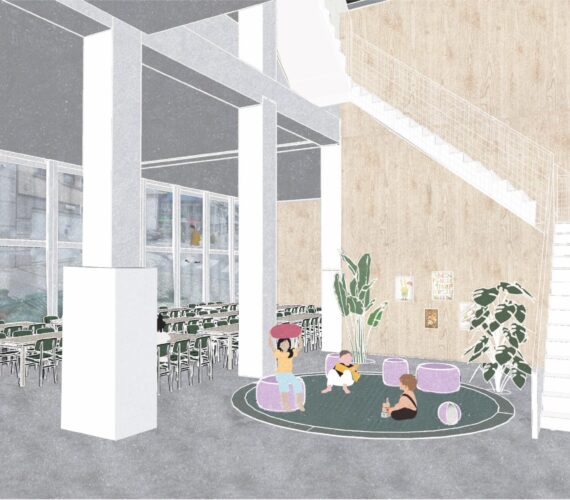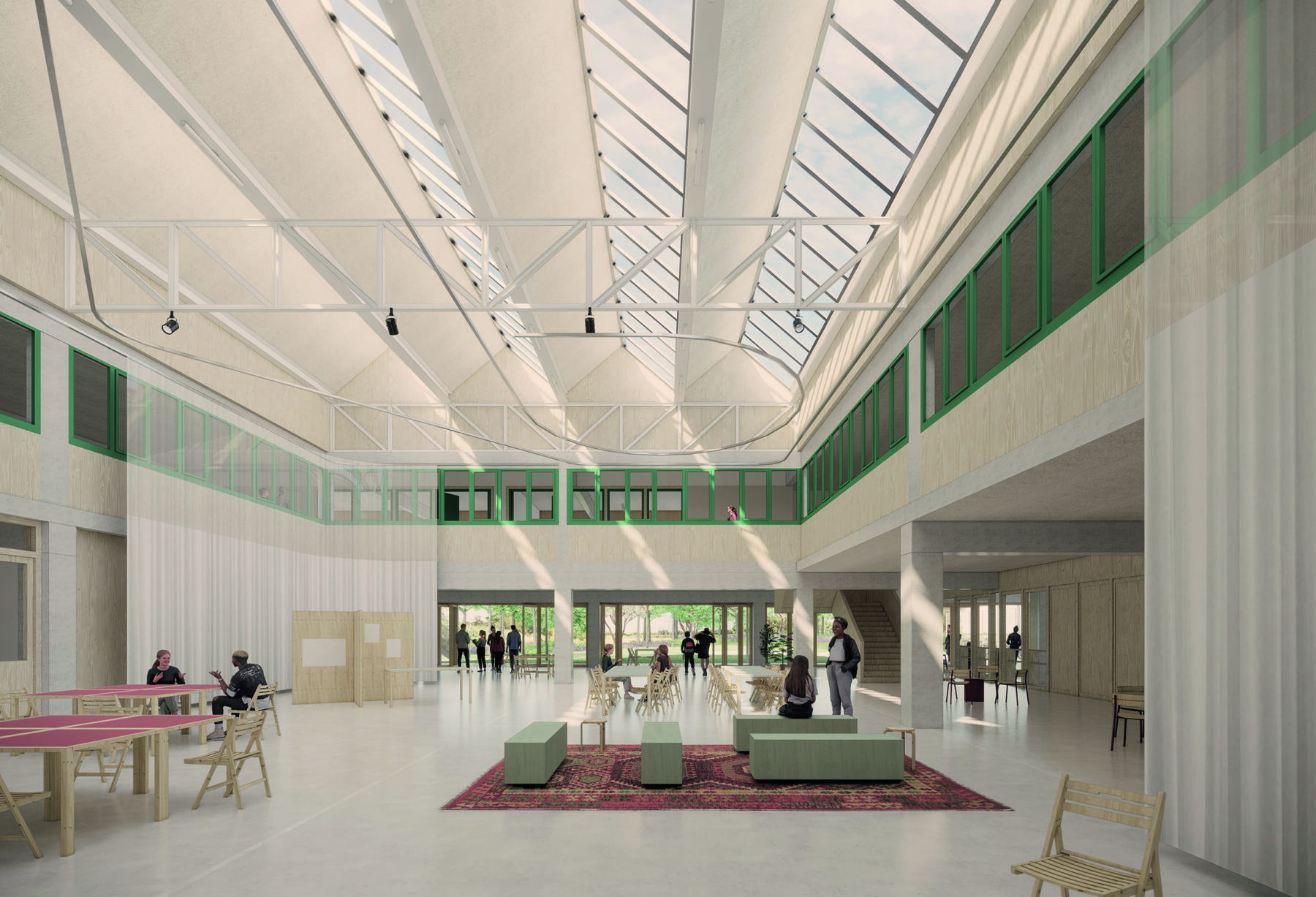
The Architecture Unit of the Wallonia-Brussels Federation has launched a competition to develop an expanded campus and address the many challenges facing the Athénée Royal Paul Delvaux secondary school in Louvain-la-Neuve. How can this office building be transformed into a high-quality secondary school to accommodate students in the context of the new core curriculum vision? How can a new urban dynamic be generated where the building will have to interact with its surroundings, both through the language of its façades and through the paths taken by future pupils within the neighbourhood?
Located in the Lauzelle neighbourhood of Louvain-la-Neuve, the Athénée Royal Paul Delvaux is currently cramped in the six terraced houses it has occupied for years. Organised around a participatory approach to general secondary education, the school wishes to benefit from a new branch in order to develop an enlarged campus by converting a former office building located nearby. Spread over two levels, the square-shaped building is structured around a central patio and benefits from an extension that generates a volume that does not really dialogue with the existing context. This lack of dialogue is reinforced by the language of the exterior façades, which are rigorously banal. Nevertheless, the building offers a rational structure composed of posts and beams and has a surface area of approximately 3,000 m² capable of accommodating the expected 320 pupils. The new site is strategic, as it is close to the current school and bordered by the future Athéna-Lauzelle district (1,400 homes), which will be developed on the other side of the boulevard separating them. Among the five proposals received, each of high quality, it was the team of Goffart-Polomé – Czvek Rigby team that came out on top, proposing a project based on a certain degree of detachment and a vision on a neighbourhood scale. What distinguishes the project from its competitors is the response it offers on an urban scale, in which the school integrates a new public pedestrian link connecting the current neighbourhood with the one that will be developed beyond the boulevard. This development redefines the urban layout of the neighbourhood by evoking the idea of a school campus linked by pedestrian alleys, which has become a trademark of Louvain-la-Neuve.