Every year, the BMA team selects and funds research proposals from civil society organisations, designers and researchers under the BMA Label. With Label, the BMA team encourages experiments in the urban domain and defines emerging research themes. This article takes a closer look at two projects: Du bruxellien au bruxellocène(Maxime Jaume and Lucile Pujol, BMA Label 2023, in final phase) and Stadssubstraat (Plant & Houtgoed, BMA Label 2024, ongoing). These projects share a common interest: they investigate the soil, more specifically the Brussels urban soil, with its complex interweaving of surfaces, processes and policy measures.
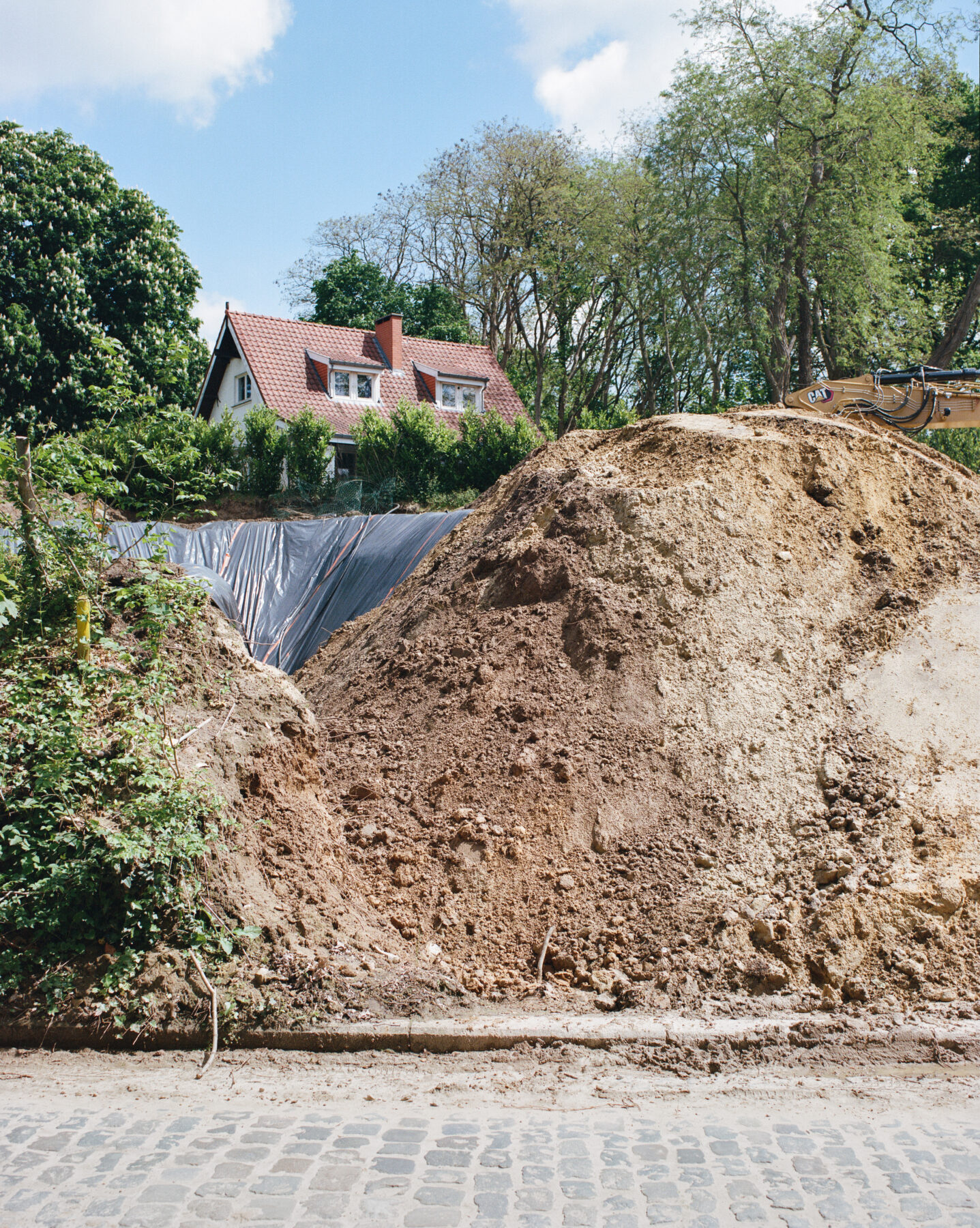
The Brussels-Capital Region rests on a base of sedimentary rock that is more than 500 million years old. This base is covered by a geologically much younger layer: the Quaternary. Various human interventions, such as excavations and embankments, have altered the nature of this soil and blurred the boundaries between geology, soil science, biology and urban planning. However, the two projects approach this “deep” cross-section in different ways, by examining two different soil layers: Stadssubstraat analyses the surface layer of the Quaternary formation, a layer rich in organic matter, while Du bruxellien au bruxellocène examines the layer directly below it. This layer contains a specific geological sand formation characteristic of the Brussels Region: the Brusselsian. Two layers and two protagonists, then: anthropogenic soils as development potential for “new ecosystems” and the sand layers of Brussels, which are not examined as inert and passive matter, but as an active force, a “living participant in human technology and culture”, jointly responsible for the construction and decomposition of the capital region.