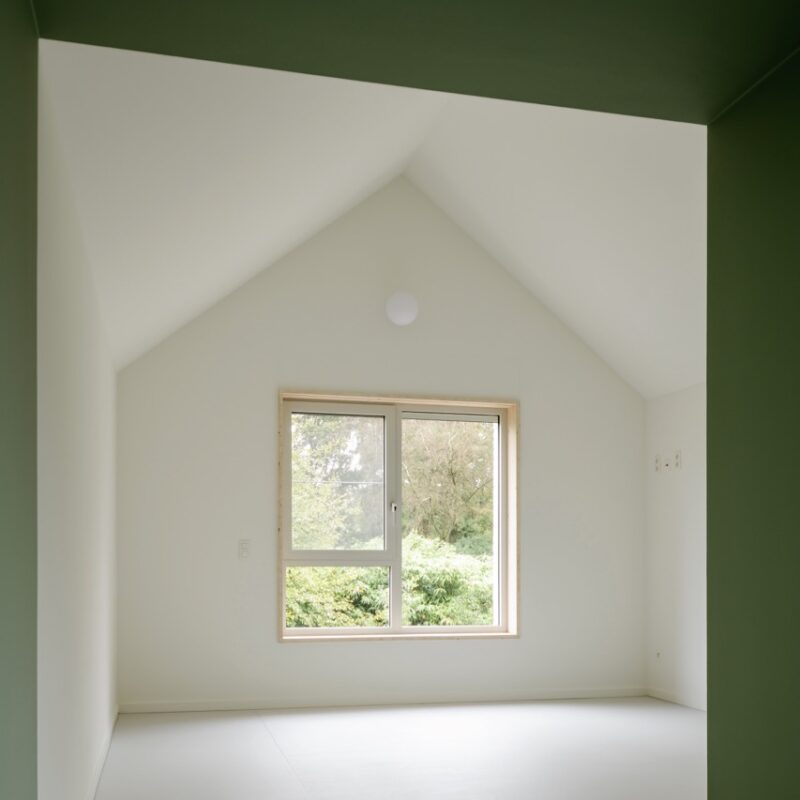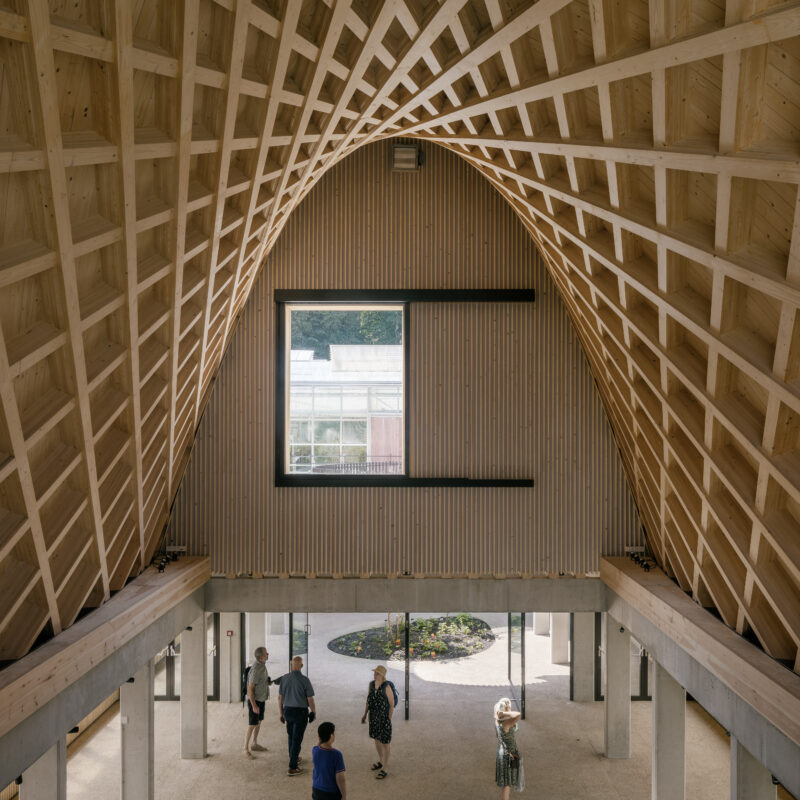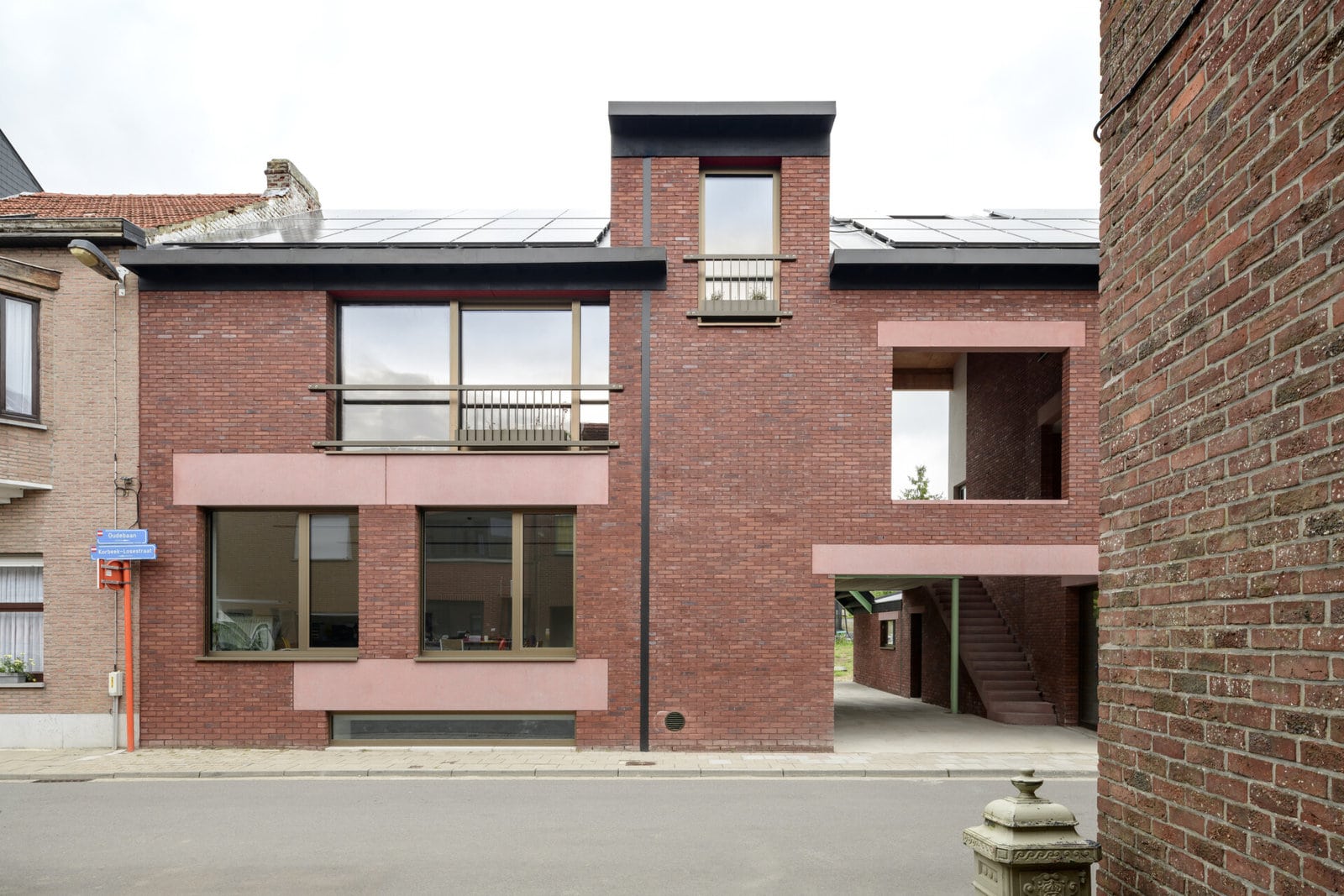
Set to the rhythm of the street, the brick façade seems to conform to generic terraced houses. Or is it just an impression? Behind the outer shell, in the middle of this unusual collective dwelling in Leuven, the Carton123 architecten firm has left almost the entire space of an entire house free, from the front to the rear and across the entire height, up to the gabled roof. However, there are four houses on this site, where the building code in force would normally only allow three.
Sofie and David, parents of four children, took the initiative to involve An and Ludo (Sofie’s parents), Peter (her brother), as well as Sarah (David’s sister) and her three children in their project. The architects therefore designed this dwelling for an ‘extended family’, a term from cultural anthropology used to describe a nuclear family supplemented by other family members. The four households do not share living spaces, but they do share a communal garden and an internal street, a laundry room and storage space in the basement. As they do not share living spaces, this is considered – according to the definition of the province of Flemish Brabant – to be co-housing, rather than ‘co-living’. To combine co-housing and the internal street, the architects played with four types of dwellings in their plans and sections: a partially underground duplex with a patio and four bedrooms, a ground-floor dwelling adapted to life changes, a duplex on level 1 and a more traditional flat.