Edito
Eline Dehullu – Rédactrice en chef
Sofie De Caigny – Co-rédactrice en chef
The developer, a key player in spatial quality
Abroad, the Belgian public procurement system is widely admired. Institutions such as the Vlaamse Bouwmeester and the Brussels Master Architect, as well as the Architecture Unit of the Wallonia-Brussels Federation, are internationally recognised for their role as guardians of quality and facilitators of processes. Through project competitions, quality chambers and active dialogue with designers and clients, they have succeeded in placing spatial quality at the heart of public procurement.
However, in Belgium, spatial development is largely in the hands of private actors. Nowhere else in Europe is their impact on the landscape so great. Over time, this influence has grown, taken root and become multifaceted. As the public authorities have played a rather limited role in land use planning and housing policy for several decades, property developers and private individuals have enjoyed considerable latitude in shaping the face of towns and villages. Private initiatives are therefore not complementary, but often decisive in the transformation of our national space. It is precisely this dominant position that requires critical reflection, given that the quality of private projects varies greatly. Some stand out for their quality and architectural and urbanistic appropriateness, while others sink into banality or the pure pursuit of maximum profit.
In this issue of A+, we examine how the culture of private construction manifests itself today, what mechanisms underpin it, and above all, how it can contribute to improving spatial quality. Together with guest co-editor Sofie De Caigny, we looked at the instruments, formulas, regulatory measures, design strategies and forms of collaboration that could encourage private developers to carry out projects that transcend individual private demand and, to a certain extent, take into account people, the environment and the future.
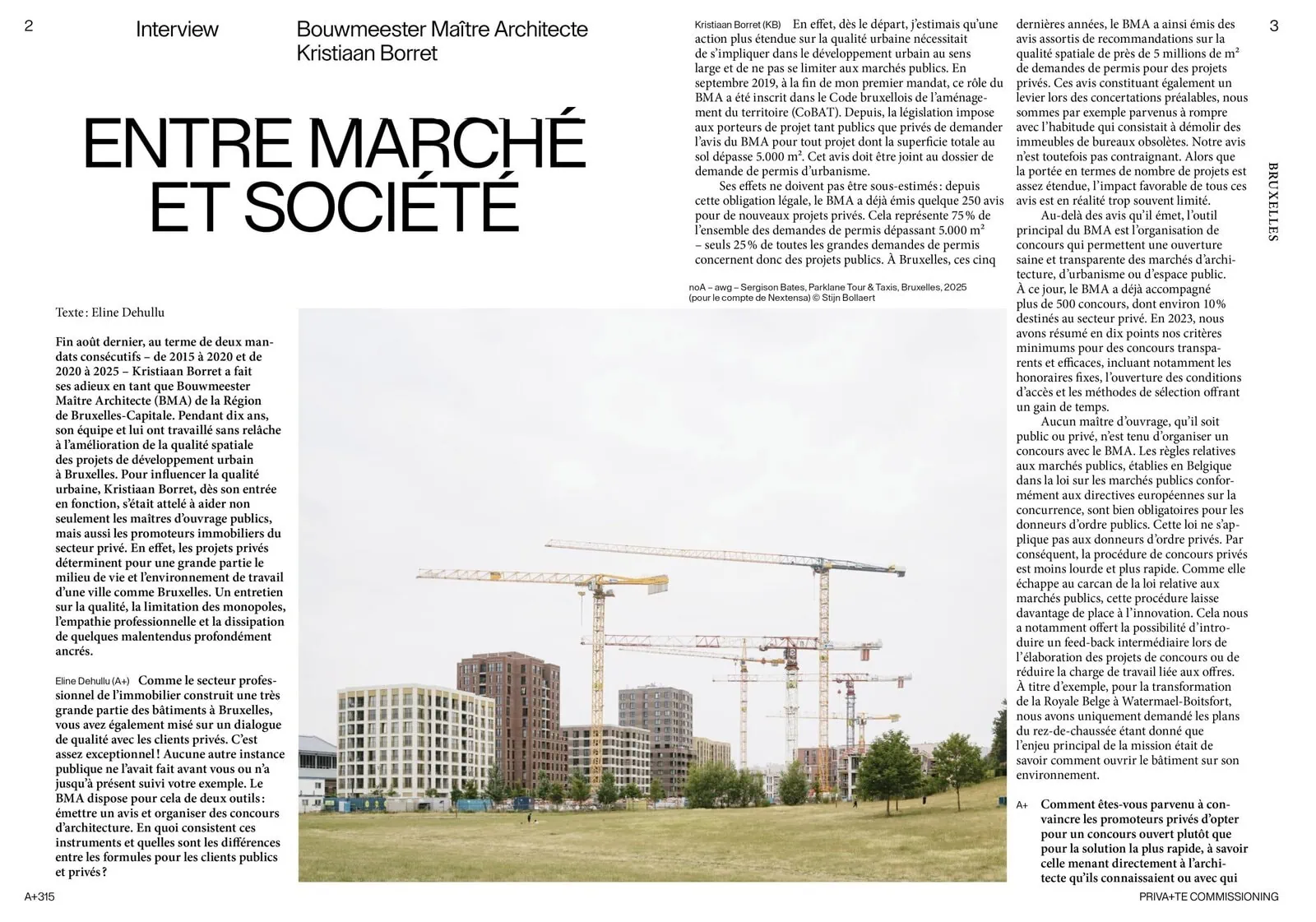
As the capital, Brussels acts as a magnifying glass on the culture of spatial planning in Belgium. Géry Leloutre describes how the city – and more specifically the Northern Quarter – has developed over decades under the influence of private developers, without any strong and systematic coordination policy. As private actors and individual initiatives had free rein, the city developed more according to market logic than spatial vision. From the start of his term as Bouwmeester Maître Architecte bruxellois (BMA) in 2015, Kristiaan Borret has attempted to reframe things. Together with his team, he organised consultations and encouraged design competitions, particularly for private real estate projects, addressing quality at an early stage and through ongoing dialogue. In this culture of collaboration, private developers are partners in urban development who contribute to a high-quality city that is a great place to live.
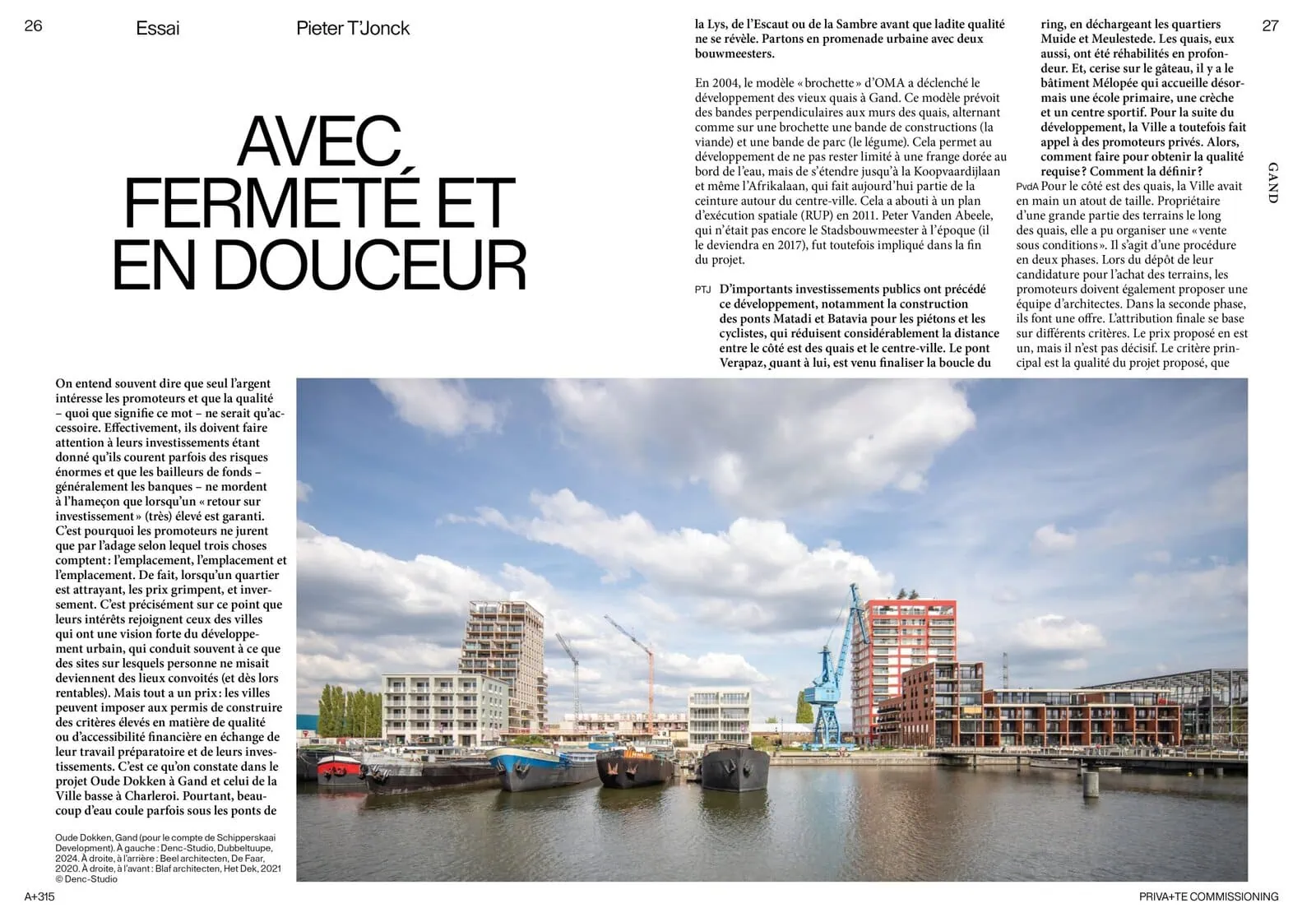
Ghent and Charleroi also show how a city with a strong vision can encourage private developers to commit to quality. Accompanied by bouwmeesters Peter Vanden Abeele and Georgios Maïllis, Pieter T’Jonck visited recently completed projects that demonstrate how urban development and commercial logic can reinforce each other, provided that the preconditions are clear and underpinned by a long-term vision.
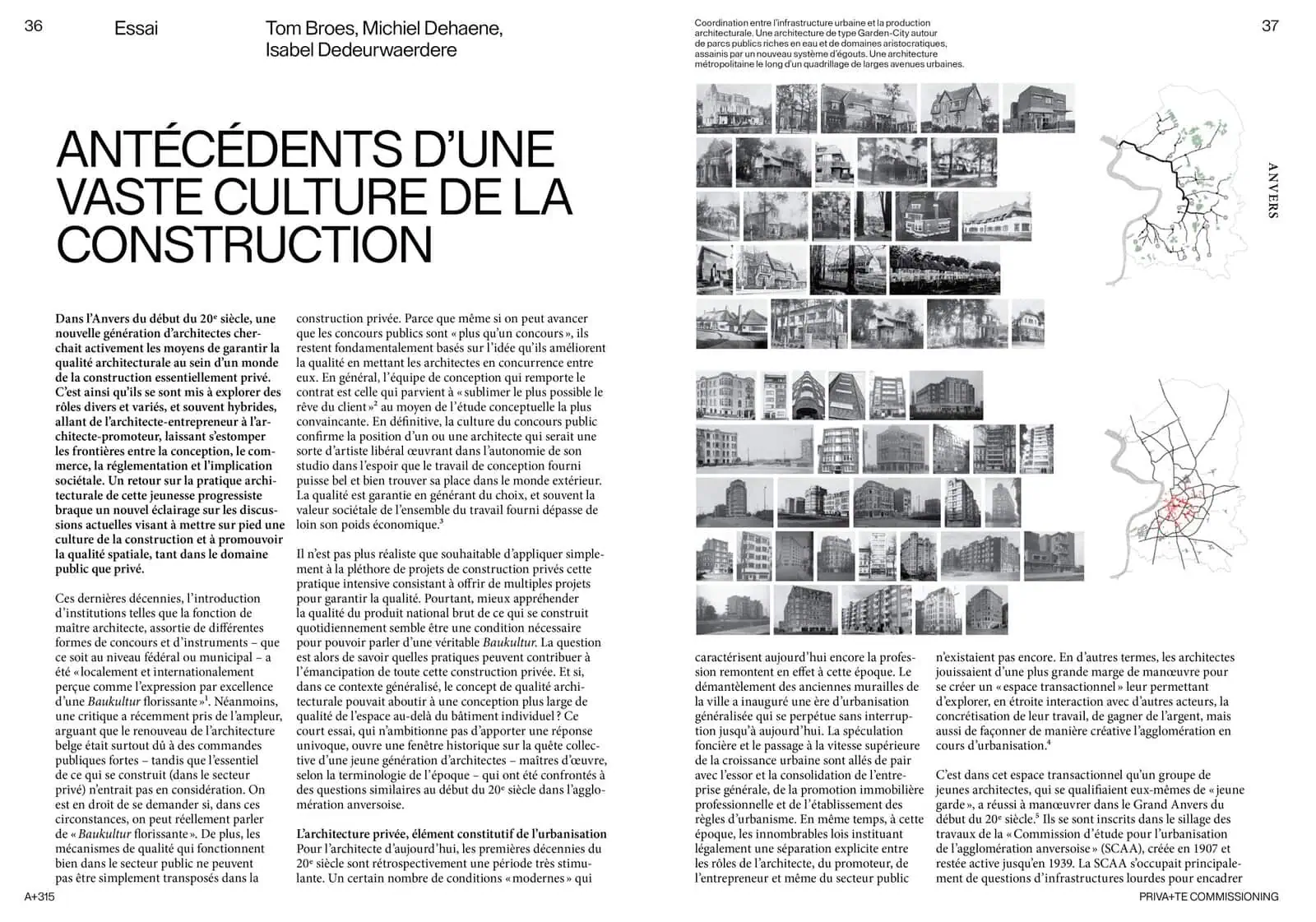
Inspiring examples of alternative forms of private commissioning can be found both in the past and in the present, often initiated by architects. Tom Broes, Michiel Dehaene and Isabel Dedeurwaerdere examine how, during the rapid urbanisation of the Antwerp conurbation between the two world wars, architects took on hybrid roles to ensure architectural quality in a privately-driven construction culture. As part of a broader societal commitment, these architects worked to promote quality by taking on various positions themselves to represent the profession. The essay also offers food for thought on the role of architects in the context of private commissions today.
Peggy Totté, for her part, is interested in private requests from cooperatives as an alternative to the dominant model of individual ownership. Housing cooperatives offer the prospect of collective responsibility and spatial cohesion, values that have become indispensable in a fragmented landscape.
Finally, we also give a voice to the developers themselves. During a round table discussion, they reflected with designers and policy makers on the conditions required to create good development opportunities. In their respective roles, they are all concerned with the quality of space and the “public interest” in private development projects. And they all agree that, in order to improve architecture and urban development, beyond more refined policy frameworks and transparent processes, what is needed above all is greater cooperation, dialogue and shared ambitions.
Table of contents
PRIVATE COMMISSIONING
Editorial – The Developer as an Actor of Spatial Quality
Eline Dehullu and Sofie De Caigny
Interview – Kristiaan Borret: Between Market and Society
Eline Dehullu
Essay – The Private Life of Architecture in Brussels
Géry Leloutre
Round Table – Conditions for Favourable Development Opportunities
Sofie De Caigny and Eline Dehullu
Essay – Firmly and Gently
Pieter T’Jonck
Essay – History of a Wide-ranging Construction Culture
Tom Broes, Michiel Dehaene, Isabel Dedeurwaerdere
Essay – Cooperative Commissioning
Peggy Totté
Opinion – Working for Project Developers
Paul Vermeulen
PROJECTS
LAVA
Paul Van Ostaijen Site, Leuven
AAC
Communal Swimming Pool, Ixelles
A Practice
Philippe Geluck School, Herseaux
LRArchitectes
Six Heures Barn, Nil-Saint-Vincent
Bovenbouw – David Kohn
Beguinage, Hasselt
Studiobont
Waterkant, Ghent
SNCDA – Jan Minne
Endymion, Luxembourg
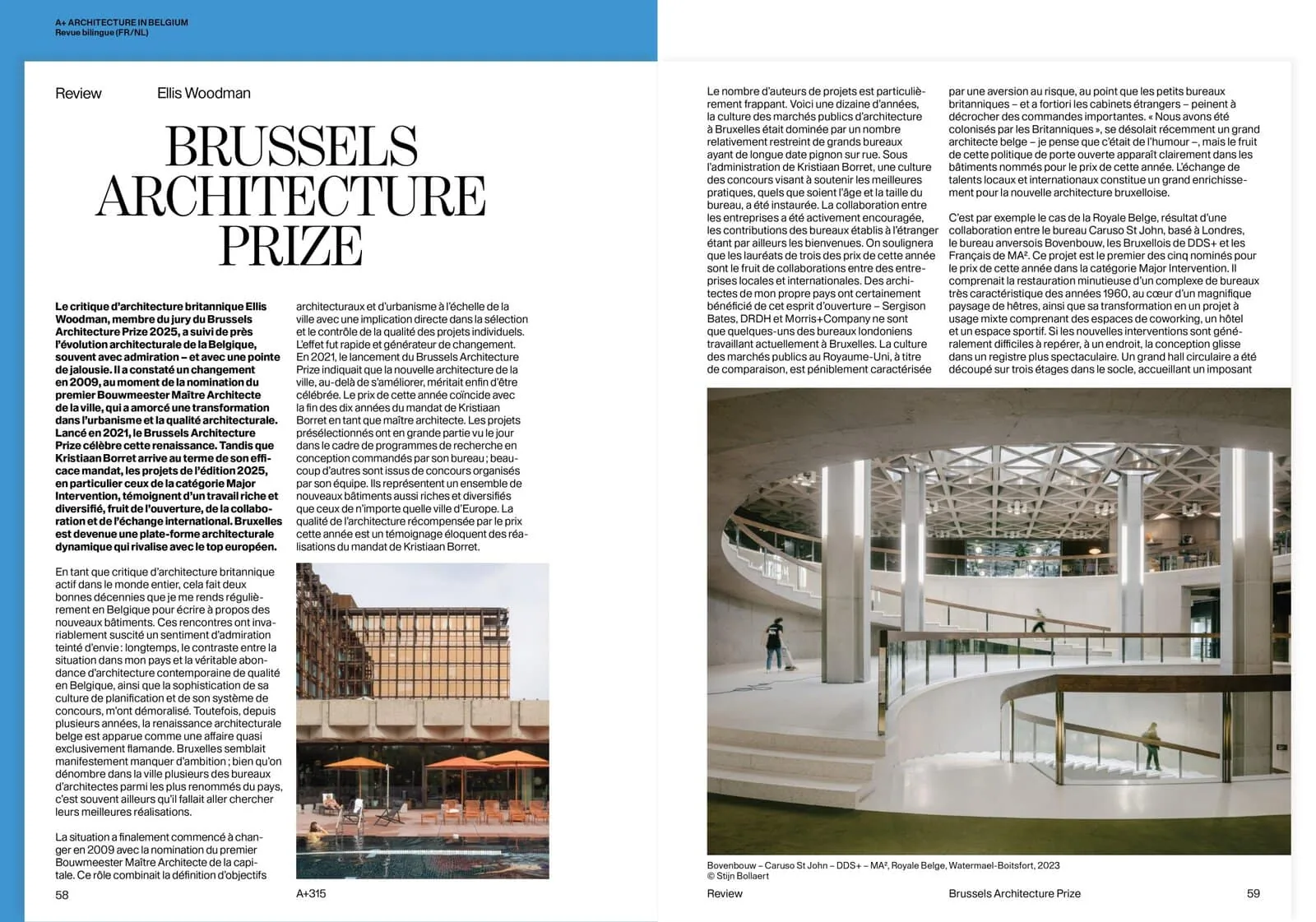
Brussels Architecture Prize
Ellis Woodman