Edito
Eline Dehullu – Editor-in-Chief
“Never demolish, never move or replace, always add, transform and reuse, with and for the residents. Anne Lacaton’s (Lacaton&Vassal) philosophy is becoming a starting point for a growing number of architects, especially when it comes to average residential or office buildings that, lacking historical or cultural value, are quickly falling prey to demolition.
Institutional and symbolic buildings such as churches are often so closely linked to the history and identity of a place and its inhabitants that demolition is not an option. However, when the function of such a building declines, what new use can be given to it? And when this is ideally done in consultation with and for the residents or local community, how should it be done? It has been a long time since towns, villages and neighbourhoods were homogeneous communities where everyone shared the same history, culture and religion. What some people see as an obvious recontextualisation will be considered sacrilegious by others.
“[A parish church] expresses a culture and history that, to this day, define our human condition,” writes Erik Wieërs in Herscheppen, the report of a study by Team Vlaams Bouwmeester on the repurposing of churches in Flanders. Furthermore, in a secularised society, some new programmes are not really appropriate. It is the churches that are likely to remain what they have always been – namely a local meeting place – that are most likely to be integrated and adopted. The repurposing of the Heilig Hart church in Mont-Saint-Amand as a community centre and the Notre-Dame des Douleurs church in Wavre-Sainte-Catherine as a school building are just two examples among many other successes.
While the initial controversy surrounding the repurposing of churches has lost its virulence, the renovation of other iconic buildings or emblematic monuments is increasingly striking a chord. The current spirit of anti-racism is prompting various authorities to decolonise public spaces. In the wake of the anti-racism protests that took place around the world following the death of George Floyd in 2020, the Brussels-Capital Region set up a working group which, in 2022, published recommendations for identifying, contextualising, removing or transforming symbols evoking the atrocities perpetrated in the Belgian colonies in Congo and Rwanda.
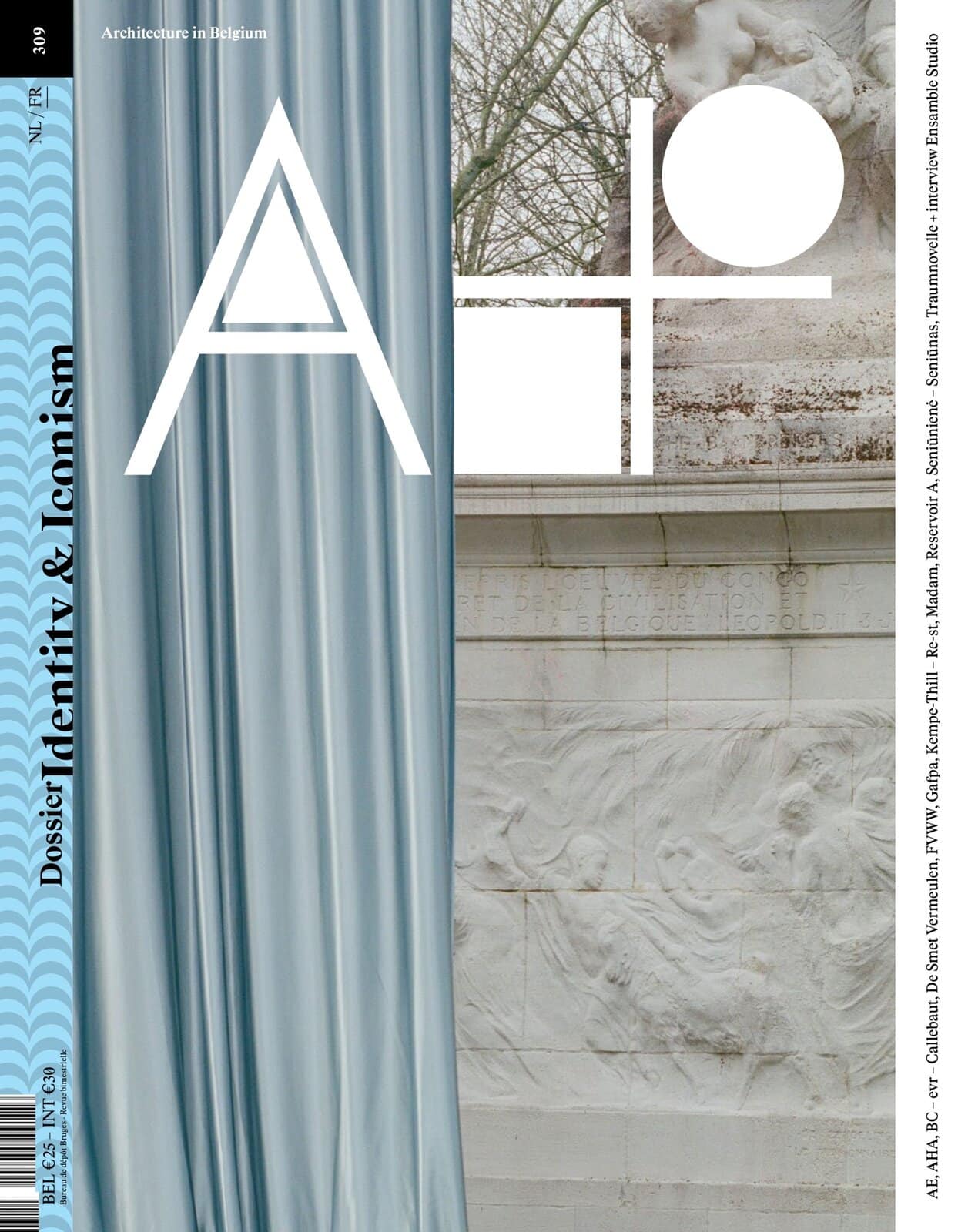
Traumnovelle’s intervention on the Congo monument in Brussels’ Cinquantenaire Park is one of the first projects to open the debate on architectural heritage tinged with traumatic memories. How to deal with ‘difficult heritage’ is an increasingly topical international issue. In 2023, the DAAR (Decolonising Architecture Art Research) collective won the Golden Lion at the Venice Architecture Biennale with a contribution on the critical appropriation and reuse of Mussolini’s fascist architecture. The same biennale also honoured the work of Sammy Baloji, a Brussels resident originally from Lubumbashi. In his film Aequare: the Future that Never Was, he presents, in absurd detail, the territorial and cultural annexation of Africa by Western colonists: from decaying European architecture that apparently cannot withstand the extremely humid climate to disoriented scientists dripping with sweat in their starched collars. This magnificent film directly inspired this issue of A, dedicated to identity and iconicity.
How does a city or nation deal with a heritage that commemorates atrocities? As a society, how do we manage public symbols that remind us of a past we are ashamed of, such as slavery, exploitation or large-scale abuse? In this sense, churches may also be part of ‘difficult heritage’. This is obviously also the case for the house occupied by serial murderer and rapist Marc Dutroux in Marcinelle. After some three decades, Réservoir A, exercising great caution and empathy for individual grief and collective shame, has transformed this particularly charged site into a serene place of remembrance with symbolic value for the entire community. This is a fine example of how the ideological and social dimensions of architecture can be brilliantly expressed in a small project such as this.
Table of contents
IDENTITY & ICONISM
Julius Seniūnas & Dalia Puodžiūtė Seniūnienė
Interview – Ensamble Studio (ES)
Eline Dehullu
PROJECTS
COMPETITION
Competition FWB Cellule architecture
“The mutation of Ougrée”
PORTRAIT
STUDENTS
NEWS
Expo IABR 2024
Veronique Patteeuw
Architecture Guidebook Louvain-la-Neuve & Walloon Brabant