Edito
Lisa De Visscher – Editor-in-chief, A+
“You know, they’ve straightened the Mississippi River in some places to make room for houses and farmland. From time to time, the river floods these areas. They use the word “floods”, but in reality, they’re not floods: they’re memories. Memories of where it used to be. All water has a perfect memory and constantly tries to return to where it was.” Taken from a lecture given more than thirty years ago in New York by author and Nobel Prize winner Toni Morrison, these few sentences are more relevant today than ever: water flows where, depending on the topography and climate, it is most appropriate. Whether dammed, drained, diverted or straightened, natural watercourses often end up regaining the upper hand.
At the 18th Venice Architecture Biennale, which began last month, curator Lesley Lokko presents the ‘Laboratory of the Future’, featuring projects mainly designed by architects of African origin. Climate change, and by extension our management of water, is one of the most hotly debated topics, with architecture, urban planning and landscaping providing the key to sustainable solutions. Several national pavilions have addressed water management, notably the Netherlands with Plumbing the System and Denmark with Coastal Imaginaries, while Finland and Germany have installed dry toilets as a political statement. While it is an understatement to say that water is omnipresent in Venice, the severe flooding in northern Italy in May and the unmistakable presence of MOSE, the bright yellow flood defence system designed to protect the City of the Doges from seawater, remind us once again of the current emergencies.
In Belgium, the memory of the disastrous floods in the province of Liège in 2021 is still very much alive, and the wounds have not yet fully healed. At the same time, we are facing a persistent problem of drought, which last spring’s rainfall, although abundant, was not enough to remedy. The days when Belgians’ main concern was to drain large amounts of rainwater as quickly as possible are now long gone. It is clear that drought and flooding go hand in hand.
‘To solve the problem of drought,’ writes Julie Mabilde of Labo Ruimte, “we need to make a radical shift and replace rapid water drainage with a system of infiltration, retention and slowing down of water on site. Furthermore, to combat flooding, the strategy of storing water much further upstream in order to relieve the valleys in the event of heavy rainfall is also very effective. It is a question of spatial planning, which requires a completely different approach to our space and our landscapes – and is therefore a design mission.” A large-scale design mission. Watercourses cover vast areas and cross administrative and political boundaries. Today, this policy is highly fragmented. In Flanders, in terms of competences, there is the Vlaamse Waterweg for all navigable waterways, the Vlaamse Milieumaatschappij for large non-navigable waterways, the provinces for smaller waterways, and the municipalities for streams. Given that all these streams and rivers are connected, this gives rise to endless flows of complex partnerships at different levels of power and an administrative jumble of contracts that complicate any large-scale intervention. After the floods in the province of Liège, efforts were therefore made once again to develop a more comprehensive approach, for example through a Walloon master architect.
If we want to stop neglecting water’s perfect memory so that it can regain the space it needs, we must organise our management of it differently and follow the logic of water itself. Only by creating water companies and adopting a radically different approach – for both rainwater and groundwater – will we finally be able to restore water to the role it has always had, namely no longer considering it a threat, but as the sine qua non of all life.
Table of contents
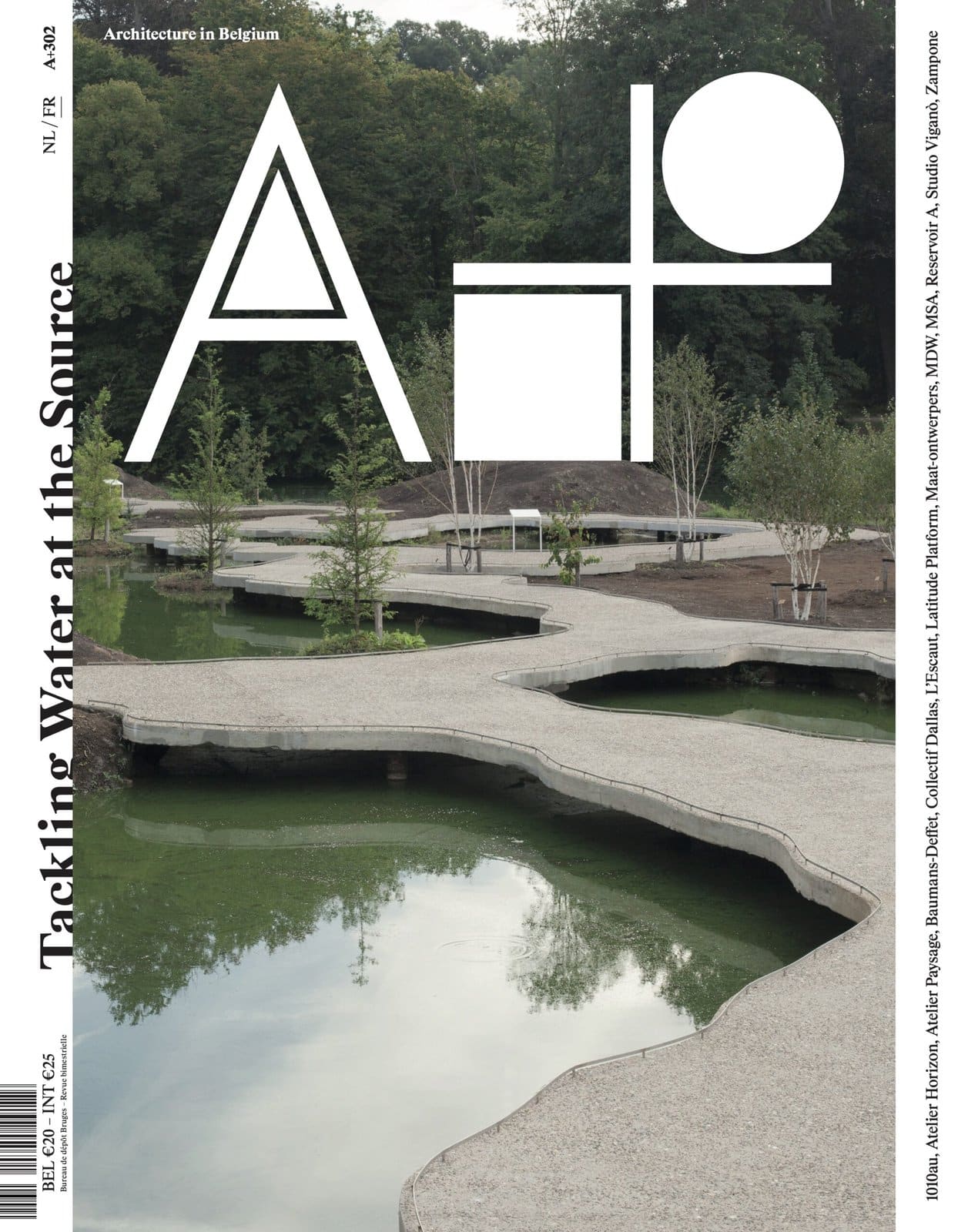
TACKLING WATER AT THE SOURCE
Lisa De Visscher
OPINION – Function follows soil
David Verhoestraete
Wetland, Chevetogne
Studio Paola Viganò – MSA – Baumans-Deffet
Vesdre Basin
Dendre Valley
Round table – “Guardians of water”
Louisa Contipelli, Joeri De Bruyn, Bram Vandemoortel
Julie Mabilde
50 years of A+ archive: Optimism below the waterline
Emmanuel van der Beek
City of Antwerp – Aquafin – Water-link
Garden streets, Antwerp Bart Tritsmans
L’Eau d’heure, Cerfontaine – Charleroi
Woluwe terre d’eau 2050
BMA Label: Herbronnen / Re(S)Sources
Robin De Ridder, Henri Lebbe, Nele Maes
Gijs Van Vaerenbergh – Atelier Arne Deruyter
Jardin de l’Île, Meise
Latitude Platform – Collectif Dallas
Eau de couture, Brussels
IN THE SPOTLIGHT
A+ 50 years: Everything is architecture
Maarten Delbeke
Philippe De Clercq
Venice Architecture Biennale 2023
Lara Molino
Eline Dehullu
COMPETITION
Parc de la plaine des Manœuvres, Tournai
Jean-Philippe De Visscher
RECENT PROJECTS
Petite Senne, Molenbeek-Saint-Jean
Terre-Neuve, Brussels
STUDENT
Lisa De Visscher
Riet Coosemans
PORTRAIT
Eline Dehullu
Lisa De Visscher
Eline Dehullu