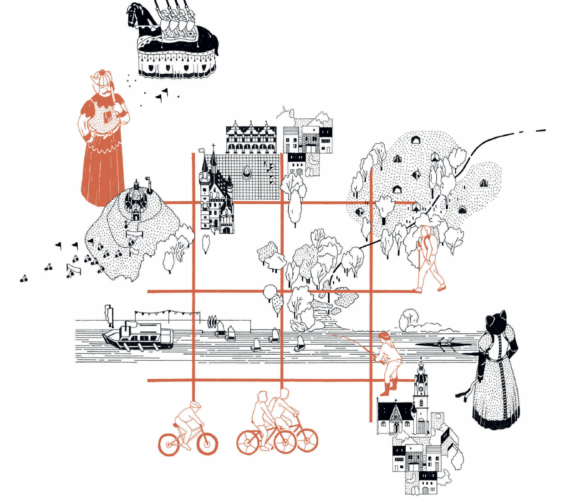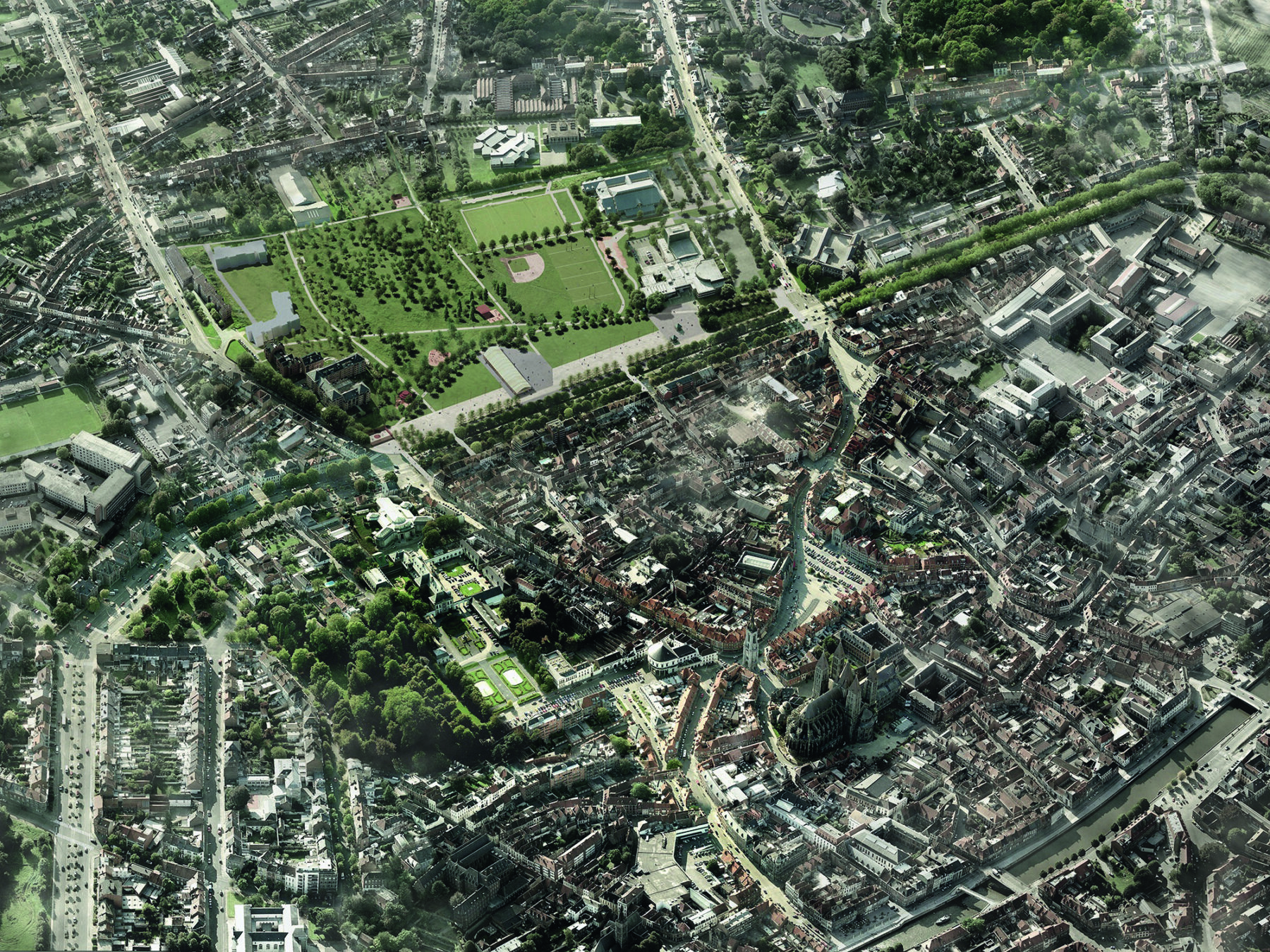
How can we connect the centre and the outskirts of Tournai? How can we restore the elegant landscape of boulevards that have become motorways? How can we reconnect a site that has been fragmented by multiple uncoordinated developments? What are the role, uses and image of a large urban park today? Above all, how can we meet these challenges with an extremely limited budget? Through their projects for the Plaine des Manoeuvres park, five teams demonstrate the virtues of poetic pragmatism, where the essential thing is to take care of existing urban spaces, the biodiversity that develops there and the people who will shape its future.
Located on the edge of the boulevards surrounding the centre of Tournai, on the site of former fortifications, the Plaine des Manoeuvres is a vast space of around 17.5 hectares belonging mainly to the City of Tournai. Over time, the edges of this large land reserve have been used to build the Maison de la Culture (cultural centre), a sports hall, sports fields and a skatepark, a car park regularly used as an event area for fairs, markets, etc., as well as residential buildings. In the centre, spontaneous vegetation is gradually colonising the remaining space. The City of Tournai’s ambition is to transform the 5.8 hectares of undeveloped space into a large urban park. The aim of this park will be to re-establish links between the city centre and the outlying districts, particularly in terms of active mobility. It will reintegrate existing facilities into a coherent landscape and support the development of new recreational uses. Finally, it will enhance biodiversity and the continuity of the green network. As the budget allocated to address these various issues is particularly low, the real challenge is to make the most of the elements already present, to support the natural development of spontaneous vegetation and to mobilise residents in the activation and management of the park. To achieve this, the City of Tournai, supported by the Architecture Unit of the Wallonia-Brussels Federation and a jury of invited experts, launched a call for project proposals through a competitive procedure with negotiation. Five teams were selected from the eleven applications received and were invited to develop a preliminary sketch. At the end of this process, the contract was awarded to the POP-VVV team.