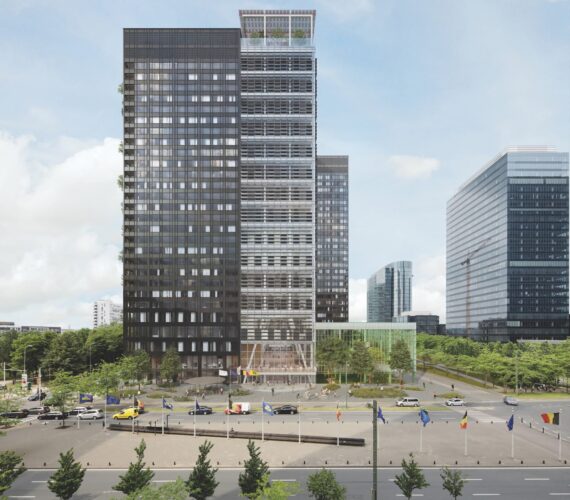
Can high-rise buildings contribute to a denser urban fabric that is simultaneously healthier, more diverse, self-sufficient, carbon-neutral and scalable? And if so, how? This year, Sven Verbruggen and Bart Hollanders are working with Master’s students from the University of Antwerp to explore the ‘good’ reasons for building upwards. In this ‘vertical’ master’s studio, fourth- and fifth-year students are working on the same theme. Together, they read Rem Koolhaas’s 1978 book Delirious New York as a typological manifesto, and started from the premise that, in terms of high-rise buildings, all the cards have been on the table since the late 1970s. Today, however, the priorities have shifted, and it is climatic, economic and social concerns that determine which aspects of high-rise construction can still be utilised.
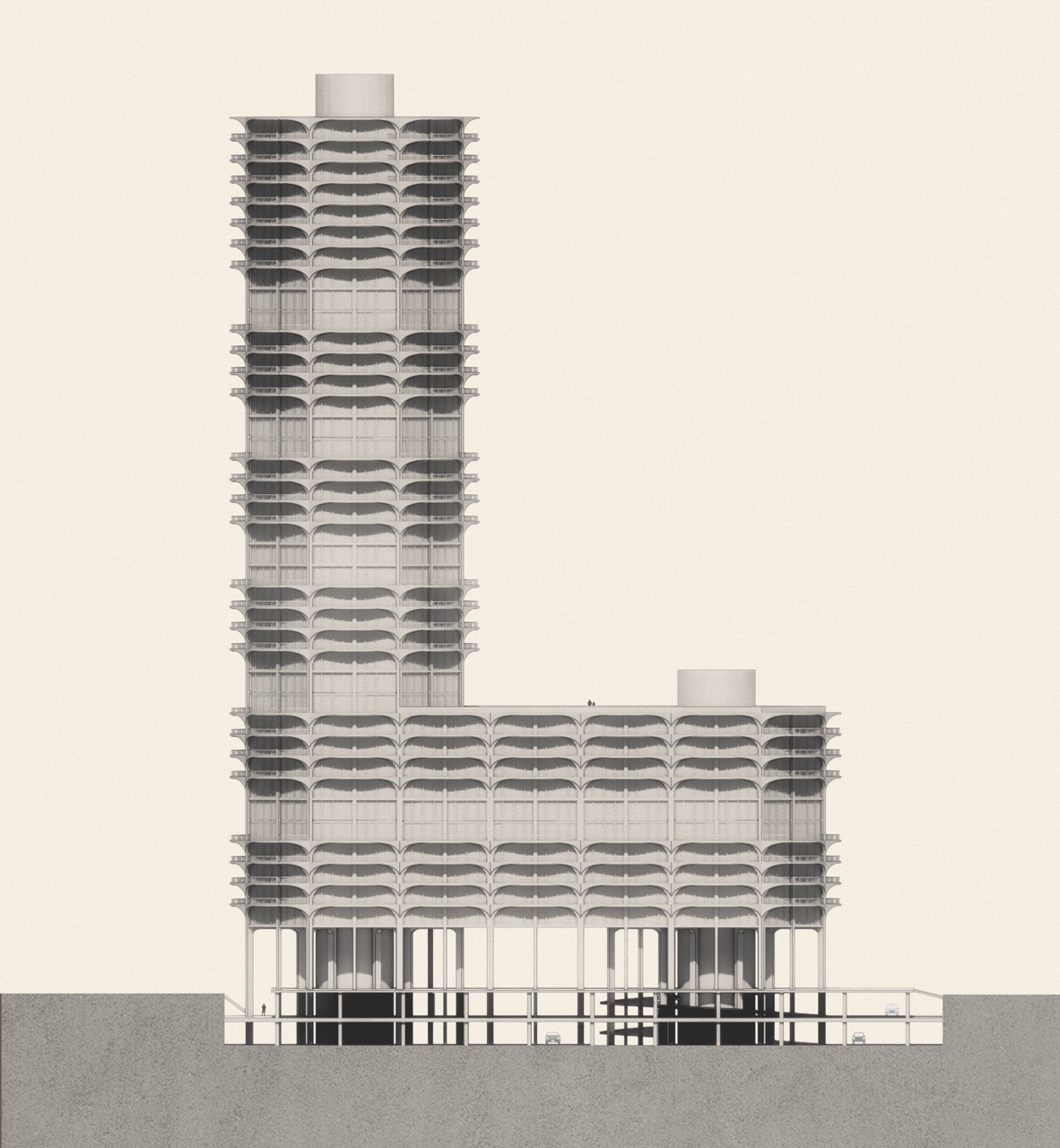
The second-year Master’s students were tasked with further exploring this theoretical framework, drawing on various themes such as metabolism, discourse, medium and message, and cultural perception. Based on these themes, they are investigating how high-rise buildings relate to the city. Sven Verbruggen: “In the 1970s, the upper structure of the tower took centre stage and played an iconic and performative role in relation to the city. Today, the key to good high-rise architecture lies in how the plinth helps shape the city.” That is why The City of the Captive Globe, the well-known painting by Madelon Vriesendorp, was symbolically turned upside down: instead of generic plinths with specific towers as superstructures, the students designed specific plinths whilst ignoring the superstructure from a height of 40 metres. This results in an abstract brief in which the lobby, the structure, the façade and the circulation play a crucial role. The contemporary tower turns out to be, first and foremost, a well-designed ground floor.