Edito
Eline Dehullu – Editor in Chief
Bas Smets – Guest Editor
Second nature
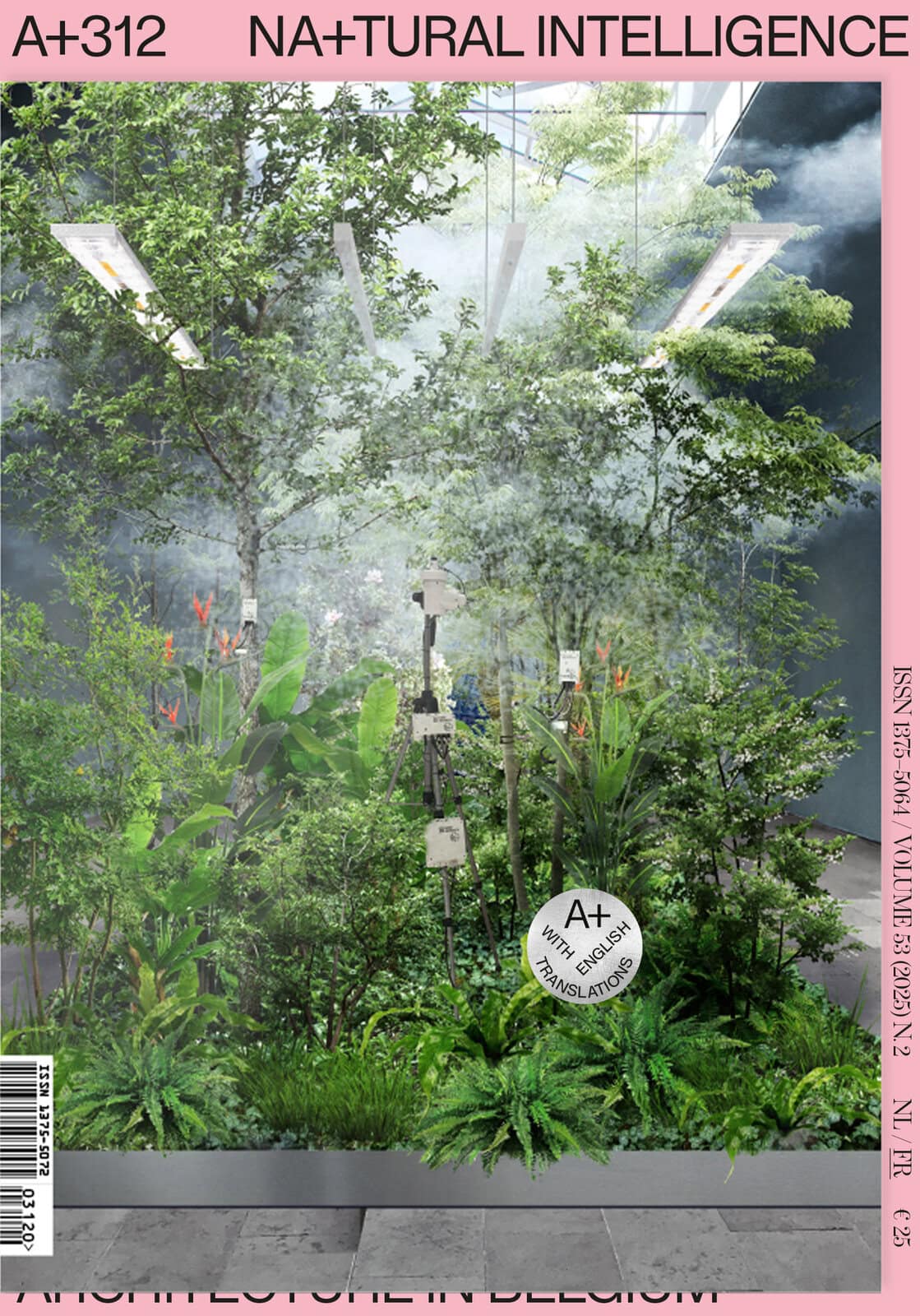
The 19th edition of the Biennale Architettura, the international high mass of contemporary architecture, will start in Venice in early May 2025. Under the title ‘Intelligent. Natural. Artificial. Collective.,’ curator Carlo Ratti brings together designers, thinkers and makers who apply different types of intelligence in their architectural, landscape and urban planning projects to respond to the major climatic challenges we face: ‘In this time of change, architecture must take the lead. It must draw on all forms of intelligence – natural, artificial and collective. It must transcend generations and disciplines, from the hard sciences to the arts.’
This is precisely what the experimental project by landscape architect Bas Smets, guest editor of this issue, and neurobiologist Stefano Mancuso in the Belgian pavilion does in all areas. With Building Biospheres, they are attempting to understand the growth and rooting processes of plants, on which the organisation of life on our planet depends, and are investigating the impact of that natural intelligence on architecture. They regard buildings as artificial spaces in which plants can produce a cooling microclimate and play a controlling role in terms of irrigation, ventilation and lighting.
Smets and Mancuso are working on this with a team of architects, historians, bioengineers, botanists and software developers. ‘Our collective intelligence enables us to better understand natural intelligence and then apply it to our living environment. What’s more, we can use the potential of artificial intelligence (AI) to better apply natural intelligence (NI) and mitigate the existential threat posed by global warming,’ Smets argues in an interview with urban planner Kelly Shannon.
Due to the accelerating climate crisis, we find ourselves at a simultaneously frightening and challenging juncture. It is an exciting moment in the history of the biosphere (the part of the earth where life is possible), because “intelligence” – human, natural, artificial – has never been greater and, when combined, can lead to solutions. Bureau Bas Smets’ projects are based on the idea of “biospheric urban planning”: the city is seen as a series of different artificial microclimates, each with its own topography, geography, geology and meteorology. The study of a comparable natural microclimate can help to introduce vegetation into the artificial variant. In this way, every city becomes a second nature.
It is a constellation of local, feasible solutions to a macro problem, and that is indeed cause for optimism. No one in Wallonia needs to be told that we must learn from nature to make our cities more resilient and flexible. During the major floods in July 2021, the Vesder river burst its banks and destroyed large parts of Chênée, a borough of Liège. The floods prompted a review of various developments in the Walloon Region and the redesign of large areas from a more sustainable perspective, with respect for rivers and their banks.
Young designers are concerned about the future habitability of the earth and are using new, different or transdisciplinary methods to arrive at spatial concepts that make a positive difference to the climate. Producing materials based on local plants, wool, algae and salts or integrated nature-stimulating building elements, nature-inclusive construction to improve biodiversity and using the soil as development potential for new ecosystems are high on their agenda. The gap between the knowledge of biologists, ecologists and field workers on the one hand and the practice of designers, clients and policymakers on the other will become increasingly smaller in the future. This will enable us to use collective intelligence to devise inventive solutions that can establish a new relationship between architecture and nature.
This summer in Venice, we will undoubtedly discover the wide variety of approaches taken by many architects in their search for non-extractive ways to build with nature and strengthen it. See you there.
Table of contents
NA+TURAL INTELLIGENCE
Eline Dehullu en Bas Smets
Interview – Bas Smets: Hacking natural intelligence
Kelly Shannon
Interview – Atelier Luma: Lessen uit de natuur
Pieter T’Jonck
Michiel De Cleene
Bert Gellynck, et al.
Chiara Cavalieri
Wedstrijd – Stad aan de stroom
Lisa De Visscher
Opinie – Afscheid van de status quo
Daniel Barber
PROJECTEN
École le Trèfle, Templeuve
De Plas, Rotselaar
Manufacture des tabacs, Straatsburg
Duinhelm, Oostende
Pier Kornel, Aalst
Gevechtscentrum, Tahiti
Emilie Bechet – Thomas Willemse
Klavertje Vier, Brussel
Interview – Herzog & de Meuron
Eline Dehullu