Edito
Lisa De Visscher
Editor-in-chief
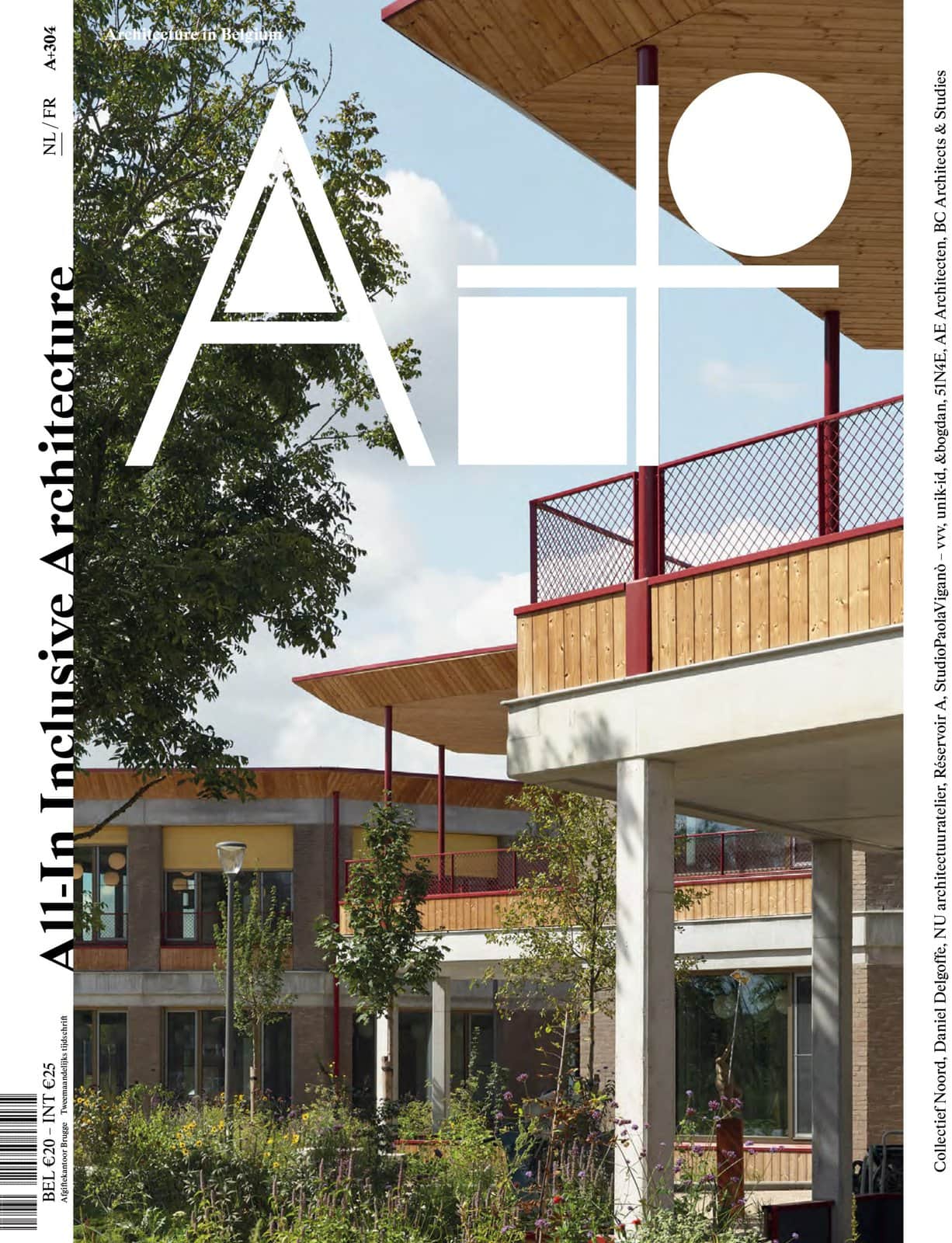
A+304 Last summer, Copenhagen hosted the UIA World Congress of Architects, where designers and researchers from around the world spent four days discussing how better design of the built environment can help us tackle climate change, contribute to growing biodiversity and, above all, create an environment for social inclusion. This year’s central theme was “Sustainable futures – leave no one behind”. The congress concluded with the launch of 10 principles for rapid and radical change in the built environment – based on the SDG, the UN’s 17 Sustainable Development Goals – to give concrete form to this theme. The first principle immediately set the tone: “Dignity and agency for all people is fundamental in architecture, there is no beauty in exclusion.”
Indeed, there is nothing beautiful about exclusion, and yet the world of architecture seems to be riddled with it. The architecture and construction sector remains stubbornly male and white. Although great strides have been made in recent decades, it is still necessary to search with a magnifying glass to find architecture firms led solely by women or people of colour. The recently established Platform for Architecture & Feminism (PAF) is dedicating a series of activities to further highlight this issue, and Apolline Vranken has also been working for years to increase the visibility of women in architecture (history) with the platform ‘L’architecture qui dégenre’.
‘If you want to build as inclusively as possible,’ says Ann Heylighen, professor at KU Leuven, ‘you need to understand how a building and its surroundings are experienced from different perspectives. This applies to both architects and clients.’ So you not only need diversity among the designers of a project, but also a deep understanding of its use. Certain programmes have users with specific needs, such as all forms of care and special education, but also prisons, psychiatric institutions, migration centres or drug consumption rooms.
And these are precisely the kinds of programmes that are all too often hidden away on the outskirts of the city. It seems difficult to empathise with population groups that are fully part of society but whom you never encounter in everyday life, due to spatial policies that push everything that is undesirable out of sight. Yet it is precisely this empathy that is the key to designing thoughtful architecture, inclusive places that are locally anchored and integrated into the urban fabric. It seems like a vicious circle. Various organisations are trying to break it. For example, the city of Leuven set up a committee of experts by experience in which people with sensory, mental or motor disabilities engage directly with architects about their designs in order to support them and give them more insight into the needs of the user.
The team of the Brussels Chief Architect Maître Architecte is trying to better anticipate future needs and advocates experimentation and temporary use in preparation for the actual project as a tool for a more inclusive city. ‘By perpetuating what emerges from the temporary use,’ writes Elsa Marchal of Team BMA, ‘we allow the project to evolve and contribute to a transitional and therefore more inclusive urban development.’
In this way, architecture and urban development do not become instruments of exclusion, but rather a way of making certain population groups visible thanks to projects that focus on integration and connection.
Theme
All in – Inclusive Architecture
How can architecture promote social inclusion? Prisons, psychiatric institutions and migration centres are an integral part of society. Thanks to well-designed architecture, these inclusive places are also locally anchored and integrated into the urban fabric. Can architecture that responds to integration and connection change the way we view these types of programmes? And how do you monitor the boundaries between private and public, between security and accessibility? A+ investigates the dynamics these programmes generate and the aesthetics they entail.
See all themesTable of contents
Nicolas Hemeleers, Léolo Lawinski
NEWS
Archiweek: Brussels Architecture Prize
Sharing doubts: Platform for Architecture & Feminism
Everything and nothing: book Included
Showcase of care architecture: book Living in Monnikenheide
Master’s thesis Flemish Government Architect
ALL IN-INCLUSIVE ARCHITECTURE
Amal Amjahid, Sint-Jans-Molenbeek
Interview – NU architecture studio
Temporary use provides insight