
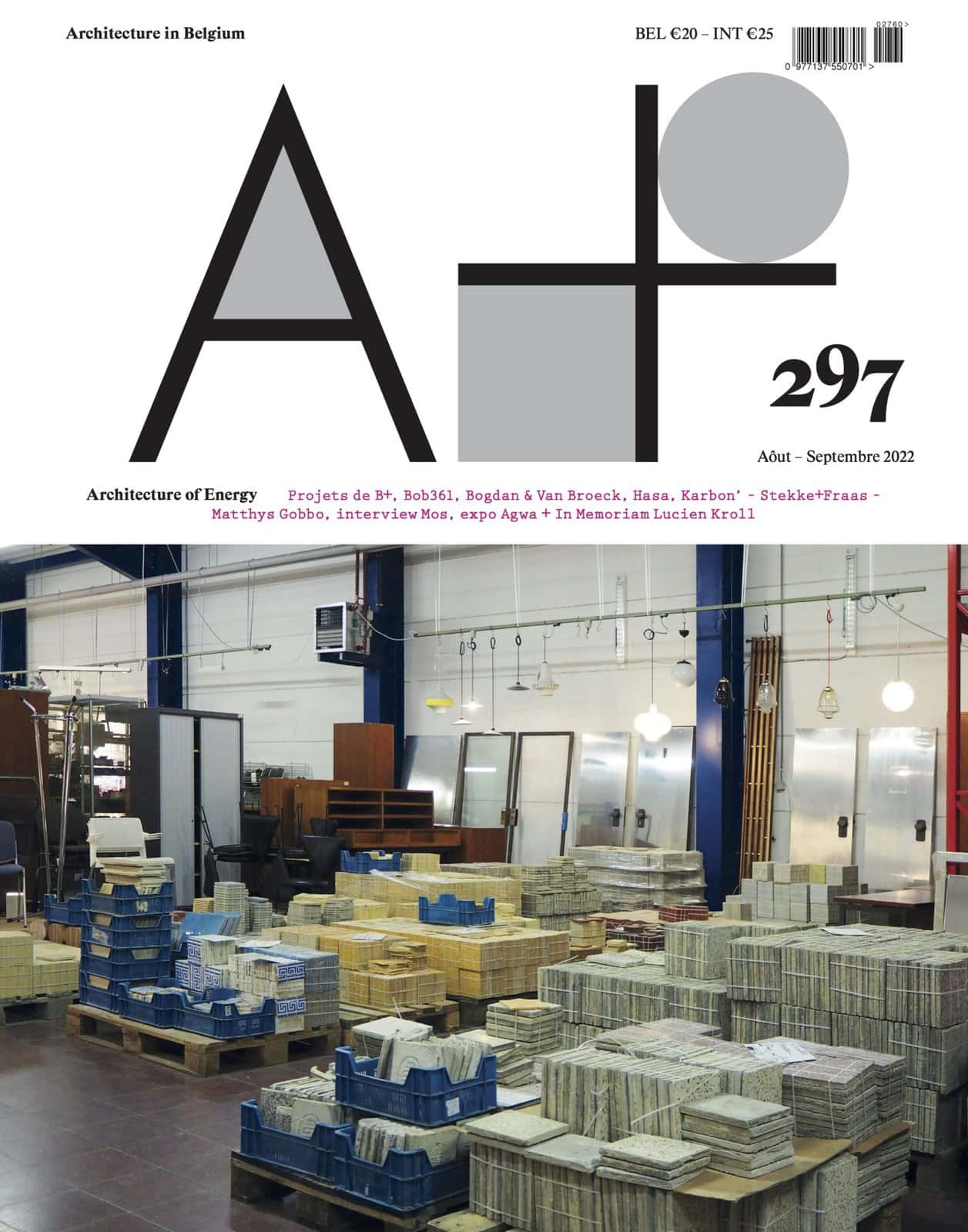
Edito
Lisa De Visscher
Editor-in-chief
Geert Palmers,
Guest editor
Our planet is suffocating under the heat. Forest fires, dried-up rivers and extreme water shortages are making it difficult for humans and nature to catch their breath, leaving no doubt about the urgency of the climate crisis. What’s more, soaring energy prices are putting citizens, businesses and national economies under severe pressure.
For years, climate change and the need for energy transition have been making headlines in the international press. This year, the International Architecture Biennale Rotterdam is dedicating an entire edition to this topic with It’s about time. The construction sector is responsible for 40% of CO2 emissions in Europe. Decisions related to architecture, urban planning and construction techniques therefore determine 40% of today’s challenges. This also means that architects and urban planners have the tools they need to drastically reduce these emissions and are therefore the co-architects of the zero-carbon society envisaged for 2050.
For years, architects around the world have been building a more sustainable environment where reducing energy consumption and using environmentally friendly materials are well integrated. Today, however, the severity of the energy crisis is giving the transition a tremendous boost. What are the conditions of this new, highly restrictive paradigm? First of all, we need to move faster: the transition must happen now. Secondly, we need a radical change of scale. Forget isolated measures affecting individual homes: we want to tackle neighbourhoods, even entire cities. Finally, we must rise to the challenge of bringing together as many aspects of sustainability as possible under a common denominator and addressing them with a unified strategy.
Building materials are one of the basic ingredients of the energy revolution, both in terms of production processes and ecological properties. Ideally, materials are produced locally with little energy or, better still, they are no longer produced at all, but reused. In order to give the circular economy the scale it needs to have a real impact, Lionel Devlieger advocates a complete rethink of the construction industry. Renewable, non-fossil fuel sources of electricity, such as solar and wind energy, as well as heat pumps, are another necessary ingredient, both in terms of CO₂ emissions and in our ambition to become independent, particularly from Russian gas, and to stimulate the European economy. However, technology is not an end in itself and is certainly not the only answer to the energy crisis. Eef Boeckx lists a series of low-tech solutions that complement the “technologisation” of the energy debate.
Making every new neighbourhood a “climate-friendly” neighbourhood is an ambitious but achievable goal. The main challenge lies in large-scale, extensive renovations at the neighbourhood level. For this issue, we brought together five experts – Stijn De Roo, Roeland Dudal, Marie-France Lebbe, Theo Vaes and Bart Cobbaert – who, drawing on their different areas of expertise in sustainability, formulated a response on how we can collectively tackle this problem. Given that in the European Union, more than 7% of the population can no longer heat their homes properly and 40% do not have the necessary means to carry out energy renovation work, the challenges of the energy transition are not only technical or architectural, but above all social. However, society is resilient enough to see the multitude of opportunities that this crisis presents. In this issue, we propose avenues that do not translate into a binding action plan, but rather a series of levels of freedom that reveal the opportunities of this era and open up perspectives on a different and cleaner world.
Theme
Architecture of Energy
The construction sector accounts for a significant proportion of energy consumption. If we want to meet the climate targets set out in the Paris Agreement, this consumption must be drastically reduced. How can we coordinate the production and distribution of renewable energy on the one hand, and reducing consumption through home renovation on the other? What are the current and future projects that incorporate an alternative energy system? How can architecture contribute to energy management? A+ profiles today’s energy-efficient city and examines its consequences for architecture, both technically and aesthetically.
See all themesTable of contents
EDITORIAL
Lisa De Visscher and Geert Palmers
OPINION
How affordable is the energy transition?
Yves De Weerdt
IN THE SPOTLIGHT
In Memoriam Lucien Kroll
Dag Boutsen
AgwA
Lisa De Visscher and Iwan Strauven
Archiweek Brussels
Léone Drapeaud
Prefigurations
Eline Dehullu
10th IABR: It’s About Time
Eline Dehullu
CLEF-WB
Lisa De Visscher
ARCHITECTURE OF ENERGY
Bogdan & Van Broeck
Bijgaardehof, Ghent
BOB361
Huileries, Forest
Changing the construction of social housing
Frederik Serroen
Round table – Pace, Scale, Scope
Eline Dehullu
Karbon’ – Stekke+Fraas – Matthys Gobbo
Seucha, Profondsart
Hasa
Veterinary school, Anderlecht
Real estate heritage and energy
Anne Malliet
A step backwards: deindustrialising the construction sector
Lionel Devlieger
Peaches in Paris
Eef Boeckx
B+
Zwartberg-Noord, Genk
Solar energy
Geert Palmers
Comfort before heat
Ruben Baetens
Innovation
Geert Palmers
INTERVIEW – Mos
Lisa De Visscher
STUDENTS
33.3% Re-Brussels
Lisa De Visscher
A post-fossil port of Antwerp
Eline Dehullu
A super-diverse island
Eline Dehullu
PORTRAIT
Karbon’
Lisa De Visscher
Plusoffice
Eline Dehullu
RE-VISITED
Jean Moutschen
Sébastien Charlier
