
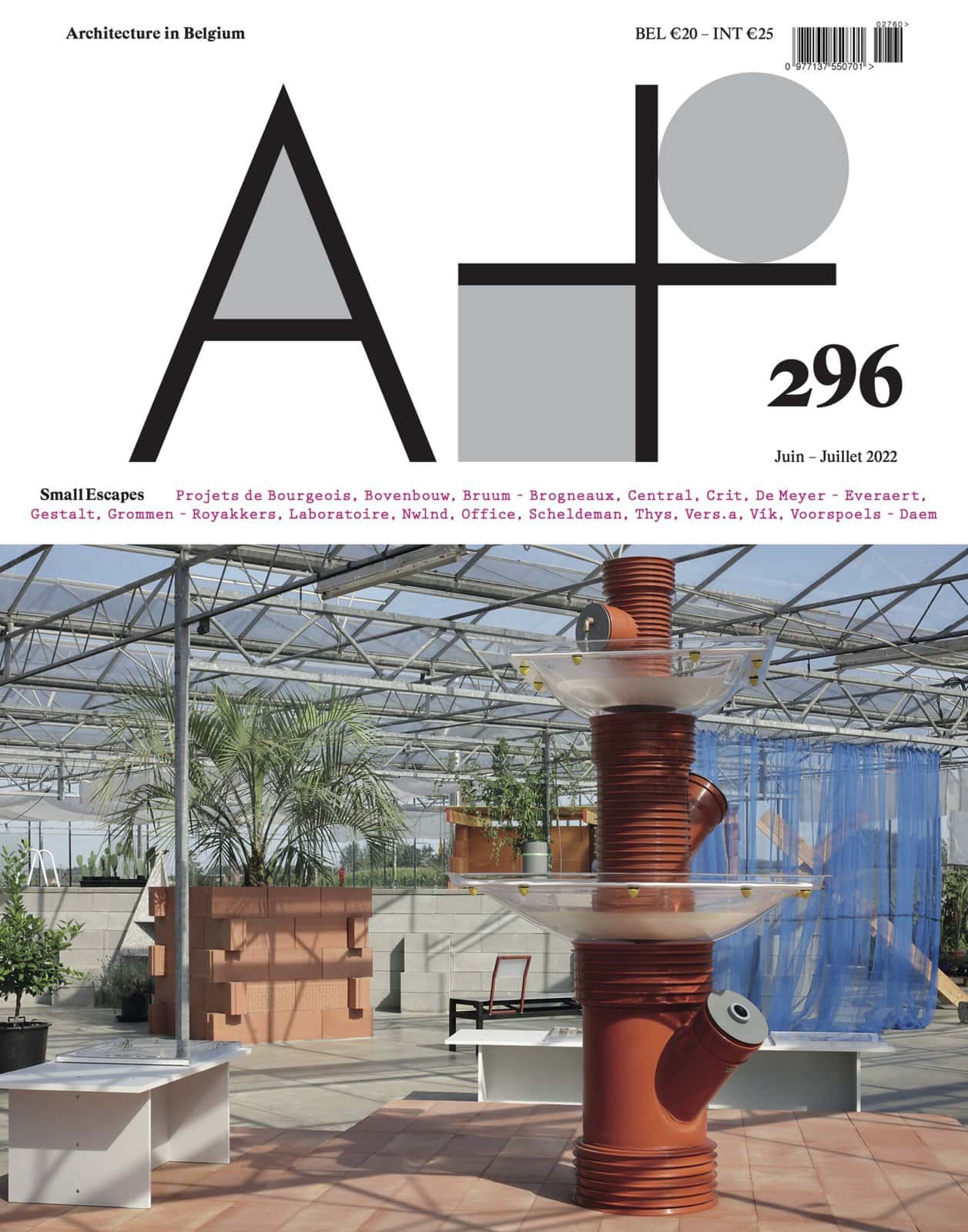
Edito
Lisa De Visscher
Editor-in-chief
A tree house, a camp behind the sofa, a tent in the garden: through play, children love to escape from the real world and take refuge in a hidden, intimate place where they can invent a new universe. The lack of space and attributes is a treasure trove that feeds the imagination; absence becomes inspiration. This child and the secret, hidden room that he invents in his dreams are nestled deep within each of us.
‘Once we have overcome the terrors of the corridor, we too have all loved to dream in the back room,’ writes French philosopher Gaston Bachelard. ‘It is because a dream house lives within us, because we were a dark corner of our childhood home, a more secret room. (…) Every dreamer needs to return to his cell.’[1] Bachelard thus refers the dreamer back to the cell, a place of sober isolation where the imagination can run free.
The exhibition Inner Travels by Belgian artist Rinus Van de Velde, which recently ended at the Palais des Beaux-Arts in Brussels, offered something similar by showing how the artist represents himself in exotic landscapes, underwater, in space, while admitting that he leaves his studio as little as possible. Rinus Van de Velde illustrates like no other the spatial paradox of the closed cell as a metaphor for freedom, where architecture provides an escape to a place where one can think and work better. In a world where distraction has become an addiction and concentration an economic model, the emancipatory power that emanates from a room of one’s own where one can shut oneself away, a place where one can function at one’s own pace, ‘a place to idle’ as Virginia Woolf wrote, where one can be totally idle or, on the contrary, totally productive, is stronger today than ever before.
‘The quest for a space where one can escape mentally and physically is very much a topical issue,’ writes Bart Tritsmans in an article in which he analyses four ‘refuges’. From an airy room in a garden to a concrete pool house, from the simplicity of a log cabin to the refinement of a study lounge, in each case, through seemingly minor additions, the architects have sought a way to respond to an eminently human desire: the quest for essence.more
But what happens when architects embark on this quest for themselves? Véronique Patteeuw examined four refuges created by architects and concluded that, here too, letting go was the common thread. If creating can be translated into endless testing of infinite possibilities, in the cabin, greenhouse or holiday home she describes, the minimal surface area gives rise to a project requirement of maximum simplicity. Experience comes naturally.
It is impossible not to notice that each of these places of refuge is ostensibly connected to the outside space, the garden, nature. Is it because nature helps us to embrace slowness? Does living in the midst of nature and with nature allow us to escape? Wim Cuyvers brings us out of our reverie with a clear and concise answer: No. ‘One of the few ways not to be a tourist in a landscape,’ he writes, ‘is to work there.’ But isn’t that precisely what we wanted to escape?
[1] Gaston Bachelard, La Terre et les Rêveries du repos (1948). Paris, Corti, 1984, pp. 102–103.
Theme
Small Escapes
Architects, too, sometimes need to take a breather. Faced with fierce competition in the world of design contests, ever-increasing regulations and the administrative burden associated with public procurement, architects long for simplicity. In this issue, A+ publishes small-scale projects with a particular focus on architects’ (secondary) homes: small refuges, retreats and cabins. Creating for oneself is above all a quest for slowness, lightness, freedom and, above all, experimentation. With projects by Tom Thys, Vers.a, Bovenbouw, Central and a contribution by Wim Cuyvers.
See all themesTable of contents
EDITORIAL
Lisa De Visscher
OPINION
Does the layman have anything to say about architectural quality? [For]
Nicolas Hemeleers
Does the layman have anything to say about architectural quality? [Against]
Pieter T’Jonck
IN THE SPOTLIGHT
Ultimas 2021
Lisa De Visscher
Sick Architecture
Eline Dehullu
Peer review Bouwmeester Master Architect (BMA)
Els Vervloesem and Nicolas Hemeleers
SMALL ESCAPES
Bovenbouw
Weekend house, Bazel
Laboratory
La Roseraie, Modave
Office
Art room, Uccle
Atelier Scheldeman, Cabin, Berlare / Atelier vík, Garden Room, Kortrijk / Gestalt, Office Room, Kapellen / NWLND, Refuge, Bonheiden
Grommen – Royakkers
House for Seasonal Neighbours, Borgloon
Vers.a
Sauna M, Ronse
Wim Cuyvers
Le Montavoies, Montavoix (FR)
Tom Thys, Aristo House, PalmoliIT / Crit., La Roche qui Pleure, FécampFR / Carl Bourgeois, Country House, Wibrin / Theo De Meyer – Stefanie Everaert, Serra, Ghent
Voorspoels – Daem
Sparre, Saint-Idesbald
Bruum – Thibaut Brogneaux
Nature Infrastructure, Braives
Central
President, Brussels
COMPETITION – Trema.A Museum of Ancient Art, Namur
Hervé Bouttet
STUDENT
On circular materials and processes
Lisa De Visscher
Repositioning the cabin
Eline Dehullu
An atlas of the homeless
Eline Dehullu
PORTRAIT
Trans
Eline Dehullu
Central
Lisa De Visscher
RE-VISITED
Jacques Boseret
Sven Sterken
