Edito
Lisa De Visscher
Editor-in-chief
The office market is shrinking. With the coronavirus crisis, an economic model that had been stagnating for years has shifted to outright negative growth. The impact is most noticeable in cities such as Antwerp, Namur, Ghent, Liège and especially Brussels, where the tertiary sector is highly developed. While old office buildings are no longer being rented out, we are still seeing new projects flourishing on the market despite plummeting demand, which only serves to increase vacancy rates and urban decay.
‘In Brussels, before the coronavirus crisis, there were already 1 million square metres of vacant office space,’ Isabelle Pauthier, former director of the ARAU, told the Brussels newspaper Bruzz in February. Added to this are 500,000 square metres of buildings that have become obsolete. However, permits have been issued for the construction of 417,000 square metres of new buildings. The European Commission, which is an excellent barometer of office occupancy, wants to reduce the number of its buildings by 25% and plans to reduce its office space by 200,000 m² next year.
Beyond being problematic, the millions of square metres freed up also present an interesting opportunity to rethink both the city and the typology of work. Kristiaan Borret, Brussels Master Architect, analyses this sometimes paradoxical situation and summarises it as follows: “Traditionally, urban planners have always thought in terms of growth – of housing, shops or offices. Today, we are experiencing a phase of decline, which makes things interesting. From now on, the dynamic is no longer growth, but transformation. ‘
The repurposing of office buildings is, of course, nothing new. Given the high ’turnover” in this market, buildings quickly become obsolete and are no longer profitable. Since 1997, in Brussels alone, 1.67 million m² of office space has been converted (mainly) into housing. Given that not all office buildings are suitable for conversion into traditional housing, we have seen some interesting experiments, with the emergence of new types of housing and alternative uses. In De Standaard, Gideon Boie and Lieven De Cauter proposed opening up empty offices to accommodate Ukrainian refugees, thus creating a more humane solution than the remote refugee reception centres we are familiar with today.
Of course, it would make no sense to replace a single-function office district with a single-function residential district. After years of resistance from the major players in the property market, mixed use is finally making an appearance. Thanks to the efforts of the Brussels-Capital Region and the Chief Architect, an iconic office project such as Zin still includes 15% residential space! In the Proximus tower, this figure is expected to reach one third.
However, the change is not limited to reallocation: over the last two years, work itself has also changed fundamentally. As we have seen, teleworking offers significant advantages in terms of personal quality of life. New office typologies now take this into account. People stay at home to work in a focused manner and come to the office to develop their network, brainstorm, participate in workshops, in short, to see people. In addition, office staff are increasingly critical of the geographical location and layout of their workplaces.
In the near future, the office will therefore be sustainable, easily accessible by public transport, sensibly designed and offer space for (in)formal meetings. To complement individual work at home, the new office is increasingly integrated into a broader collective context, where different entities share buildings, meeting rooms and coffee corners.
This paradigm shift is a turning point for the classic office typology. In this issue, we look to the future and try to understand the consequences of this change from a spatial perspective.
Theme
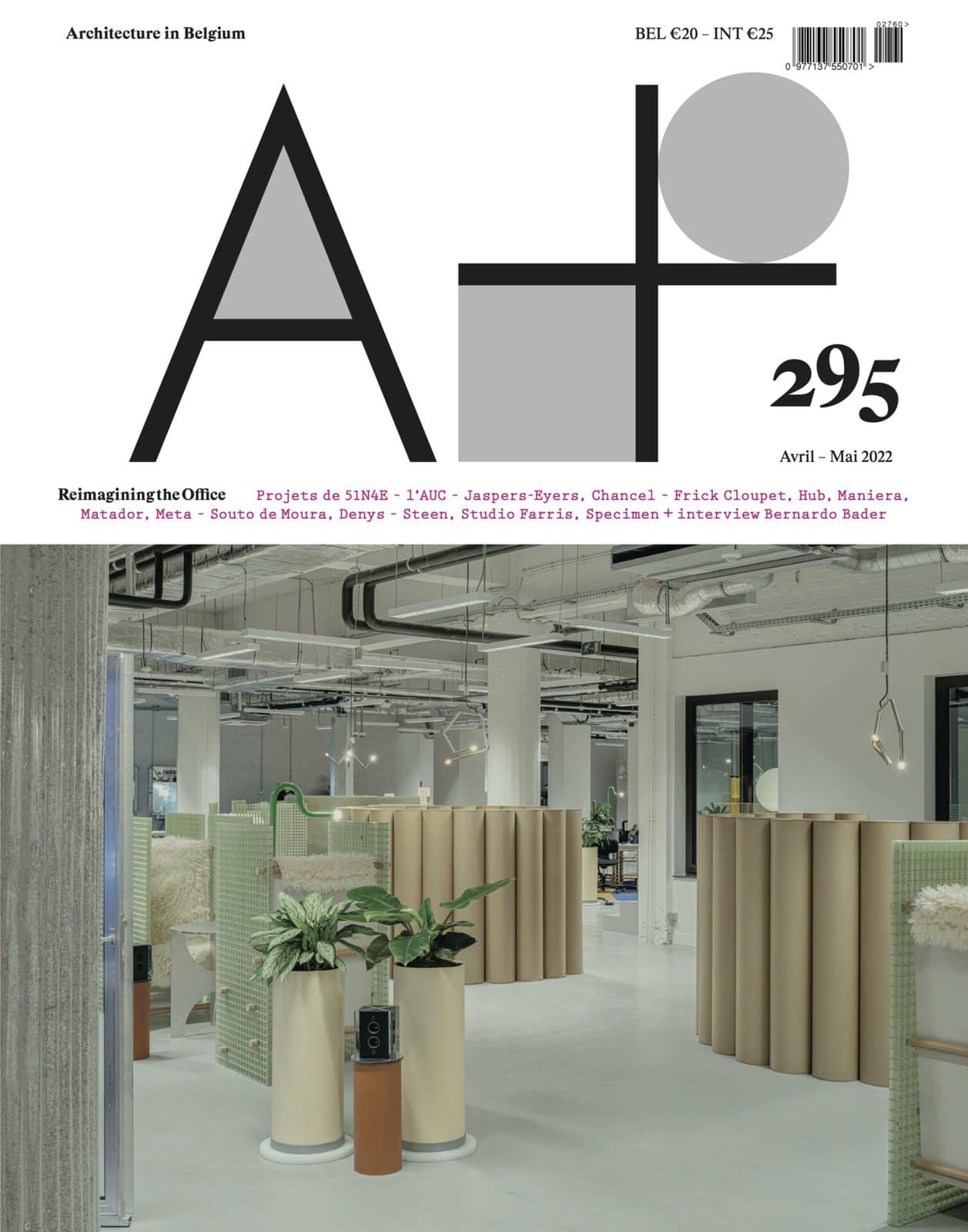
Reimagining the Office
In recent years, teleworking has continued to gain ground. This trend has had a significant impact on the office sector, which has seen a considerable number of vacant premises in recent years. Many office buildings from the 1960s and 1970s are also undergoing large-scale renovations, and single-purpose office towers are now an anachronism in which no one is investing. As a result, many office buildings are being converted into housing or school buildings. We are seeing the emergence of alternative typologies capable of accommodating different programmes such as housing, professional or leisure premises, where the interior also plays an important role.
A+ looks at the future of offices in the era of teleworking and examines the consequences of renovation from the point of view of typology, programmes, densification and technical challenges.
See all themesTable of contents
EDITORIAL
Lisa De Visscher
OPINION
Should we continue to build new offices? [for]
Stéphane Sonneville
Should we continue to build new offices? [against]
Marion Alecian
IN THE SPOTLIGHT
BC Architects
Arnaud De Sutter
Fluctuations
Cécile Vandernoot
Thomas Demand
Mathieu Berteloot and Véronique Patteeuw
RECENT PROJECTS
Specimen
Co-housing, Saint-Servais
Meta – Souto de Moura
Meeting & Convention Centre, Bruges
Chancel – Frick-Cloupet
Théâtre Océan Nord, Schaerbeek
REIMAGINING THE OFFICE
Maniera
Silversquare, Brussels
Matador
Toit & Moi, Ghlin
The future of office buildings
Pieter T’Jonck
Typological research based on office floors
51N4E – Jaspers-Eyers – l’Auc
Zin (WTC 2023), Brussels
Hub
Headquarters of the autonomous municipal company, Antwerp
Anton Hendrik Denys – Steen
AEtelier, Heverlee
And after the office?
Kristiaan Borret
Studio Farris
BP Building, Antwerp
INTERVIEW – Bernardo Bader
Lisa De Visscher
COMPETITION – Royal Athenaeum Leonardo da Vinci, Anderlecht
Daniel Delgoffe
STUDENT
UAntwerp: On the shoulders of giants
Lisa De Visscher
EAP Euregionale Prijs voor Achitectuur 2021
Eline Dehullu
KU Leuven: Existenz 2022
Eline Dehullu
PORTRAIT
Pigeon Ochej
Lisa De Visscher
Komaan
Eline Dehullu
REVISITED
Valentin Vaerwyck
Marc Dubois