
Edito
Lisa De Visscher
Editor-in-chief
It has been just over thirty years since the United Nations adopted the Convention on the Rights of the Child. This text emphasises the legal protection of children and their right to education, healthcare and a safe environment. Over the past few decades, this latter aspect has developed into a movement explicitly committed to the quality of children’s built environment, often in consultation with children themselves and with the support of UNICEF’s Child Friendly Cities programme.
It has now been more than twenty years since the Kinderbüro was founded in Basel, Switzerland. This organisation works with children to advise public authorities, schools and public institutions and support them in designing and creating a child-friendly environment. The Kinderbüro has since become a key player at national level and, through participatory processes in which children act as experts, contributes to creating the city where children and young people grow up.
In Belgium – even though the country has not signed up to the international Child Friendly Cities programme – in the wake of a general climate that increasingly favours participation, several initiatives have also been launched to involve children more in the design of child-friendly spaces in the city. This is essential, given that most playgrounds, school playgrounds, nursery classrooms and even public spaces are often designed without considering the specific needs of children or taking gender into account. In Flanders and Brussels, the non-profit organisation Jes supports participatory programmes involving young people from a socio-cultural perspective in order to respond precisely to this demand. The Wauw Collective does the same thing from an architectural and urban planning perspective, through workshops. The result is a better understanding of what a city adapted to children should be like.
While we wait for a real Kinderbüro to be set up to support this, in this issue we are publishing a series of projects that create a stimulating environment conducive to children’s play and development. Once again, we see that what is good for the youngest members of society is also beneficial for the local community and the climate, in short, for society as a whole. At the Flow outdoor swimming pool in Anderlecht, swimming becomes the “super glue” that binds different communities together and mobilises an entire neighbourhood. The climate-friendly recreational spaces of Plusoffice in Heverlee not only improve water management in densely populated Flanders, but also offer children places to play in the great outdoors. In Ixelles, the Carton123 youth centre is revitalising a somewhat neglected neighbourhood and creating space for young people who sometimes have nowhere else to go. And finally, in Eeklo, Denc-Studio’s conversion of a church into a crèche has made it possible to protect modernist heritage in a climate-friendly way. In each of these projects, play is the central element, not only in terms of spatial challenges, but also as a powerful factor linking designers and users, public and private, street and school, and above all adults and children. Let’s play!
Theme
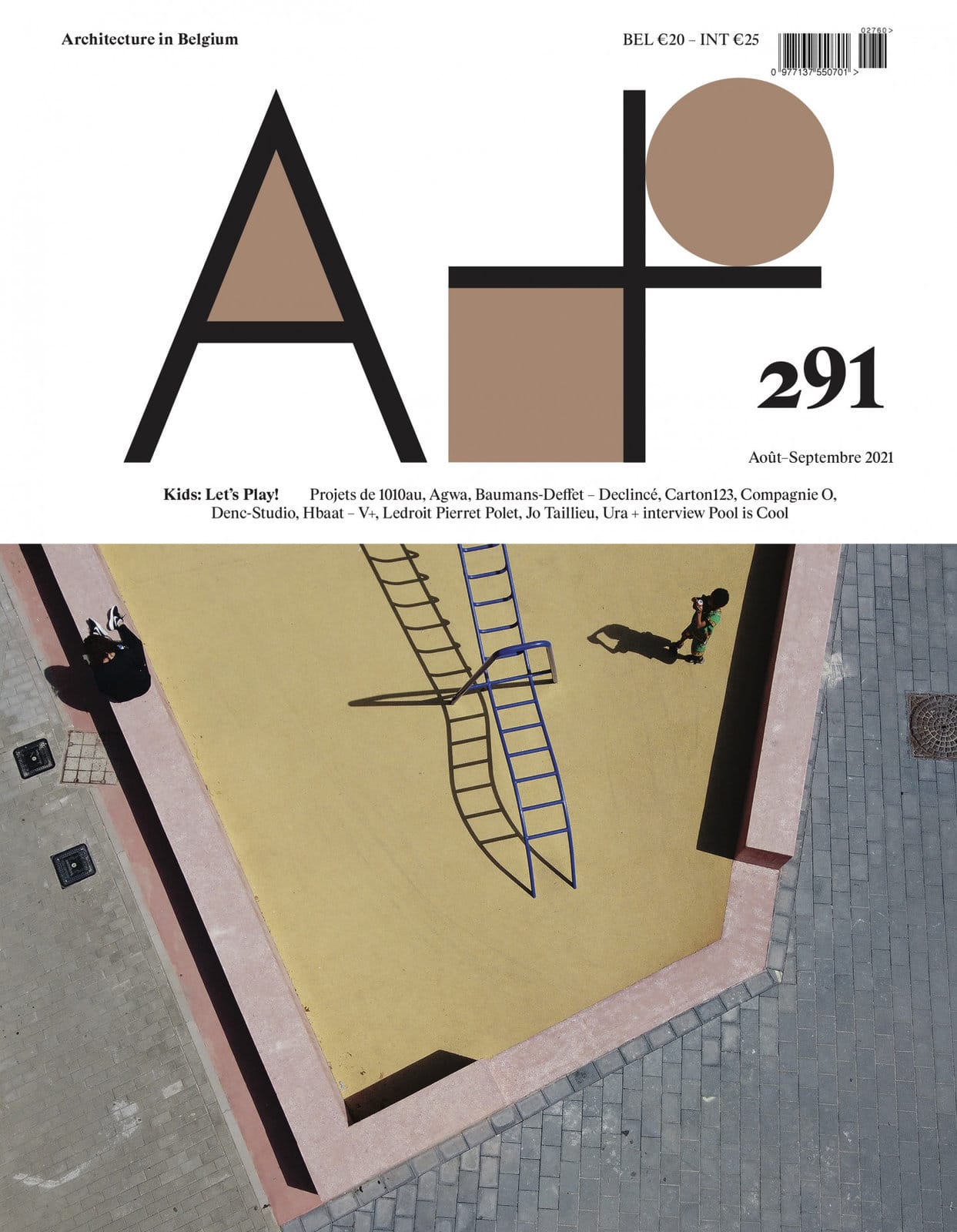
Kids: Let’s Play!
The availability and quality of infrastructure for children – such as schools, nurseries, sports facilities and grounds, libraries, playgrounds and skate parks – largely determine the quality of life in a place. Issue A+291 is based on the adage that if a city is “child-friendly”, it is a good place for everyone to live. In this issue, we look at the built environment through the eyes of a child and showcase projects that contribute to a stimulating and inspiring environment for young people as they grow up. We will publish projects by 1010au, Baumans-Deffet, Carton123, Compagnie O, Denc!-Studio, Grue and Ura, among others.
See all themesTable of contents
EDITORIAL
Lisa De Visscher
OPINION
Tine Van Herck
NEWS
Archiweek – Brussels Architecture Prize
Lara Molino
Architecture goes to school
Lisa De Visscher
Architecture Festival 2021
Eline Dehullu
The Venice Architecture Biennale 2021
Pieter T’Jonck
Carmody Groarke
Lisa De Visscher
PROJECTS
Jo Taillieu
Paddenbroek, Gooik
HBAAT – V+
Cinema, Lille
KIDS, LET’S PLAY!
Denc-Studio
BKO Saint-Joseph, Eeklo
Nature goes to school
Saskia Vanderstichele
Compagnie-O
De Leerexpert Dullingen, Brasschaat
Agwa
Durlet secondary school, Antwerp
Research: space for play and freedom
Sara De Sloover
1010au
MolenWest, Brussels
Carton123
Malinard, Ixelles
Playgrounds: social condensers
Pieter T’Jonck
Ledroit Pierret Polet
Sainte-Walburge nursery, Liège
Baumans-Deffet – Delincé
Nursery, Koekelberg
Ura
JGE, Etterbeek
INTERVIEW – Pool is Cool
Lisa De Visscher
STUDENT
University of Antwerp: The Healthy City
Eline Dehullu
UCL LOCI Tournai: Architecture for the Bio-region
Lisa De Visscher
LafargeHolcim Awards: Transforming Collectivity in Belgium
Eline Dehullu
#012 Michiel De Cleene
