
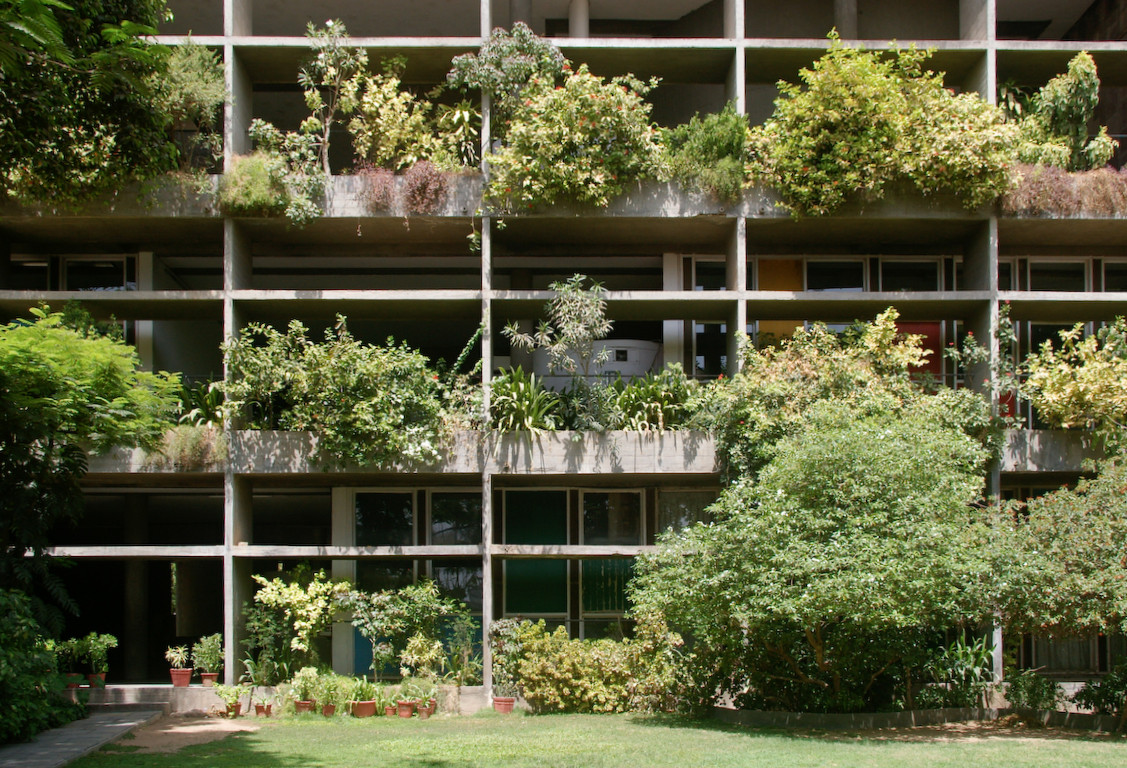
Entire libraries have been written about Le Corbusier as an architect, artist, author and person. Nevertheless, Le Corbusier’s Ahmedabad Millowners’ Association Building, the latest offering by Mehrdad Hadighi, architect and professor at Penn State University, is well worthwhile. Not only does the author analyse one of Le Corbusier’s lesser-known Indian projects from the 1950s, he also uses an array of different sources to examine the tension in Le Corbusier’s work between the desire for regularity and structure on the one hand, and sublime beauty on the other.
The building in Ahmedabad – AMOA for short – was commissioned by a local, wealthy industrialist as a place to do business. It is located between the Sabarmati River to the west and an arterial road to the east. The east and west façades feature floor-to-ceiling brise-soleils in concrete, while the north and south brick façades are virtually closed. The building is entered on the west side via a ramp leading to an imposing, open piano nobile on +1. In addition to this ramp, an external sculptural concrete staircase connects all levels.
The most spectacular space is the large hall on the second floor. Its closed outer wall in walnut follows a more or less oval line, with the two ends shooting past each other, forming an entrance porch. Despite the closed wall, the hall is bathed in light as the roof isn’t flat but shaped like a concave shell. Also noteworthy are the sanitary cells, the cloakroom and the mezzanine on +2. Resembling organic sculptures, they stand freely in the strictly rhythmic skeleton of columns, sheets and walls. Le Corbusier also paid a lot of attention to the alternation between rough walls in brick or concrete and stucco walls with strong colour accents.
Hadighi’s main thesis is that this building reflects the essence of Le Corbusier’s architectural philosophy. He summarises this as the pursuit of maximum tension between the structure’s Apollonian clarity and the Dionysian ecstasy created by the deviations that occur inside it during a promenade architecturale. Hadighi emphasises that Le Corbusier was well aware of the necessity of a rational structure but only considered a building successful if it was complemented by artistic insight. Without this layer of pure, sublime beauty, architecture was meaningless to him.
Hadighi thoroughly documents this assertion. He draws on such books as Paul Valéry’s Eupalinos ou l’architecte and the works of Nietzsche – texts that were close to Le Corbusier’s heart. He pored over collections of essays by authors such as Peter Reyner Banham and Alan Colquhoun, in the Oeuvres complètes, as well as important essays by Kenneth Frampton and Charles Jencks. He compares these to Vers une architecture, a key text by Le Corbusier. Quite surprisingly, he also shows the close resemblance between Le Corbusier’s ideas and those of John Ruskin, whose works he discovered in his youth at the academy in La Chaux-de-Fonds. Hadighi uses these insights to analyse AMOA from different angles. Despite the rather dry academic tone at times, this yields intriguing insights into the fascination that Le Corbusier’s (post-war) work still evokes today.
Le Corbusier’s Ahmedabad Millowners’ Association Building, Mehrdad Hadighi, Birhäuser Verlag Basel, 2025. English. ISBN 978-3-0356-2869-2 / E-book ISBN 978-3-0356-2870-8
