The Brussels Region does not have many circular buildings or ‘doughnuts’, cylinders with a hollow core. The reason is obvious: even though round buildings – apart from the even rarer spherical shape – are the most compact form a structure can take, they require a lot of surrounding space: they do not fit into a row or a building block. Circles are also difficult to build, because building materials are usually straight in shape. Round buildings are also difficult to furnish. Nevertheless, architects like to try their hand at them.
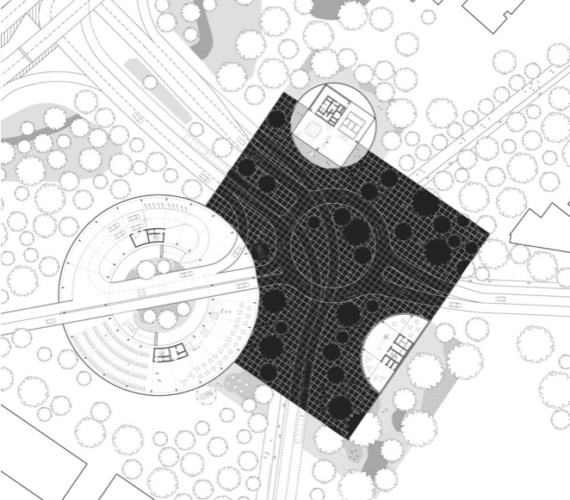
In Brussels, circular buildings are often pavilions, such as the bandstand in the Royal Park. Religious buildings also have a thing for circles. Think of the large Mosque of Mongi Boubaker (1975) on Kortenberglaan, or the church on Hoogte Honderdplein in Vorst by Léon Guiannotte and André Watteyne (1935), a Greek cross enclosed in a circle. Round office buildings are equally rare. A well-known example is the doughnut-shaped Glaverbel building by Pierre Guillissen, André Jacqmain and Victor Mulpas from 1967. On the corner of Kortenberglaan and Wetstraat, such a doughnut is hidden in a pointed corner building. Close to Central Station, you have the oval tower of the National Lottery. There are a few other oddities, such as the American Theatre at the Heizel, a remnant of Expo 58 (a doughnut and a cylinder!). Recently, the canopy of xdga on Rogierplein enriched the list of round public buildings. Round houses are truly a rarity. Villa iv by Office Kersten Geers David Van Severen is a recent (octagonal) example. At the end of the 18th century, the architectural theorist Quatremère de Quincy (1755-1849) described the cylinder as a primal type from which many models were derived. Le Corbusier (1887-1965) repeated this in Vers une architecture as if he had thought of it himself. It is a perfect form, pure architecture, regardless of content or function. This makes the circle attractive for competition designs. The archive of the Bouwmeester maître architecte (BMA) contains many examples of this, although these designs often had to bow to proposals that were more straightforward. Designers return to it for various reasons. They choose it, for example, because of the contrast with the surroundings. A recent example is the competition for new buildings for the Forest Brigade along the Waversesteenweg in Oudergem (2022). The winning design by the team led by Atelier Julien Boidot – Czvek Rigby stuck with rectangular buildings. However, 51n4e proposed a circular building with a diameter of about 30 metres, while architecture platform Terwecoren Verdickt and Générale – Jo Taillieu opted for a doughnut with an even larger circumference. Here, the architecture asserts itself in contrast to its surroundings: clear geometry versus capricious nature. 51n4e takes the geometric game to the extreme by inscribing a square of load-bearing walls within the circle, the sides of which extend to the edge of the outer circle. Générale – Jo Taillieu spare a single tree in the open centre of the doughnut, as a gesture of mercy that tempers the violence of the form. At Terwecoren Verdickt, the inner circle is much larger and creates a double contrast: that between the ‘tamed’ nature inside the circle and the untamed nature outside it.