‘We can learn a great deal today from the way in which large-scale civil and religious monuments were built in pre-modern Europe. The architect built these monuments not only with imagination, brick and mortar, but also with time. […] Rather than being erected as an absolute, immutable work of art by a famous architect-author, the building and its design belonged to the replaceable world of things. Buildings and their plans were never considered absolutely complete. They were expected to undergo extensions, revisions, reintegration with the context, including (re)combination with new and old structures. — Marvin Trachtenberg, Building-in-Time, 2010
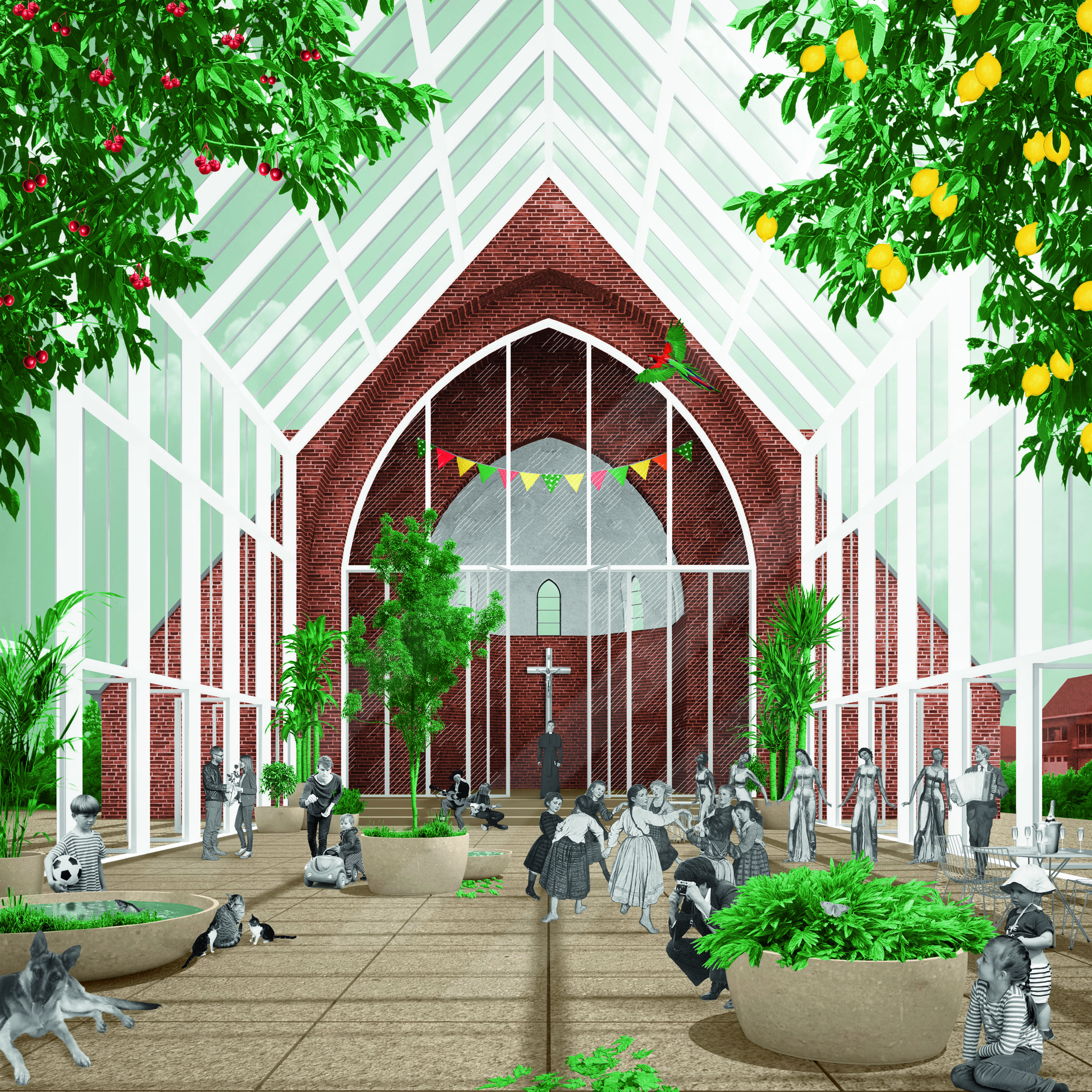
No fewer than 141 Flemish parish churches were reviewed by the Projectbureau Herbestemming Kerken (Church Repurposing Project Office). From 2016 to 2021, local authorities could call on the Project Office to carry out a spatial feasibility study for a church they wanted to repurpose. The response was overwhelming. The results of this tour de force have recently been compiled in the beautifully designed and richly illustrated publication Herscheppen (Reinventing), which looks back on the work of the Project Office and the accompanying design research. 1 1 Ardui, C., Vermeulen, S., Sterken, S., Vervloesem, E., Wieërs, E. (Eds.) (2023). Herscheppen. Design research for the Project Office for the Repurposing of Churches 2016-2021. Brussels: Team Vlaams Bouwmeester.