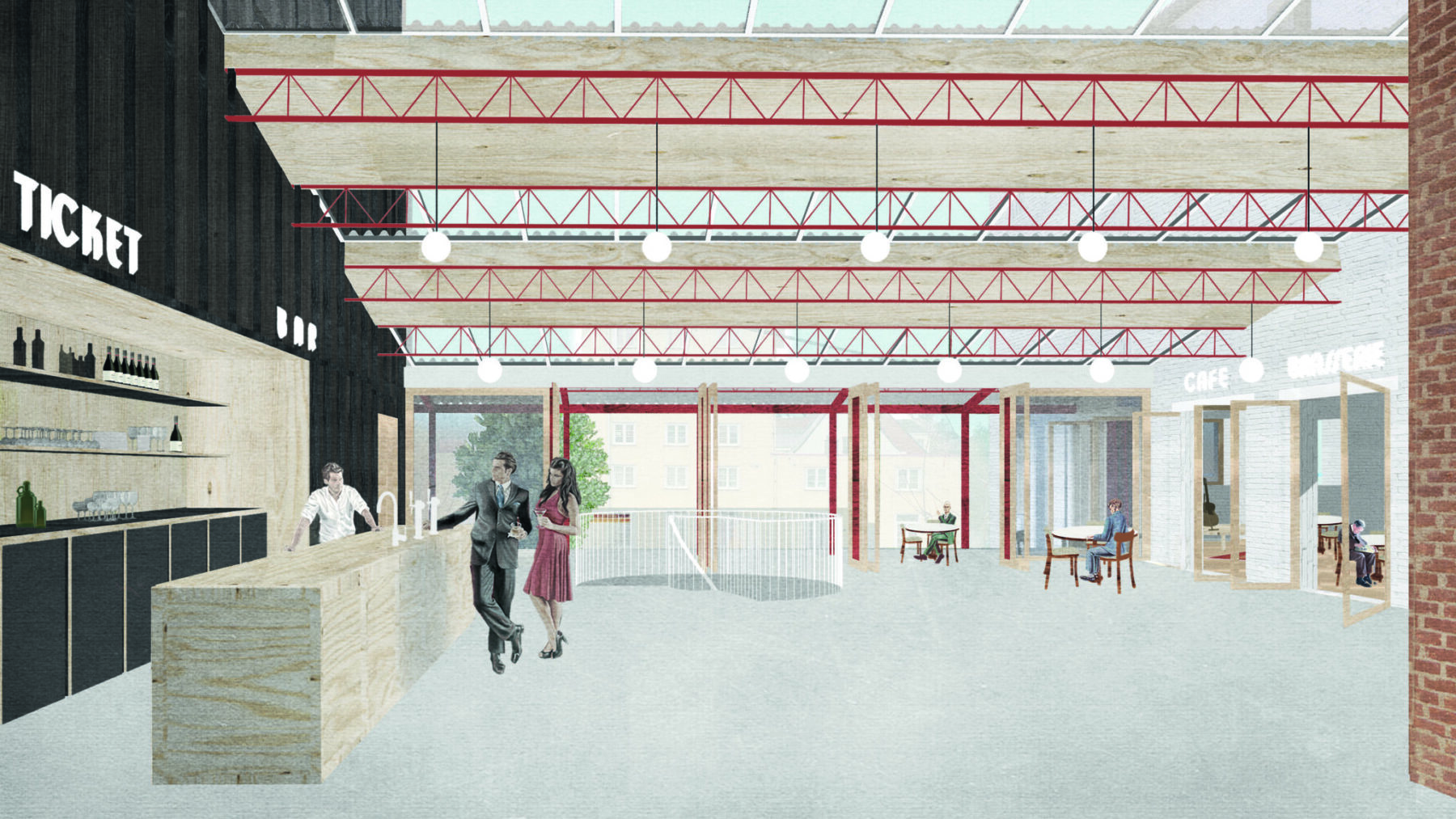
Lessines, a small “town in the countryside” located in Hainaut, on the linguistic border, crossed by the Dendre river, has a cultural centre nestled in a former hospital, Notre-Dame à la Rose. A little further on, in one of the main streets, an old abandoned mill and its outbuildings catch the eye: the cultural centre would like to expand there and benefit from a concert hall and a café-theatre. This was the subject of a competition organised by the Architecture Unit.
In this town in the countryside, one can be enthusiastic about finding rural urbanity and urban rurality. Surreal? Lessines is a little bit surreal, associated with two prominent figures of this movement: Magritte, who was born there and gave his name to the cultural centre in question, and the writer, poet and friend Louis Scutenaire, who lived there and is too little talked about. “Don’t talk about me, I’m enough,” he anticipated. Was he also talking about this town, which is charmingly old-fashioned, as if suspended in time? When we think of the suburban model of detached houses, which has never been and never will be either town or country – or anything else – we realise that the somewhat outdated character of Lessines is more relevant than ever at a time when we are rethinking our territories. For thirty years, the cultural centre has been offering rock music from the city and the countryside, for a discerning audience coming from afar and for neighbours coming for the atmosphere. The café-theatre project, on the one hand, and the 650-seat concert hall, on the other, aim to meet the different needs and audiences. Opposite the beautiful listed site of the convent-hospital, which dates back to the Middle Ages, is the Williame mill, located on the street front. Although not listed, this abandoned site, which is nevertheless important in the local imagination, stands on the site of a former seigneurial mill already mentioned in 1089. The site is to be rehabilitated, as is the rear plot extending along the river. In this inspiring urban/rural setting, the relationship with the landscape will be fundamental. This is one of the ambitions of the competition, which runs through the teams’ proposals.