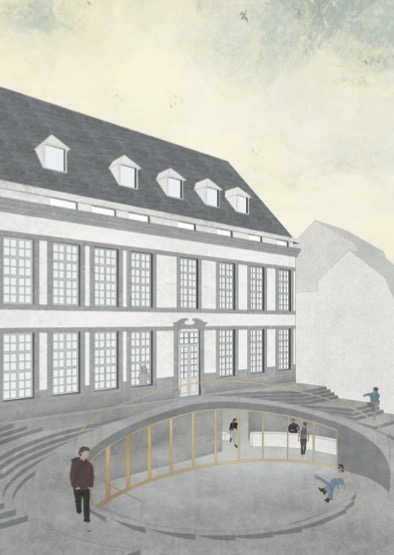
In Namur, treasures can be found in the Museum of Ancient Arts. Behind the richly decorated façade of the 18th-century front section, listed as ‘Exceptional Heritage of Wallonia’, on Rue de Fer, this bustling little museum strives to showcase a collection that is too extensive for this townhouse. The aim of the competition launched by the Province, supported by the Architecture Unit, is to provide the museum with exhibition and visitor facilities that do justice to the collection.
This museum houses the Oignies Treasure, a collection of late 18th-century gold and silverware; the pictorial treasure comprising the world’s largest collection of paintings by Henri Bles, a 16th-century painter; a treasure trove of Rhenish-Moselle sculptures from the 12th to the 17th century; and other remarkable treasures. Equally remarkable is the dynamism of the team, which, drawing on its collections, offers high-quality temporary exhibitions and a variety of activities, including concerts in the garden on summer evenings. The Province of Namur has set itself a lofty ambition: to create a venue accessible to all, aiming for 25,000 visitors a year, 1,500 m² of permanent exhibition space, 400 m² of temporary exhibition space, 300 m² of storage space for artworks, a garden area, a documentation centre and administrative offices. The programmatic context is set, so the site must be densified. This is a delicate task, given the remarkable architectural features and significant variations in elevation.