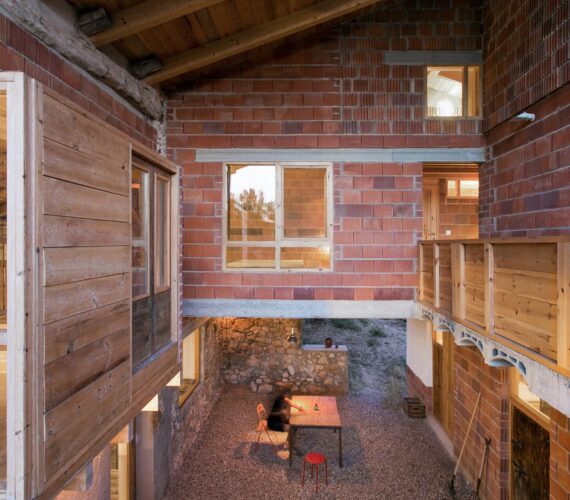
Brick building has a long history in Flanders. The knowledge embedded in that history is multifaceted and offers insight into the material and its potential for architecture. In 2015–2016, Barbara Oelbrandt (Blaf), together with Karen Allacker, Els Verstrynge and Staf Roels, coordinated a brick studio at KU Leuven. Four Master’s students conducted historical research into brick architecture and created a timeline of brick construction in Flanders. This timeline provides a chronological overview of the solid wall in the 19th century and the cavity wall at the start of the 20th century, up to the changing standards in insulation and ventilation that have eroded the role of the brick wall. Finally, the timeline incorporates various future perspectives which the students developed further in individual theses. Karen Deldime and Kathleine Housmans conducted research into sustainability in radical renovations; Siem Rombaut investigated the technical and aesthetic qualities of innovative external walls using facing bricks; and Jente Jorissen explored the potential of solid walls in Flemish housing construction. Their research provided insights into energy-efficient building and explored new construction methods beyond the traditional cavity wall. The brick studio was organised for just one year, but Karen Allacker highlights sustainable building in her lectures ‘Building Construction’ and ‘Construction Economics’ and in the design studio for third-year undergraduates.
Elements of the Brick Studio have shifted from the final year of the programme to the first year. And that is quite interesting. At KU Leuven, Barbara Oelbrandt now coordinates the design studio in the second semester of the first-year bachelor’s programme with a team of young designers. In that semester, students are traditionally asked to design a house. Five specific sites in the Klein Begijnhof in Leuven not only yield five specific housing typologies, they also confront the students with brick architecture. “We start with the basics. Every student must have knowledge of the traditional way of building in Flanders, the evolution of brick construction, and how this is reflected in the façade structure and detailing,” says Oelbrandt.