Monadnock’s contribution to The Book of Copies on Circular Buildings (2015) prompted A to ask Job Floris to write an article about what motivates an architect when he chooses the radically geometric shape of the circle as a floor plan. In many cases, the choice of a circular floor plan goes beyond purely functional considerations, meaning that form does not necessarily follow function. What other considerations and motives underlie the choice of a circular building?
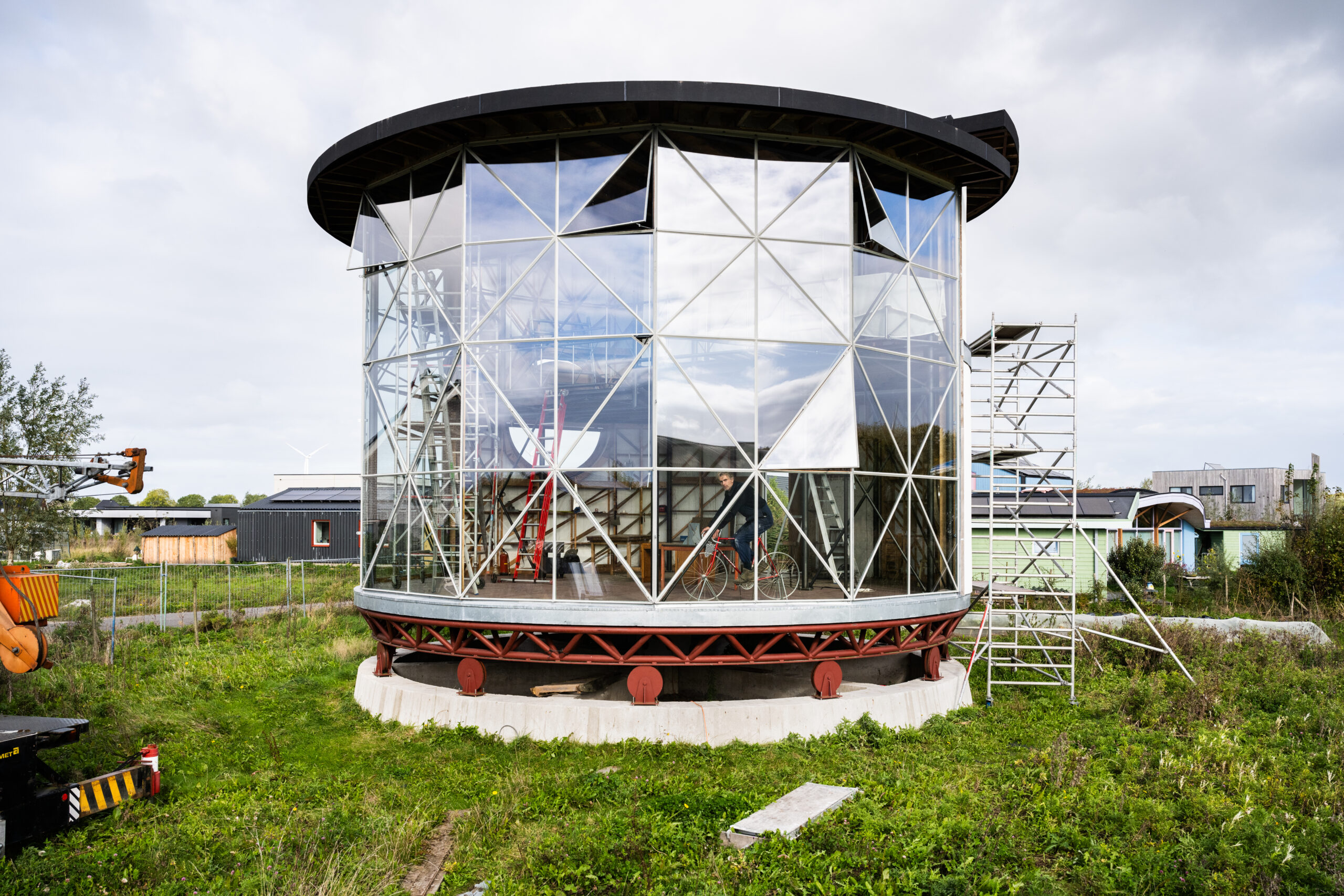
When I recently visited a circular house under construction, I was struck by how unique this house will be. The artist Joost Conijn is building this house himself in Almere, the Netherlands. Conijn’s main motivation for making the house circular is to allow it to rotate with the sun. That is why one half of the house is glazed and the other half is almost completely closed. In addition, the house is set in motion by the occupant himself: by means of a red racing bike, which is prominently displayed in the living room. The racing bike is connected to an ingenious mechanism under the house and can thus set the house in motion with relative ease. As with Angelo Invernizzi’s Italian Villa Girasole, a source of inspiration for Conijn, function and form come together logically in this project. This is a feature that makes these two examples unique within the family of circular buildings.