
CLARA is a scholarly journal published by the Faculty of Architecture at the Université libre de Bruxelles (ULB), which appears once a year. For the 2026 edition, Éthique du détail, the editorial team dissected the architectural detail and stripped it of all its obviousness. It examines its historical and contemporary significance in the building process, and thus ties in particularly well with the theme of A+317 Joints and Details. The academic journal concludes that a forward-looking architectural practice presupposes a different conception of detail that rethinks the relationship between designer and contractor and between standard and execution.
In the introduction, editors Tiphaine Abenia – who is also a contributor to A+317 –, Louis Destombes and Daniel Estévez directly state that detail gained in importance once engineers began to intervene in the construction process from the 18th century onwards. By prescribing a specific method of execution, they undermined the conventional knowledge shared by designers and builders. The standardisation of building elements accelerated this process. The designer thus gained considerable authority. Paradoxically, detail thus also evolved into a hallmark of authenticity.
According to the authors, this view is now reaching its limits due to the ecological, political and social crisis. Current ‘productivist and extractivist’ building methods are proving unsustainable. A different ethic of building is needed. In this context, detail can be a driving force for change. The issue is framed in four key questions. What is the purpose of detail? How does it lead to (collective) collaboration and a new relational ethic? To what extent is detail the subject of consultation and/or controversy? How does detail regulate the handling of the indeterminacy of materials and techniques? Seven essays shed light on these issues. Despite the somewhat dense, academic language, they offer surprising insights. We highlight two of them here.
In ‘Precision in Japanese Woodcraft: Embracing Indeterminacy or Conforming to Digital Exactitude?’, Nicolas Rogeau clarifies the different ways in which Japanese craftsmen and the Japanese construction industry approach timber joints. In timber construction, this is a crucial factor due to the unpredictable properties of wood. Traditional Japanese details respond to this with masterful precision and thus carry great cultural significance. However, Japan also excels in industrial prefabrication, which strives for repeatability and therefore requires a different kind of precision. Rogeau suggests a third way: parametric design methods can also support traditional craftsmanship. As is the case with tradition, they also define insights and rules that are adapted to specific circumstances. In this way, they complement craftsmanship.
In ‘Tailoring the Detail’ Eireen Schreurs and Sam Stalker, who also co-authored an article in A+317, analyse the practice of the Dutch architect Enzo Valerio, who does not only design but also builds. Although the design takes shape in scale models and a 3D model, he and his team fine-tune many details on site. The authors compare this to medieval building methods: insights developed during the construction process, based on a framework that was refined and improved as work progressed.
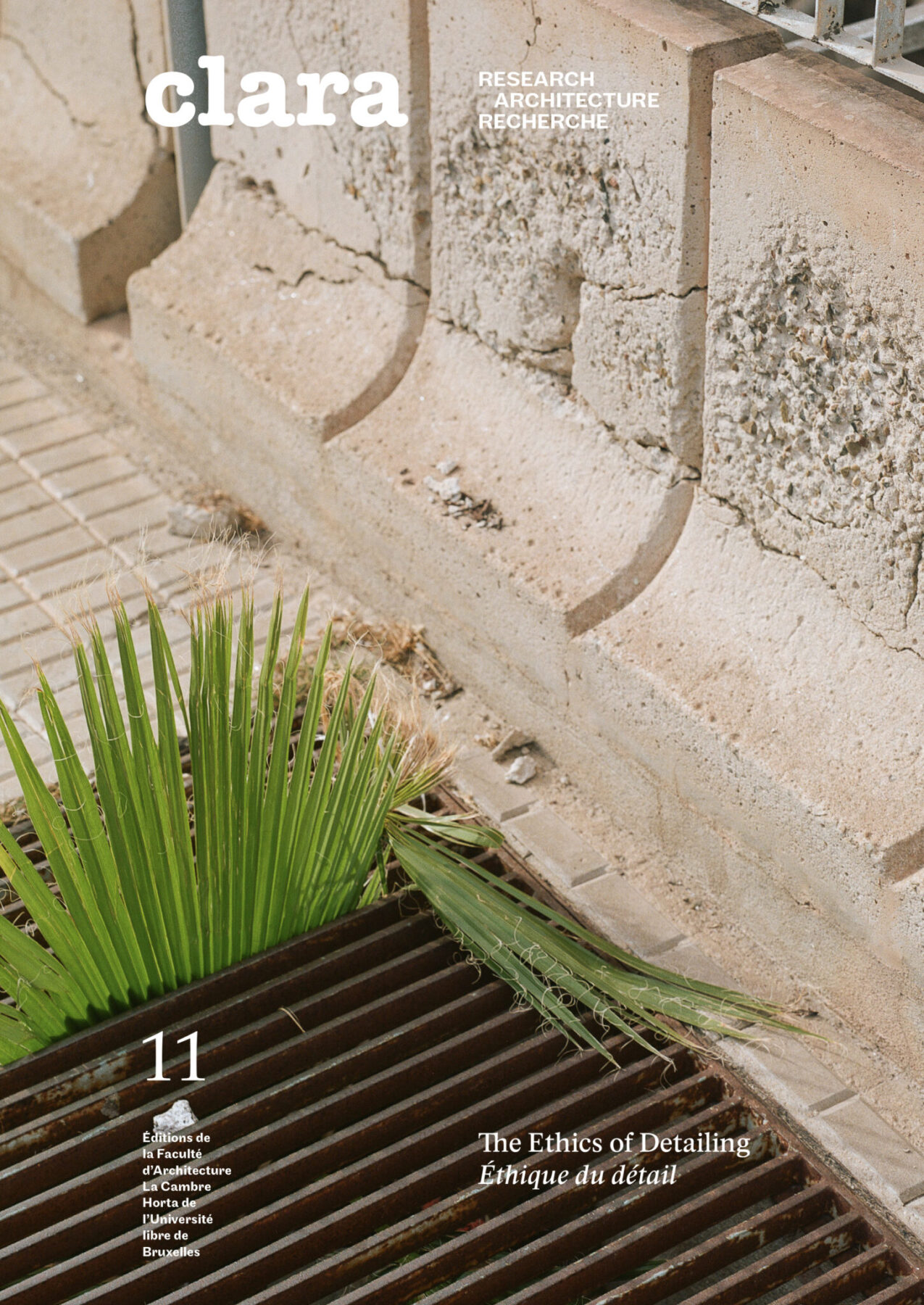
CLARA 2025/1 n° 11 Éthique du détail, Éditions de la Faculté d’Architecture La Cambre Horta. Digital version €20.
